
 Search Articles


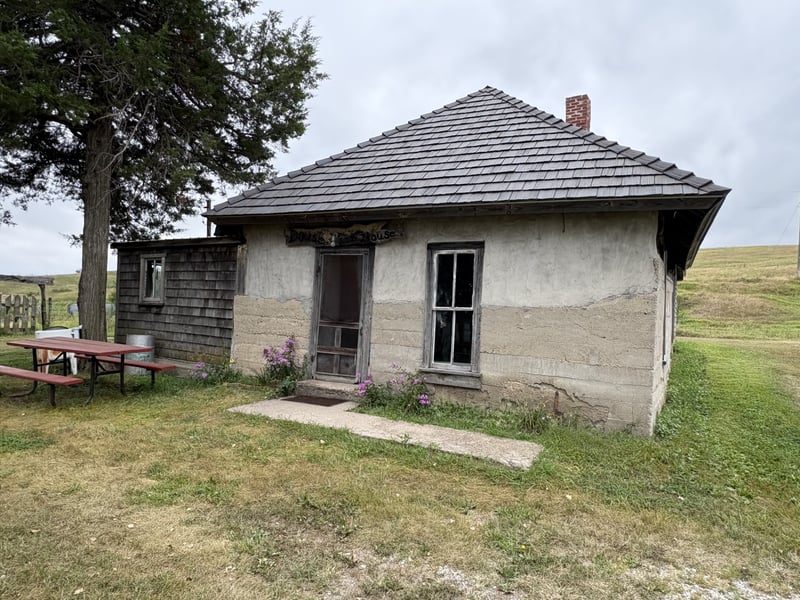
COMSTOCK, Neb. (CN) — Although Nebraskans grow up learning about the sod houses of their ancestors, few may consider a key drawback of them: Wildlife could burrow right inside.
That was definitely a concern of Florence Dowse, who once lived with her husband William in the Dowse Sod House outside Comstock. According to family history, she was once at home alone when a bullsnake got in and made its presence known.
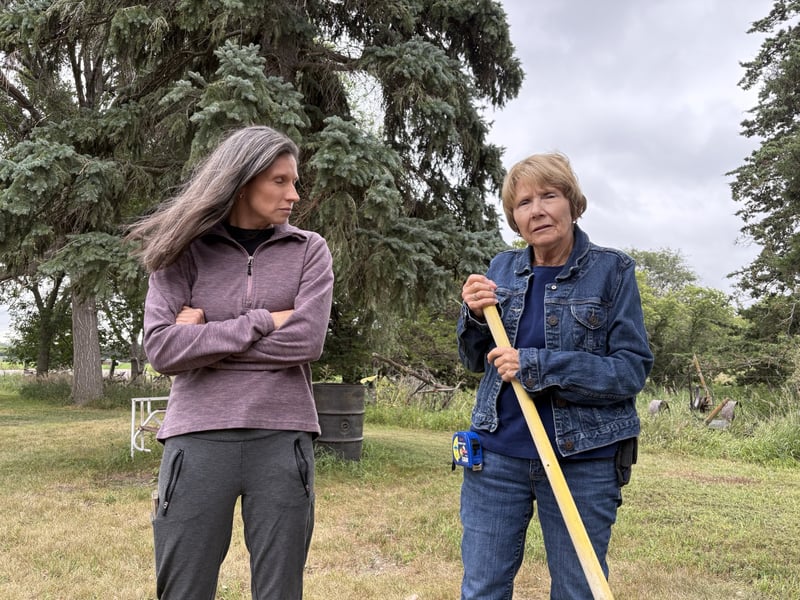
“Grandma hated snakes — and she had to deal with them all the time,” granddaughter Dory Sutton, 70, said in an interview. Florence Dowse was sewing one day, “and she kept hearing the shade rustle.” When she got up and inspected, she found a snake. “So, she got the ice pick and stabbed it.”
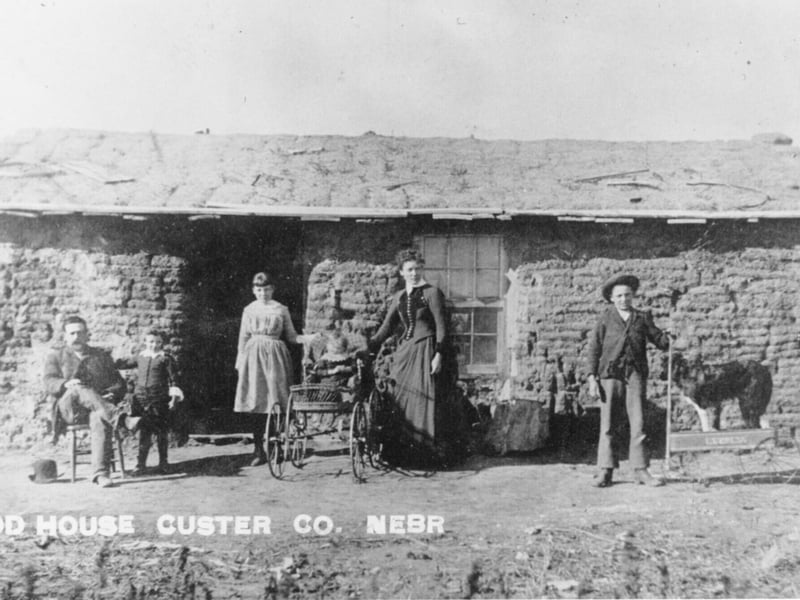
As settlers arrived in the Great Plains after the Civil War, they found themselves on prairies mostly barren of the trees needed to build wood homes.
The result was the sod house, a unique type of structure built from soil-carved brick. Though largely forgotten in an era of modern construction, these sod builds were once common throughout the Great Plains, which stretches from Texas and through Nebraska all the way to the Canadian prairie in Saskatchewan.
Without sod houses, building on the Plains would have been financially impossible for a wide swath of new arrivals, many of whom were showing up from Europe with limited means.
For these new Americans, hauling in lumber “would have been quite pricey and out of reach,” LuAnn Wandsnider, a University of Nebraska-Lincoln professor of anthropology who has studied sod houses, said in an interview. Thus, were it not for sod houses, “you wouldn’t have had the kind of diversity we see on the Plains, in terms of people coming from around the world.”
Colloquially known as “soddies,” the epicenter of sod-house construction in the late 19th century was right here in Custer County, a square of rolling hills near the dead center of the Cornhusker State.
Large numbers of settlers began arriving in this still-unorganized territory in the 1870s, following the 1862 passage of the Homestead Act during the Abraham Lincoln presidency. Under the law, new arrivals were entitled to 160 acres under a few conditions, including that they inhabited the land and made improvements on it.
Those conditions came with a conundrum: How would homesteaders stake out a home on the treeless prairie?
Growing up in Nebraska, one is sure to learn the answer.
According to lore, regular wildfires in the Plains kept big, lumber-bearing trees from establishing roots. But there were still the roots of the Great Plains’ ubiquitous grasses, which gave area dirt the strength and flexibility needed for brick-making.
That’s a bit of an oversimplification — there were some trees here, especially along the Middle Loup River which bisects Custer County — but the lore mostly gets it right. Sod thus became the dominant material in Great Plains houses.
“We didn’t have railroads, we didn’t have trees,” explained Tammy Hendrickson, curator of the Custer County Historical Society and museum in the county seat of Broken Bow. “Almost every homestead started with a sod house, because that’s what you had.”
The best source material usually came from so-called buffalo wallows, depressions on the Plains where water collected. The sod there held more grass and was therefore stronger, said David Murphy, a retired research architect who has studied sod houses for the past 50 years.
There were few if any professional sod house builders. Instead, neighbors helped each other with this difficult and dirty work.
“The sod house was a lot of intense labor,” Hendrickson told Courthouse News. “It did not come in a kit that said ‘some assembly required.’” Making the process even more difficult were the multitude of languages spoken at the time on the Nebraska frontier. One can imagine a dusty scene with lots of rudimentary hand gestures.
Where settlers got the idea for sod construction is disputed.
Inspiration may have come from the Native people they were displacing, many of whom lived in earth lodges. Earthen construction is still in practice in parts of the United States today, particularly in the adobe builds seen in the Southwest.
Soddies were more comfortable than readers might imagine. Walls were typically three layers thick, providing plenty of insulation during harsh summers and winters on the Great Plains. Dirt floors could be swept with a broom until they were smooth and hard, while cloths affixed to the ceiling could catch dirt and critters coming in from the roof. Add in some furniture, and living in a sod house could be pretty respectable by 19th century standards.
Soddies did present their own unique problems. Wildlife could crawl through the walls, and dust was ubiquitous.
Some settlers blanched at the idea of living in a dirt home and either moved back east or continued west to California or Oregon. But as Wandsnider, the anthropology professor, noted, was living in a New York City tenement really any better?
Besides, as families adjusted to life in sod houses, they could also make upgrades. “If you had a dirt floor, that was not much fun by all accounts — but if you could put in a wood floor, that would be great,” Wandsnider said. “Putting on a shingle roof would, I think, be desirable as well.”
Another big drawback: Sod houses weren’t exactly built to last. Unless owners took steps to preserve them — say, by retrofitting stucco, plaster or wood into the structure — the buildings were not likely to last more than 20 years.
As the railroad reached Custer County in 1886 and the price of lumber dropped, many converted their old sod houses into barns or storage sheds or simply let them deteriorate. Upgrading to a wood house was the frontier equivalent of moving to a McMansion in the suburbs, Wandsnider said.
“You can say, ‘Look, I’m leaving my sod house and going into this frame house now,’” she said. “‘Look how well-off we are.’”
These factors help explain why the once-common soddy is hard to find today, even in Custer County. Examining the subject for a 2008 masters’ thesis, architectural historian Andrea R. Kampinen estimated that although 8,000 were built in Custer County between 1870 and 1940, only eight remained by the mid-2000s.
“When I first started, there were quite a few more standing,” said Murphy, the research architect. That was in ’74. They have really crumbled and fallen away during that 50-year period.”
In Custer County, one stunning example of sod construction was the so-called Haumont Sod House. Constructed by Belgian immigrant Isadore Haumont in the mid-1880s, it was the only known two-story sod house in the state, according to the Nebraska Historical Society.
The structure was demolished in 1972. Before that, in 1962, Nebraska Educational Television, the precursor to Nebraska Public Media, filmed historian and University of Nebraska professor Robert N. Manley as he toured the home. Among its features were what Manley described as “homesteader wallpaper": In at least one room, Haumont had lined the walls with newspaper. Headlines appear to be in French, a sign of Haumont’s European roots.
Of the soddies that do still remain, many have been reinforced with wood or concrete. Notable examples include theSod House Museum inOklahoma and the Addison Sod House inSaskatchewan. But although sod construction was mostly out of style by the 20th century, the building technique persisted. Wood and brick cost money; dirt was free.
Florence Dowse died in 1969 after spending decades in her family’s sod house.
Today, her descendants including Sutton manage the Dowse Sod House as a museum.
Located about three miles southwest of Comstock, the Dowse Sod House is open to the public — literally. As in, one can just open the door and walk right into this monument to Great Plains grit. When Courthouse News visited this summer, a guestbook suggested that about 20 people had stopped by in the past month.
The Dowse Sod House is an example of a second-generation Plains sod house. Sutton’s great-grandfather Lewis Dowse arrived in 1873, becoming the first homesteader. But by 1900, the property had been largely abandoned.
Lewis Dowse’s son, William Ryan Dowse, decided to move in with his wife Florence. Sutton said, “Granddad built this home to start their married life together.”
A wood house would have been feasible — but sod was much cheaper. So he built one, the second on the land, and raised a family in it.
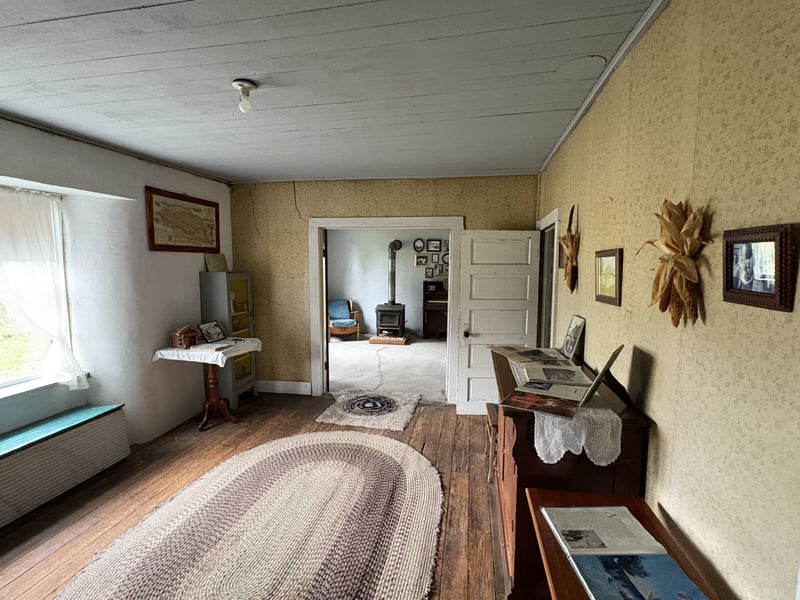
At first, the Dowse Sod House was three rooms with dirt floors and plastered walls. In typical sod-house fashion, a muslin tarp was installed on the ceiling to catch dust. Florence Dowse would wash it twice a year, Sutton said.
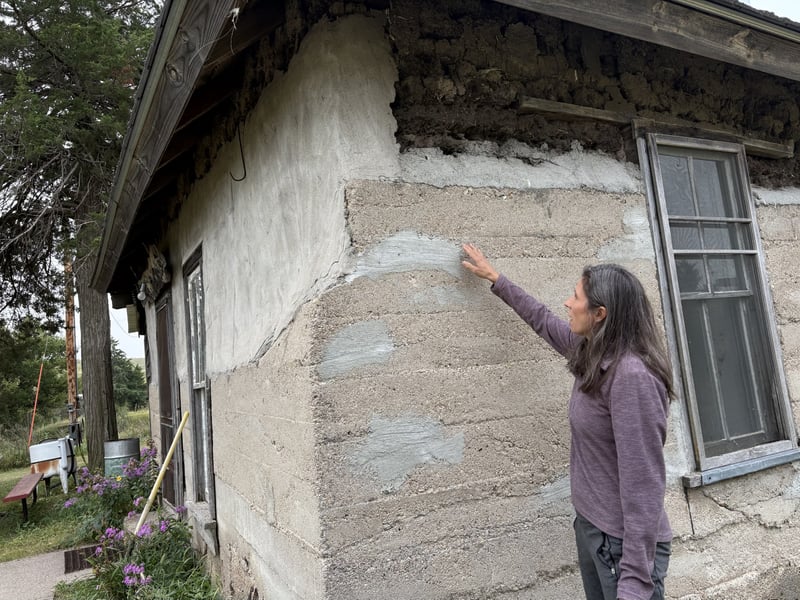
In 1935, the family installed concrete on the outer walls to protect the building’s structural integrity.
After the Dowses moved out, the family’s cattle liked to shelter inside on hot summer days. But although this was a dirt house with occasional cows in it, it wasn’t exactly Stone Age living. The building looks like a quaint country cottage, if a bit old-timey. In 1952, they even put in electrical wires.
William Dowse died in 1951, and Florence Dowse moved out in 1954. Their second-oldest son Bill lived there for a while but moved out in 1959, becoming the Dowse Sod House’s last resident.
When the nearby Haumont Sod House was demolished, the family was alarmed. Sutton’s uncle Phil Dowse spearheaded an effort to restore and renovate the family property. The wallpaper was replaced, and a new plaster ceiling was put in.
Other than the 1980s plaster ceiling, the Dowse Sod House today looks similar to how it would have in the early 20th century. Windows are beveled into the roughly two-foot-thick walls. There’s a wooden box telephone and a black and white photo of Grandma Florence.
The family visits regularly to keep up the property. They still find snakes. One time, Sutton had to kill a snake that had burrowed headfirst into the house, its tail still protruding through the outer walls.
“Bullsnakes are good, but I don’t like them,” she said. Still, the occasional snakes are worth it to own a bit of Nebraska’s frontier past. “We are blessed that people come and visit and respect it,” said Sutton’s daughter, Tanya Stecker. “People who do come out here just want to see a piece of history.”
 Follow @nelson_aj
Subscribe to our free newsletters
Our weekly newsletter Closing Arguments offers the latest about ongoing trials, major litigation and rulings in courthouses around the U.S. and the world, while the monthly Under the Lights dishes the legal dirt from Hollywood, sports, Big Tech and the arts.