
 Search Articles


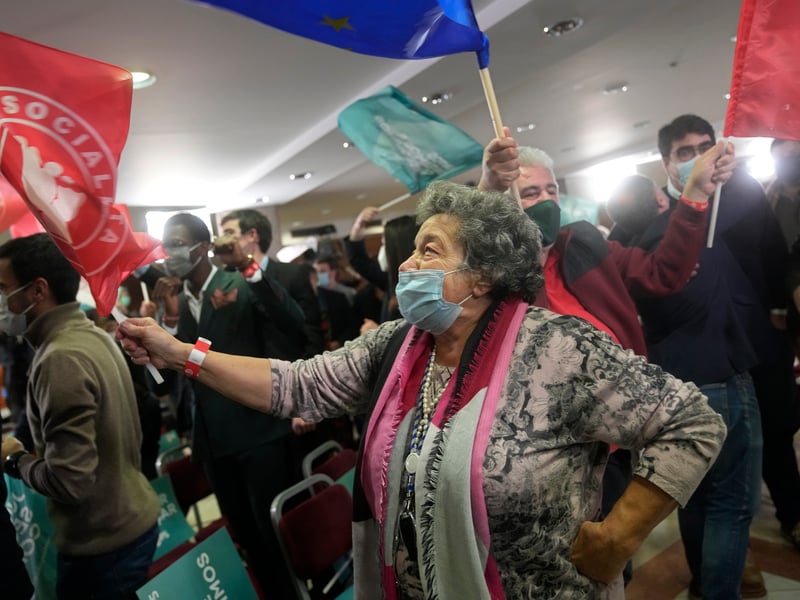
(CN) — The center-left Socialists, led by Prime Minister Antonio Costa, outperformed expectations and picked up enough votes in snap elections on Sunday to obtain a slim majority in parliament and not need the support of other parties to pass legislation.
But the elections also saw the rise of Chega (in English, Enough), a far-right nationalist party that detractors see as a reminder of Portugal’s five decades under a right-wing dictatorship that ended only on April 25, 1974, following a mutiny by left-wing elements in the Portuguese army.
Costa called the snap elections after he was unable to get a new budget passed. The Socialists were relying on votes from the Communists and Left Bloc, small hard-left parties that suffered losses.
In the run-up to Sunday’s election, polls showed the Socialists in a tight race with their traditional rival, the center-right Social Democratic Party. Ultimately, however, higher-than-expected turnout despite the coronavirus pandemic tipped the scales for the Socialists. Portugal is experiencing very high rates of infection, as is the case across Europe, but even those in isolation were allowed to vote.
“This is a special night for me,” Costa told supporters, according to the Portugal News. “The Portuguese have confirmed that they want a Socialist Party government for the next four years … they want stability, certainty and security.”
Costa promised not to use his majority in parliament to push through legislation without taking into consideration other parties.
“An absolute majority doesn’t mean absolute power,” he said. “It doesn’t mean to govern alone. It’s an increased responsibility and it means to govern with and for all Portuguese.”
Catia Reis, a 39-year-old human resources manager, said she voted for the Socialists because “stability is needed.”
“It is not the moment for a political change,” she told the AFP news agency after casting her ballot at a Lisbon polling station.
The Socialists will now have control over how Portugal, the poorest nation in Western Europe, will use about 16.6 billion euro ($18.7bn) in European Union pandemic recovery funds it is due to receive by 2026. Some will go to public projects, such as major infrastructure.
With his clear mandate, Costa is expected to continue his economic policy of reducing public debt.
The Socialists got almost 42% of the vote and obtained at least 117 seats in the 230-seat Assembly of the Republic, the national parliament in the Sao Bento Palace in Lisbon. The Social Democrats picked up nearly 28% of the votes and 71 seats.
Chega became the third largest party with 7% of the vote and will have 12 deputies sitting in the parliament. Before the election, Chega’s leader, Andre Ventura, was the only party member in parliament.
Costa has been credited with competent handling of the coronavirus pandemic. He quickly shut down the country to stem the spread of the virus and Portugal saw low rates of infection and few virus-related deaths in the initial stages of the pandemic.
Infections and deaths rose following an easing of restrictions towards the end of 2020, but Costa’s government led one of Europe’s most effective vaccination campaigns last year and nearly 94% of adults are fully vaccinated.
With a population of 10.2 million people, Portugal has recorded about 2.6 million infections since the start of the pandemic and 19,856 deaths, resulting in roughly 1,900 deaths per million people, a rate similar to those of Spain and France. By comparison, the worst hit nation in Europe has been Bulgaria where 4,830 people per million people have died. Italy and the United Kingdom, two hard-hit nations, have recorded respectively 2,423 and 2,275 deaths per million people, according to data from Worldometer.
Courthouse News reporter Cain Burdeau is based in the European Union.
 Follow @cainburdeau
Subscribe to our free newsletters
Our weekly newsletter Closing Arguments offers the latest about ongoing trials, major litigation and rulings in courthouses around the U.S. and the world, while the monthly Under the Lights dishes the legal dirt from Hollywood, sports, Big Tech and the arts.