
 Search Articles


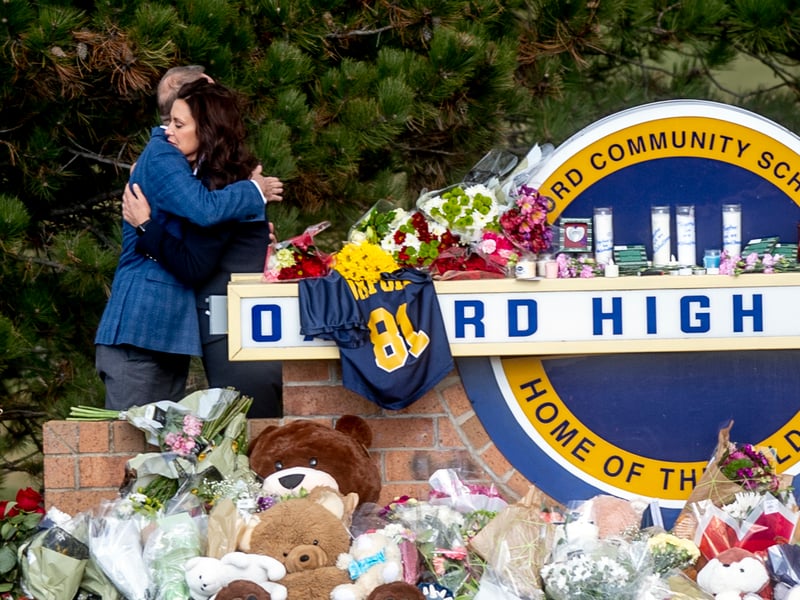
(CN) — The Sixth Circuit ruled Thursday that victims of the 2021 Oxford High School shooting and their families did not prove school administrators violated their constitutional rights on the day leading up to the tragedy.
The plaintiffs filed a pair of lawsuits, each seeking $100 million in damages for substantive due process violations, claiming administrators should have known the shooter was likely to act. They named counselor Shawn Hopkins — who met with Ethan Crumbley on the morning he killed four students and injured seven others in the deadliest school shooting in Michigan history — and dean of students Nick Ejak as defendants.
A three-judge panel found against the “state-created danger” theory, in which the plaintiffs argued in a hearing in December that the officials should be liable for harms caused by a private individual. They claim that Hopkins spurred Crumbley to immediate and fatal action by telling the boy and his parents he would contact child services if they refused to get their son counseling.
The judges found the families did not show the officials’ actions “shocked the conscience,” which was necessary to prove a violation of their due process rights.
“First, the plaintiffs argue that the defendants created a danger when, after the meeting in the office, they returned E.C.’s backpack to him and sent him back to class,” U.S. Circuit Judge Raymond Kethledge, a George W. Bush appointee, wrote in the unanimous opinion. “But those actions put the plaintiffs ‘in no worse position’ than the one in which they would have been had the defendants ‘not acted at all.’”
Kethledge noted that Crumbley had the same gun in his backpack before and after the meeting, though the judge did say that there is nothing to suggest the defendants knew about the gun.
Kethledge also dismissed the plaintiffs’ argument that Hopkins and Ejak “concealed” Crumbley’s risk of violence from other school officials.
“‘Concealed’ is a loaded term here,” Kethledge wrote. “True, on the facts alleged, the defendants failed to tell other officials about a risk that E.C. might harm others. But failures to act usually are not affirmative acts for purposes of this theory.”
Kethledge said there is nothing to plausibly support the idea that Hopkins and Ejak tried to cover up any risk of harm.
Kethledge then turned toward Ejak’s threat to call child services, which a federal court found was an affirmative act because it “increased the risk that a mentally unstable teenager” would harm other students.
The panel again found in favor of the defendants, overturning the lower court’s finding by ruling that the threat failed to meet the threshold of demonstrating reckless or callous indifference.
“Here, the defendants’ actions (as alleged in the complaint) show they perceived a serious risk: they summoned E.C.’s parents for an urgent meeting, insisted that he receive counseling within 48 hours, and said they would call Child Protective Services if he did not. … But those same actions show that Hopkins and Ejak displayed the opposite of callous indifference toward the risk they perceived,” Kethledge wrote.
Attorneys for Hopkins and Ejak and an attorney for the plaintiffs did not immediately respond to a request for comment on the ruling.
U.S. Circuit Judge Joan Larsen, a Donald Trump appointee, and U.S. Circuit Judge Andre Mathis, a Joe Biden appointee, rounded out the panel.
Crumbley was 15 at the time of the Nov. 30, 2021, shooting, in which 10 students and one teacher were shot and four died.
Crumbley was sentenced to life in prison in December 2023 after he pleaded guilty to 24 charges, including the first terrorism charges brought against a U.S. school shooting suspect.
His parents, Jennifer and James Crumbley, were each convicted of manslaughter in separate trials for their refusal to address their son’s mental health issues and providing him easy access to the gun he used in the shooting.
 Follow @joeharris_stl
Subscribe to our free newsletters
Our weekly newsletter Closing Arguments offers the latest about ongoing trials, major litigation and rulings in courthouses around the U.S. and the world, while the monthly Under the Lights dishes the legal dirt from Hollywood, sports, Big Tech and the arts.