
 Search Articles


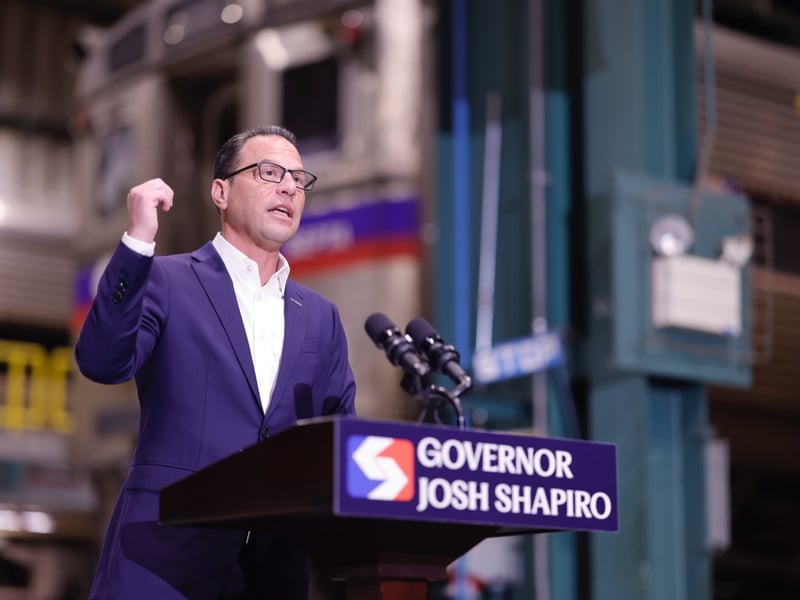
PHILADELPHIA (CN) — Pennsylvania Governor Josh Shapiro on Monday directed $219.9 million in capital funding to Philadelphia’s Southeastern Pennsylvania Transportation Authority as the transit agency attempts to weather the remainder of a crisis-laden year.
The cash infusion, allocated from the Pennsylvania Department of Transportation, aims to help SEPTA expedite its repairs of 223 commuter rail cars, which were temporarily taken out of service after several cars burst into flames earlier this year.
“With providing these $220 million, we can ensure that for as long as these rail cars are used, they will be safe and they will be effective modes of transportation for riders in and around the Philadelphia area,” Shapiro said at SEPTA’s train yard and maintenance shop in Frazer, Chester County.
SEPTA’s myriad of woes come just months before a myriad of major events are set to occur in one of the busiest years Philadelphia’s ever seen. In 2026, the City of Brotherly Love is set to host six FIFA World Cup games, the MLB All-Star Game, six NCAA Division I men’s “March Madness” games and the 2026 PGA Championship. On top of all of that, the birthplace of America is expected to see an influx of tourists for the nation’s 250-year anniversary celebrations.
“The eyes of the world are going to be on Pennsylvania, the birthplace of democracy,” Shapiro said. “SEPTA is going to transport millions of additional passengers [to these events]. Mass transit is critical to our commonwealth’s success, it is critical to our commonwealth’s economy, and it’s critical that we invest in it.”
Five of SEPTA’s Silverliner IV trains caught fire between February and September of this year, causing minor injuries to four passengers and one conductor. The repeated railway blazes ultimately prompted the Federal Railroad Administration on Oct. 1 to order emergency mechanical inspections of all 223 SEPTA Silverliner IVs — two-thirds of the agency’s commuter rail fleet.
The Silverliner IVs — built over 50 years ago during the Nixon and Ford administrations — would cost nearly $1 billion to replace and would take about 10 years to begin a phase-out, SEPTA said. The agency, which carries 800,000 daily riders across commuter rails, subways, buses and trolleys, has blamed minimal state funding for its slow upgrades.
“This technology — and I am far from an engineer — is antiquated,” Shapiro said, “but it is critically important that while they are operational, they be safe, and the work that is going on here is ensuring their safety.”
Described by Shapiro as “flexible dollars,” the $219.9 million in capital funds are set to expedite commuter rail repairs to restore full service by mid-December, allow the agency to lease additional train cars, repair overhead wires, overhaul subway machinery and repair stations across its services.
Burning train cars are only the most recent catastrophe in SEPTA’s nightmare of a year, though.
Following the end of Covid-19-era federal funding in mid-2025, SEPTA faced a $213 million budget deficit. Without state funding to fill the gaps, the agency said, it would be forced to approve a “doomsday budget,” eliminating 50 bus routes and five commuter rail lines, reducing service across its transit systems and implementing a 21.5% fare increase.
“This budget will effectively dismantle SEPTA,” General Manager Scott Sauer said in a June board meeting. “Once this dismantlement begins, it will be almost impossible to reverse, and the economic and social impacts will be immediate and long-lasting for all Pennsylvanians, whether they ride SEPTA or not.”
While Shapiro and the Democrat-led state House of Representatives approved of the cash infusion, leaders of the Republican-led state Senate repeatedly blocked the move, calling it wasteful spending and demanding increased investments in road and bridge projects. The sticking point was one of several to cause an impasse lasting for 135 days beyond the state’s June 30 budget deadline.
Left without any state funding to cover its shortfall, SEPTA began implementing its doomsday line cuts and fare hike on Aug. 24.
However, by Sept. 8, Shapiro’s administration announced a short-term workaround for the agency, allowing SEPTA to spend state-allocated capital funds on operating expenses through mid-2027. The transfer of funds reversed all transit cuts, but did not halt the fare increase.
While the move saved SEPTA from reducing its service by one-fifth and imperiling the commutes of Philadelphia’s residents, workers and students, it effectively punted the issue for two years.
“It was our hope that the Legislature could come to an agreement and pass into law Governor Shapiro’s plan to increase recurring revenue and find a long-term solution for SEPTA,” Sauer said in September following the cash infusion. “Given the legislative delay and increasing fiscal pressures, we are faced with no other option.”
Piling onto SEPTA’s already-tumultuous year, two of the transit agency’s unions — representing operators and mechanics for the agency’s buses, subways and trolleys — both voted in November to authorize a strike. Transport Workers Union Local 234 and SMART Local 1594 are comprised of over 5,000 SEPTA employees, all of whom are currently working on expired union contracts as negotiations continue. A strike from either union would not impact commuter rail operations.
SEPTA is widely considered one of the most strike-prone transit agencies in the U.S., with strikes occurring in 1971, 1975, 1981, 196, 1995, 1998, 2005, 2009, and most recently, 2016.
 Follow @JacksonHeals
Subscribe to our free newsletters
Our weekly newsletter Closing Arguments offers the latest about ongoing trials, major litigation and rulings in courthouses around the U.S. and the world, while the monthly Under the Lights dishes the legal dirt from Hollywood, sports, Big Tech and the arts.