
 Search Articles


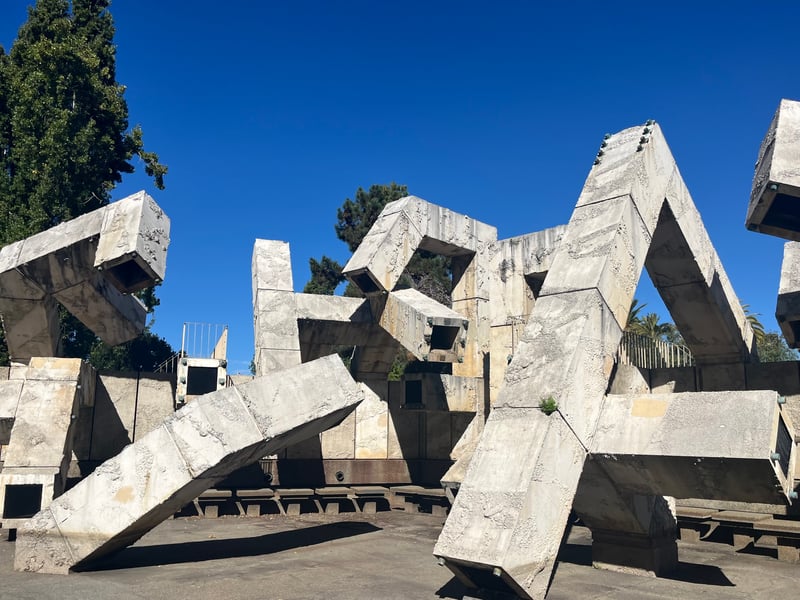
SAN FRANCISCO (CN) — The San Francisco Arts Commission voted Monday to remove Vaillancourt Fountain from Embarcadero Plaza over safety concerns about structural deterioration.
The 8-5 vote approves a plan proposed by the San Francisco Recreation and Park Department to disassemble the brutalist structure and store it at an off-site facility for up to three years for further investigation into its structural integrity. The estimated $4.4 million cost for the removal and storage would be covered by the department and is estimated to take two months to complete. Dismantling the fountain could start in as early as 90 days.
The Vaillancourt Fountain was introduced in 1971, designed by Canadian sculptor Armand Vaillancourt as part of a local competition. Contention over the fountain began early, with opponents of the structure passing out flyers at its dedication, calling it a “loathsome monstrosity,” “idiotic rubble,” and “prestigious eyesore.”
Throughout most of its time in San Francisco, the fountain’s sharply angled concrete tubing circulated 30,000 gallons of water a minute, helping block out the noise of the now-removed Embarcadero Freeway.
Over the decades, the structure has deteriorated. The fountain’s water feature ran dry when the last functioning pump failed last May, and the San Francisco Recreations and Park Department, which manages Embarcadero Plaza, fenced off the fountain indefinitely in June.
That same month, an architecture firm retained by the department released a conditions assessment of the fountain, finding several issues with the integrity of the infrastructure, including cracked concrete, corrosion, failed waterproofing, and failure to meet current seismic and safety standards. The report also estimated the annual maintenance costs for the fountain at around $100,000.
While opinions on whether to remove the fountain or not are as old as the structure itself, the department took a stance in August, writing a letter to the arts commission calling the structure a “critical constraint” to their renovation of the plaza and saying the $29 million price tag on restoring the fountain would “consume the entire project budget.”
Shortly after, Armand Vaillancourt sent a cease-and-desist letter to the city, threatening legal action if they took steps that would endanger the fountain. Despite this, the city’s Department of Building Inspection verified on Oct. 15 the foundation was degraded and corroded, advising that the structure should “remain vacated and secured from public access until the hazardous conditions are abated.”
Two weeks later, Environmental Review Officer Lisa Gibson confirmed the project qualifies as an emergency project “as it involved actions necessary to prevent or mitigate a significant public health hazard.”
“Failure to timely implement the project would pose an imminent risk to public health and safety, including the potential for serious injury to persons or loss of life,” she said.
Members of the commission weighed their decisions before the official vote, speaking about their memories of the fountain and concerns they had for its future.
“This was one of those conversations that’s so hard. It is not about artistic merit. It is not about the importance of the work, because it is very important. I love this space,” Commissioner Janine Shiota, who voted to approve the plan, said.
“What kind of distressed me and alarmed me was the deaccession and the destruction," she continued. “And I just thought that was scorched earth. We don’t have the budget for the restoration.”
Commissioner Patrick Carney, who voted against the plan, said that he fears a temporary disassembly of the fountain would lead to a more permanent decision.
“If it is temporarily removed without a plan and funds in place beforehand to possibly restore it or move it, then the fate may be sealed, because once the artwork is temporarily removed, there might not be money to put it back,” he said.
“We thus will be providing a blank slate without knowing if there will be the means and funds to put it back, if that’s deemed feasible," he added. “As an arts commissioner, I just don’t want to put an art piece on the path towards the accession unless it’s gone too far to be saved.”
Dozens of members of the public also spoke about the potential removal of the fountain.
One speaker, identifying herself as the granddaughter of Armand Vaillancourt, said the fountain represents “a bold manifestation of creativity that challenges conventional aesthetic norms.”
“The preservation of this monument is not only about maintaining a structure, it’s about honoring over 50 years of artistic heritage. What would it signify if we chose to prioritize temporary aesthetics over enduring cultural legacies?” she asked.
In contrast, Aaron Fenton, senior vice president of BXP, the real estate development company involved in the renovation of Embarcadero Plaza, said the immediate removal was not a “call to erase history,” but a “plea to prioritize public safety above all else.”
“San Francisco thrives because we balance our creative soul with the practical demands of a living city. Approving this emergency removal today safeguards lives and buys time to properly analyze the fountain. Whether or not the fountain is restored, or not, disassembling the fountain is the only available option to consider today,” he said.
In a statement to Courthouse News, San Francisco Recreation and Park Communications Manager Daniel Montes said that the department “welcomes” the commission’s decision to approve the disassembly and safe storage of the fountain.
“This action addresses urgent public safety hazards identified by independent engineers and confirmed by the Department of Building Inspection. It will remove the immediate risk, allow experts to inspect and assess the structure’s interior, and store its components for up to three years while the city and its arts commission consider options for its future,” he said.
Jack McCarthy, spokesperson for the organization Docomomo US/Northern California, an organization that advocates for buildings of the modern movement, criticized the project sponsors for celebrating the vote, “in stark contrast to the somber tone of the commission.”
“San Francisco public art was not on the agenda today. Instead, the arts commission heard a narrative curated by Recreation & Park based on their non-expert interpretation of an engineering report and a visual assessment by DBI,” he said. “This narrative relies on an unprecedented interpretation of the California Art Preservation Act and an unheard of application of the California Environmental Quality Act emergency project.”
A representative for the San Francisco Arts Commission did not immediately respond to a request for comment.
 Follow @mhattridge_
Subscribe to our free newsletters
Our weekly newsletter Closing Arguments offers the latest about ongoing trials, major litigation and rulings in courthouses around the U.S. and the world, while the monthly Under the Lights dishes the legal dirt from Hollywood, sports, Big Tech and the arts.