
 Search Articles


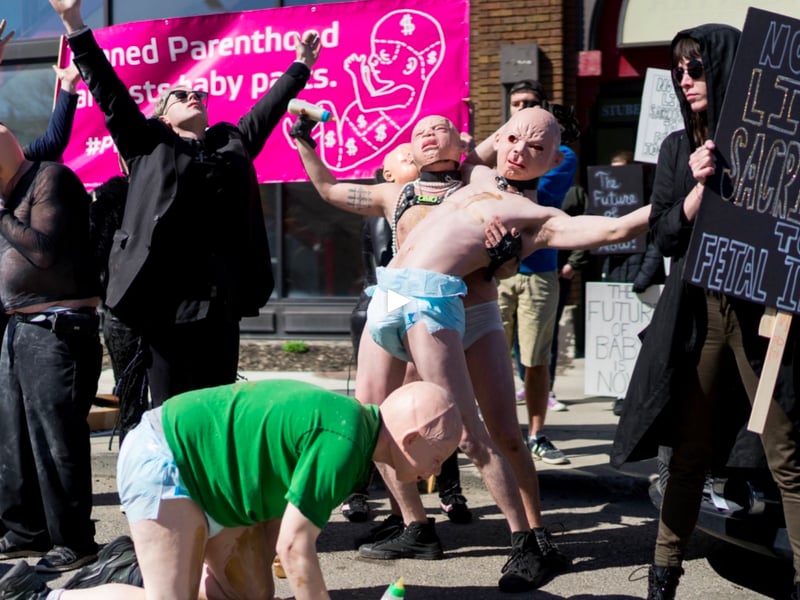
CHICAGO (CN) — The Seventh Circuit on Tuesday dismissed the Satanic Temple’s lawsuit challenging Indiana’s near-total abortion law and determined the organization lacked standing to sue the state.
The Satanic Temple, a nonreligious group that advocates for benevolence and empathy, argued before a Seventh Circuit panel at Indiana University’s law school in October that the state’s restrictive abortion law unfairly blocks the organization from providing telemedicine abortion care, including abortion drugs sometimes referred to as abortifacients.
The Indiana legislature enacted a 10-week abortion ban with few exceptions back in 2022, shortly after landmark Supreme Court case Roe v. Wadewas overturned. The Indiana law criminalizes abortion except in cases when the mother’s health is at risk, when lethal fetal anomalies are present, or in cases of rape or incest. The state’s Supreme Court upheld the near-total abortion ban in 2023.
In the final opinion and order, the panel of judges repeatedly noted the Satanic Temple was unable to point to a concrete injury, which is the first step in determining whether a party has appropriate standing to sue.
“When the appellants filed this lawsuit, they had a very specific and concrete intention to provide abortifacients to its members nationwide," James MacNaughton, a New Jersey-based attorney who argued on behalf of the Satanic Temple, said during oral arguments. “As I stand here before the court today, it has implemented that plan.”
The Satanic Temple maintained that its members have suffered a stigmatic injury because all of its members deal with the stigma of being perceived as evil people because they are pro-abortion. The Seventh Circuit panel, however, couldn’t quite square that argument.
“Other than merely saying so, the Satanic Temple provides no evidence that its members have actually suffered stigmatic injury. As we have noted, ‘generalized harm to a group of individual members will not’ support ‘associational standing,’” according to the final opinion and order, authored by U.S. Circuit Judge Doris Pryor, a Joe Biden appointee.
During oral arguments, U.S. Circuit Judge Frank Easterbrook, a Ronald Reagan appointee, presented MacNaughton with a hypothetical that ended up eating much of the allotted 30 minutes for arguments.
“If a federal court were to hold [the Indiana abortion] law unconstitutional, would that provide any relief at all to the Satanic Temple?" Easterbrook asked.
“It would be able to provide abortifacients to its members in Indiana,” MacNaughton responded.
“No, they would not," Easterbrook rebuffed. “There are other statutes on the books in Indiana requiring these drugs to be approved personally by a physician after at least one in-person visit.”
The panel echoed Easterbrook’s concerns.
“There is no evidence, however, that the Satanic Temple willknowingly or intentionally prescribe abortifacients in violation of § 16-34-2-1 to face the prospect of prosecution. Indeed, it has not provided affidavits, declarations, or other evidence describing any specific, concrete plans of doing so,” the panel wrote. “Without more, its speculative position, lacking even an outline of a plan, fails to satisfy the injury in fact requirement necessary for the Satanic Temple to establish standing.”
MacNaughton reiterated that the Satanic Temple is only asking for protection from threat of prosecution. He argued a doctor licensed in Indiana would be able to prescribe abortifacients if the panel stopped the state’s requirement of in-person visits for abortions.
But the Seventh Circuit struck down that argument in its final opinion and order. “The Satanic Temple did not make this argument below. And ‘[w]e have repeatedly reminded litigants that we will not consider evidence and factual arguments that they did not present to the district court.’ The Satanic Temple’s proffer now to support standing, ‘which is far too late,’ is no exception.”
U.S. Circuit Judge Thomas Kirsch, a Donald Trump appointee, joined Easterbrook and Pryor on the panel.
 Follow @RosenCaitlyn
Subscribe to our free newsletters
Our weekly newsletter Closing Arguments offers the latest about ongoing trials, major litigation and rulings in courthouses around the U.S. and the world, while the monthly Under the Lights dishes the legal dirt from Hollywood, sports, Big Tech and the arts.