
 Search Articles


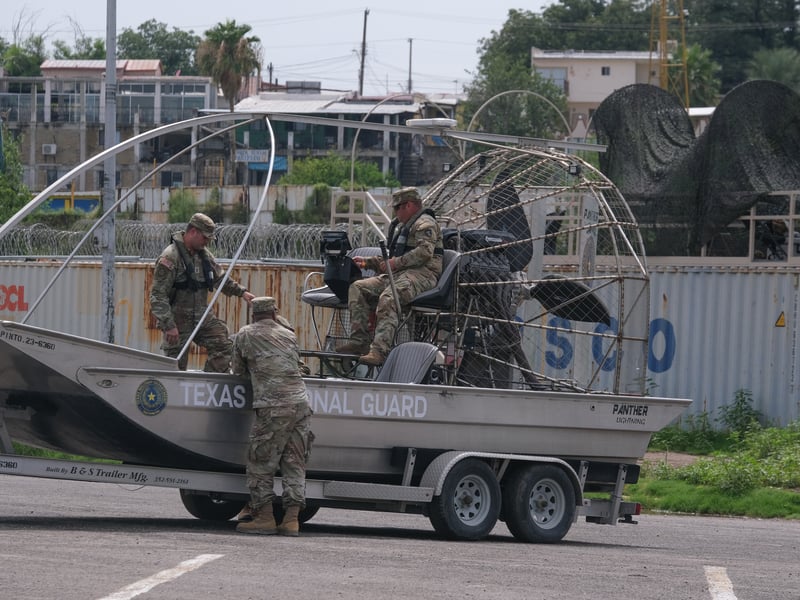
CHICAGO (CN) — A panel of Seventh Circuit judges unanimously agreed to leave a lower court’s order barring the deployment of the National Guard in Illinois intact Thursday afternoon.
President Donald Trump called the National Guard into Illinois on Oct. 4, despite repeated objections from state and local officials, after what he described as aggression and violence toward Immigration and Customs Enforcement officers at a suburban immigration processing facility. The state of Illinois sued, and a federal judge blocked Trump’s deployment of the National Guard on Oct. 9, which Trump swiftly appealed.
U.S. law authorizes limited instances in which the president can call in the National Guard: to stop an invasion, to quell an ongoing rebellion or if the president is unable to enforce U.S. laws with regular forces. Three judges appointed by Trump, George W. Bush and Barack Obama concurred that there was no active rebellion in Chicago that would warrant the deployment of the National Guard.
Deputy Assistant Attorney General Eric Hamilton argued last week before U.S. District Judge April Perry that protestors at the Broadview immigration facility have been violent toward federal immigration authorities, which necessitated the deployment of the National Guard.
The Seventh Circuit panel — consisting of Trump appointee U.S. Circuit Judge Amy St. Eve, Bush appointee U.S. Circuit Judge Illana Rovner and Obama appointee U.S. Circuit Judge David Hamilton — disagreed.
“Political opposition is not rebellion. A protest does not become a rebellion merely because the protestors advocate for myriad legal or policy changes, are well organized, call for significant changes to the structure of the U.S. government, use civil disobedience as a form of protest, or exercise their Second Amendment right to carry firearms as the law currently allows,” the panel wrote in its concordant order issued Thursday afternoon. “Nor does a protest become a rebellion merely because of sporadic and isolated incidents of unlawful activity or even violence committed by rogue participants in the protest.”
“Such conduct exceeds the scope of the First Amendment, of course, and law enforcement has apprehended the perpetrators accordingly. But because rebellions at least use deliberate, organized violence to resist governmental authority, the problematic incidents in this record clearly fall within the considerable daylight between protected speech and rebellion,” the order continued.
The Trump administration has maintained that the protests at an immigration processing facility in Broadview have made it increasingly difficult for ICE agents to do their jobs, but the Seventh Circuit wrote in Thursday’s order that there was “insufficient evidence that protest activity in Illinois has significantly impeded the ability of federal officers to execute federal immigration laws.”
“Federal facilities, including the processing facility in Broadview, have remained open despite regular demonstrations against the administration’s immigration policies. And though federal officers have encountered sporadic disruptions, they have been quickly contained by local, state, and federal authorities,” the order continued. “At the same time, immigration arrests and deportations have proceeded apace in Illinois over the past year, and the administration has been proclaiming the success of its current efforts to enforce immigration laws in the Chicago area.”
Department of Justice attorney Hamilton also argued before Perry last week that, regardless of whether the Broadview protests constitute a rebellion, a president’s decision to call up the National Guard isn’t judicially reviewable.
He cited Martin v. Mott , a landmark 1827 Supreme Court case, which found that the determination of whether there’s a rebellion or an invasion is ultimately up to the president.
The Seventh Circuit panel, however, didn’t think the finding from Martin v. Mott could extend so far. “The court’s broad language must be understood in its context,” the panel wrote.
Perry noted during last week’s hearing to block the National Guard deployment into Illinois that U.S. District Judge Sara Ellis issued an injunction on Oct. 8 that bars ICE agents from using excessive force on protestors, religious leaders and journalists.
On Thursday, Ellis determined that ICE agents repeatedly violated that injunction and ordered them to wear body cameras. She also ordered ICE Field Director Russell Holt to appear in court Monday morning in response to ICE agents’ deployment of tear gas on residential neighborhoods last weekend, as reported by the Chicago Sun-Times.
 Follow @RosenCaitlyn
Subscribe to our free newsletters
Our weekly newsletter Closing Arguments offers the latest about ongoing trials, major litigation and rulings in courthouses around the U.S. and the world, while the monthly Under the Lights dishes the legal dirt from Hollywood, sports, Big Tech and the arts.