
 Search Articles


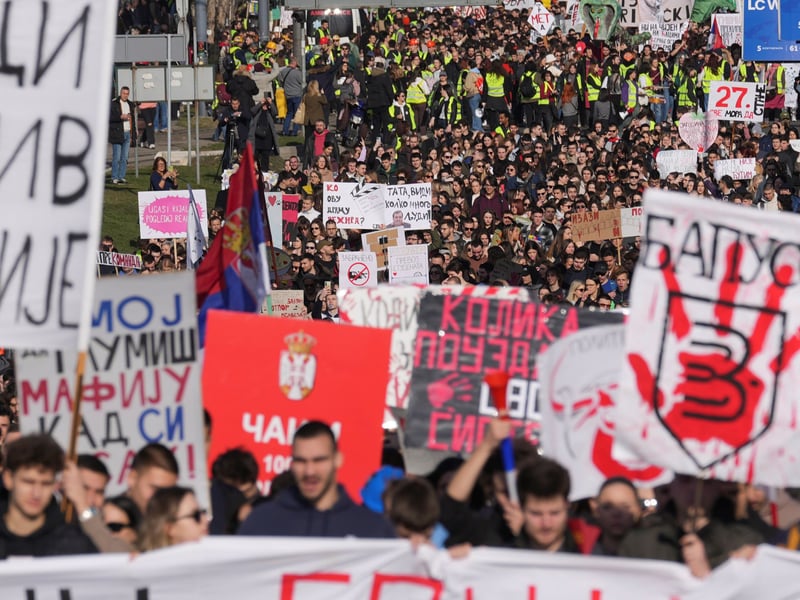
(CN) — Serbian Prime Minister Miloš Vučević resigned Tuesday in the face of tenacious student-led mass protests over a deadly concrete canopy collapse at a newly renovated train station last November that killed 15 people and exposed the country’s deep corruption.
The prime minister’s resignation deepens a national crisis with the potential to bring down Serbian President Aleksandar Vučić, the country’s populist strongman leader accused of running a corrupt-riven authoritarian government.
Vučević linked his decision to quit to an attack early Tuesday morning on five students in Novi Sad, the country’s second-largest city, where the canopy of the renovated train station crashed down Nov. 1, 2024.
The students were reportedly beaten with baseball bats by assailants from the ruling Serbian Progressive Party, Serbian media said. The students were drawing stencils on a bin in front of the party’s premises calling for protests in Novi Sad on Saturday. A 23-year-old female student remained in hospital Tuesday.
“I think that this policy to which I belong, the party I lead … must show the highest degree of responsibility … must show that it is the most responsible. And that’s why after this event last night in Novi Sad, my irrevocable decision is to resign from the position of prime minister,” the prime minister said, as reported by media.
The protests are showing no sign of ending, leaving Vučić in an increasingly vulnerable spot. He held an emergency meeting Tuesday evening, but he was not expected to call snap elections.
Instead, Vučić is trying to calm the situation by reshuffling his cabinet and making promises to investigate the canopy collapse. His government has released some documents related to the disaster, but his efforts have failed to satisfy protesters’ demands. They are calling for those responsible for the collapse to be prosecuted. No one has been convicted as yet, though some top officials resigned in the wake of the disaster.
There are fears Vučić may resort to increasingly repressive tactics to quell the protests.
100,000 protesters took to the streets in Belgrade on Dec. 22. Demonstrations also have spread across the country with students blocking university and high school classes. They have been joined by farmers, lawyers, doctors, judges and other professionals.
“As each month goes by, you have seen an increased momentum,” said Aleksandar Matković, a researcher at the Institute for Economic Sciences in Belgrade, speaking by telephone Tuesday.
He said the protests were among the largest seen in Serbia and the Balkans since mass student demonstrations in 1968.
Student blockades have taken place in 19 universities and many of the country’s high schools, he said. On Friday, Serbia ground to a halt during a general strike and a major intersection in Belgrade, the capital, was blocked Monday night. More protests are planned.
Matković said the protests are driven by widespread anger over corruption and institutional dysfunction. He said the demonstrations aren’t so much about Vučić and his government, but about rebuilding Serbia’s basic institutions and doing away with a regime “completely based on corruption.”
“Most of the demands are not actually addressed to Vučić, they’re not addressed to the government, they’re actually addressed to institutions,” he said. “They want some sort of functional government.”
He said the protesters are not openly backing Serbia’s opposition parties or using the demonstrations to call for European Union membership. Serbia is a prospective EU member, but Vučić’s authoritarian regime and close ties to Moscow are seen as major impediments.
Rather, Matković said the protesters are demanding wholesale change — talk of experimenting with direct democracy and other forms of government are rife among the demonstrators.
“We don’t care if it’s this opposition or that opposition, this government or the next government, we care about a functional society,” he said, echoing the words of protesters. “And if we didn’t do this, we couldn’t live with ourselves.”
The canopy collapse exposed the corruption at the heart of Serbian society, he said.
Work to renovate the train station was carried out by 82 subcontractors, including companies from China, Hungary, France, Bosnia-Herzegovina and Serbia, he said.
“None of these companies had the audacity to ring the alarm bell before the event occurred and that’s the problem,” Matković said.
“The sheer volume of corruption involved here is just transnational,” he said. “Eighty-two different companies from various nations have been completely engulfed in corruption on the same scale together and that I think woke people up.”
Serbian companies did the work on the canopy, but the construction was fatally flawed, he said. Mistakes included faulty concrete and a lack of engineering studies, he said.
“People from architecture and engineering backgrounds say this wouldn’t have been done even by a second-year graduate student,” he said.
The canopy collapse also is raising questions about a slew of other infrastructure projects undertaken by Vučić’s government, many of them relying on Chinese contractors and Beijing’s Belt and Road Initiative loan program. Vučić has made big public works projects a centerpiece to burnish his government’s credentials.
Matković said the Serbian Progressive Party, with its one million members, was so fond of big infrastructure projects because they allowed it to “channel funds obviously to itself.”
He added that the government has not taken steps to evaluate the structural integrity of new infrastructure projects.
The intensity of the protests threatens to unseat Vučić and his Serbian Progressive Party, a right-wing nationalist party that has long held power in Serbia. Vučić has two years left in his second term as president.
“Whether [Vučić ] falls or not, I don’t know, but if he does that will probably create a huge crisis in the Balkans,” he said.
Serbia is the biggest country in the Balkans and acts as a regional power. A collapse of the Serbian Progressive Party could have far-reaching repercussions throughout the Balkans, he said.
He said geopolitics in the Balkans has long been defined by Belgrade’s tradition of not aligning with a single superpower, a policy advocated by former Yugoslav leader Josip Broz Tito and carried on by Vučić.
“A lot of the regional dynamics depends on its foreign policy,” he said. “They basically play a balancing act between the U.S., the EU, China and Russia.”
Major change in Serbia, then, could ripple across the Balkans. For example, Vučić’s government has close ties with Russia and China and remains unwilling to recognize the breakaway state of Kosovo.
Courthouse News reporter Cain Burdeau is based in the European Union.
 Follow @cainburdeau
Subscribe to our free newsletters
Our weekly newsletter Closing Arguments offers the latest about ongoing trials, major litigation and rulings in courthouses around the U.S. and the world, while the monthly Under the Lights dishes the legal dirt from Hollywood, sports, Big Tech and the arts.