
 Search Articles


WASHINGTON (CN) — The Senate Judiciary Committee on Thursday advanced a trio of President Donald Trump’s nominees for top Justice Department positions, plowing through objections from Democrats who framed the appointees as political operatives of the president.
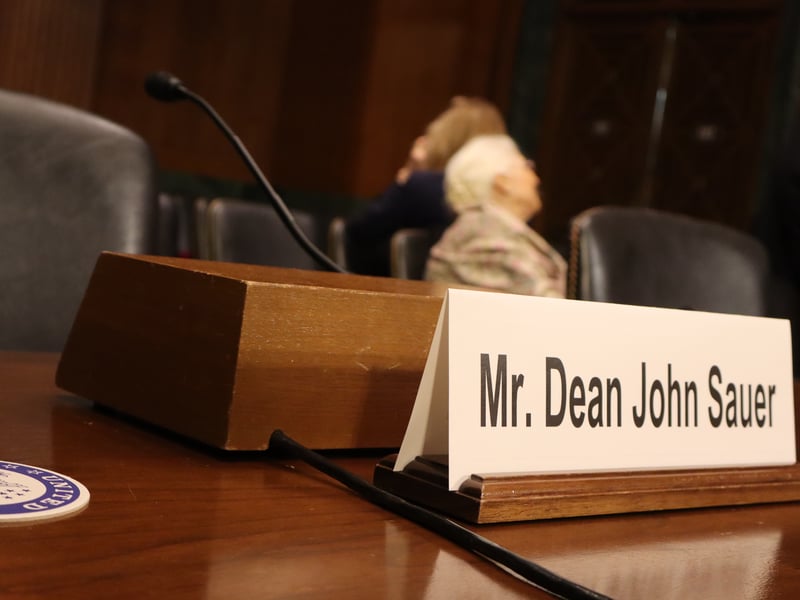
The upper chamber’s legal affairs panel voted along party lines, 12-10, to approve the nominees: John Sauer, tapped to become U.S. solicitor general; Harmeet Dhillon, selected by the White House to lead the Justice Department’s civil rights division; and Aaron Reitz, nominated as assistant attorney general for the agency’s Office of Legal Policy.
It was the expected outcome for the GOP-led panel, but that didn’t stop Democrats from pounding the table about the three nominees, who they said expressed concerning beliefs during a Judiciary Committee hearing last month.
Senate Minority Whip Dick Durbin, the top Democrat on the judicial panel, recalled during Thursday’s business meeting that several lawmakers asked the nominees “pointedly” whether public officials such as the president were bound by lawful court orders.
That line of questioning came last month as the White House denigrated restraining orders from federal judges stymying some of the administration’s sweeping executive actions.
“I was surprised, maybe even shocked a little, that they didn’t say unequivocally yes,” Durbin said.
During February’s hearing, Sauer — who if confirmed would represent the federal government in cases before the Supreme Court — argued that there were “extreme cases” that could warrant a public official defying a court order. He pointed to controversial high court decisions such as in the Civil War-era case Dred Scott v. Sandford as examples, but said it was “not a plausible scenario” that Trump would ignore a lawful court order.
And Reitz said parties to a case were, “generally speaking,” bound to lawful orders. The former staffer for Texas Senator Ted Cruz faced scrutiny from Democrats over now-deleted social media posts in which he appeared to speak approvingly about defying such orders.
Durbin argued Wednesday that the nominees’ views were a portent of how the Justice Department might view an effort from the Trump White House to ignore court orders. “If Article III courts cannot expect their orders to be followed by an executive, then there is virtually no check or balance on that executive’s decision making,” he said.
The Illinois Democrat also pushed back on the idea that government officials are only bound by “lawful” court orders, arguing that it was up to the courts — not the executive — to determine the limits of the law or the Constitution.
“Who decides whether it’s lawful?” he said. “To say that you only have to follow a lawful court order is to engage in the most circular semantics possible.”
Other Democrats on the Judiciary Committee also questioned the independence of the three nominees. Both Sauer and Dhillon have represented Trump in court, which some lawmakers said raises concerns about where their loyalties lie.
“The two lead nominees here are essentially Trump operatives who would be far more loyal to Trump personally, to the political movement that Trump leads and to Trump donors than they will to the Constitution or the institutions that they will serve,” Rhode Island Senator Sheldon Whitehouse said.
Delaware Senator Chris Coons concurred, pointing out that Sauer and Dhillon were “quite literally on Trump’s payroll.”
Sauer, formerly solicitor general for the state of Missouri, represented Trump in his 2024 immunity case before the Supreme Court. Dhillon worked on the president’s 2020 campaign as a legal adviser and her law group led efforts to keep him on the 2024 presidential ballot in Colorado.
“Those checks don’t come because the nominees Sauer and Dhillon tell Trump ‘no,’” he said. “They come because they tell him ‘yes.’”
And Democrats had few nice things to say about Reitz, who Durbin slammed for deleting thousands of social media posts which he said revealed “disturbing views” on a slate of issues. Reitz has faced scrutiny for his posting before — the nominee, who previously served as a staffer for Cruz and Texas’ deputy attorney general, apologized in 2021 for calling Olympic gymnast Simone Biles a “national embarrassment.”
Durbin further criticized Reitz for a post in which he said there was “no question” in his mind that Derek Chauvin, the Minneapolis police officer convicted of murdering George Floyd, was not guilty.
Those comments earned a harsh rebuke from Cruz, who went to bat for his former chief of staff and rejected concerns about the nominees’ adherence to the rule of law. The Texas senator contended that Democrats “happily” allowed former President Joe Biden to defy court orders, pointing to the last administration’s stated refusal to stop student debt relief efforts despite being blocked by the Supreme Court.
Reitz would make an “exemplary” assistant attorney general, Cruz added: “I for one am glad we are getting officials at the Department of Justice who will follow the damn law instead of being lawless and treating the Department and Justice and FBI as the personal enforcement arm of the Democratic National Committee.”
Sauer, Dhillon and Reitz are just the latest group of Trump’s Justice Department nominees to face scrutiny over their political independence. Lawmakers were equally critical of Attorney General Pam Bondi and Deputy Attorney General Todd Blanche and have argued that federal law enforcement under their leadership has already taken action to punish the president’s political opponents.
All three nominees, however, appear likely to be confirmed by the full Senate.
 Follow @BenjaminSWeiss
Subscribe to our free newsletters
Our weekly newsletter Closing Arguments offers the latest about ongoing trials, major litigation and rulings in courthouses around the U.S. and the world, while the monthly Under the Lights dishes the legal dirt from Hollywood, sports, Big Tech and the arts.