
 Search Articles


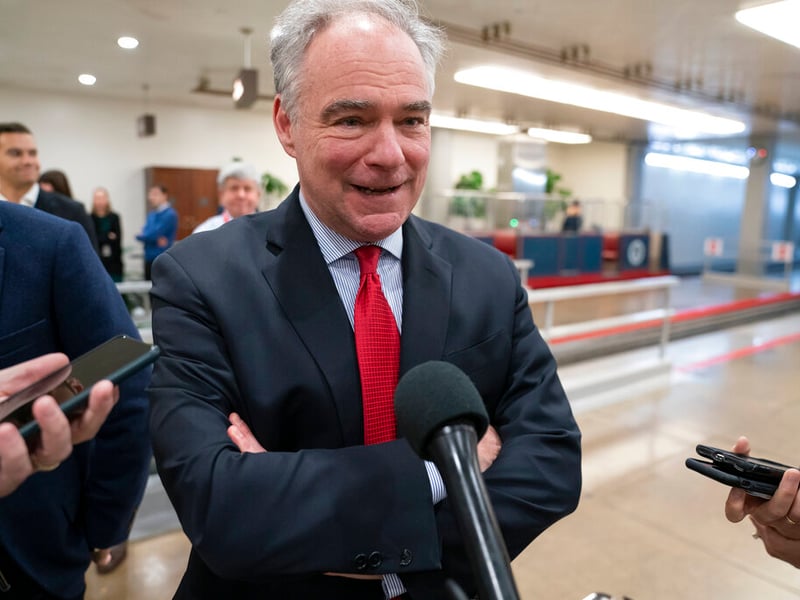
WASHINGTON (CN) — The Senate on Wednesday refused to withhold congressional support for President Donald Trump’s war in Iran, as Republicans expressed reticence to bring an immediate end to the conflict which has already killed hundreds of Iranians and a half dozen U.S. service members.
The upper chamber voted 47-53 to scrap Virginia Senator Tim Kaine’s measure brought under the 1973 War Powers Resolution, which would have halted the president from continuing a campaign of devastating airstrikes against Tehran which began over the weekend.
In order to pass, the resolution would have needed the support of several key Senate Republicans who have in the past backed similar measures checking Trump administration military actions. But the effort to bring the Iran war to a close failed to secure the necessary GOP assistance.
Indiana Senator Todd Young — who previously supported Kaine’s measure to block the U.S. military from carrying out additional strikes against Venezuela following the January capture of President Nicolas Maduro — told reporters Wednesday that he’d voted against the Iran War Powers resolution because “the context was different.”
“We’re engaged in war against a very dangerous regime, and if we were to withdraw support immediately it could be quite dangerous to our troops, to friends and partners in the region and conceivably even to the homeland,” said Young.
The Indiana Republican, however, said there was room for debate about whether the Trump administration needed to come before Congress “right now” and make a case for lawmakers to approve military force, saying in an “ideal scenario” the White House would unify Americans around such action.
“You do what George H.W. Bush did in the first Gulf War,” said Young. “You make the case, you make hard arguments, you have the vote and then we all agree.”
And the senator added that Congress had not “distinguished itself” as a body charged with oversight of the executive branch in the weeks leading up to the first Iran strikes, pointing out that lawmakers needed to do a better job as hostilities continue and opening the door to a future vote on a declaration of war or authorization of the use of military force.
“What happens if this lingers on for not just weeks, but months, right?” Young said. “I think it’s really important we continue to monitor this and get answers to all our questions — and then I’d be open to an authorization down the road.”
Maine Senator Susan Collins, another Republican swing vote who ultimately refused to back Kaine’s War Powers resolution, said in a statement that while the Constitution gives Congress an “essential” role in matters of war, passing the measure now would “send the wrong message” to Iran and to U.S. troops.
“At this juncture, providing unequivocal support to our service members is critically important, as is ongoing consultation by the administration with Congress,” she wrote.
Speaking on the Senate floor ahead of Wednesday’s vote, Kaine said that his measure would stop the Trump administration from prosecuting what he called an “unwise, unnecessary war that puts our troops at risk for no legitimate reason.”
He added that he would apply such a standard to military action taken by presidents of both parties — pointing to his opposition to former President Barack Obama’s plans to strike the Syrian regime over its use of chemical weapons.
“Presidents can protect against incoming attacks, presidents can act when there is a preexisting condition — congressional authorization to go after terrorists, the president should be able to act against,” said Kaine. “But in this instance, there is no congressional authorization on the books that would authorize this military action.”
The House, meanwhile, debated on Wednesday a similar measure proposed by California Representative Ro Khanna and Kentucky Representative Thomas Massie. Republican leadership in the lower chamber has come out hard against the bipartisan resolution, with House Speaker Mike Johnson calling it “dangerous” and arguing it would take away the president’s authority “to finish this job.”
As the Iran conflict drags toward the one-week mark, the Pentagon has signaled that its strikes inside the country will step up in the coming days.
Defense Secretary Pete Hegseth on Wednesday morning touted to reporters the U.S. military’s successes in eliminating Tehran’s missile and drone infrastructure and sinking its navy, which he said has been rendered “combat ineffective.”
“This was never meant to be a fair fight, and it’s not a fair fight,” said Hegseth. “We are punching them while they’re down, which is exactly how it should be.”
The Defense Department has so far identified four of the six U.S. service members killed in the Iran conflict so far, all U.S. Army Reserve soldiers who were stationed at a base in Kuwait. The Pentagon is so far withholding the names of the other two casualties as they attempt to contact next-of-kin.
According to the Iranian Red Crescent, as many as 550 Iranians have been killed in joint U.S.-Israeli strikes as of Monday.
 Follow @BenjaminSWeiss
Subscribe to our free newsletters
Our weekly newsletter Closing Arguments offers the latest about ongoing trials, major litigation and rulings in courthouses around the U.S. and the world, while the monthly Under the Lights dishes the legal dirt from Hollywood, sports, Big Tech and the arts.