
 Search Articles


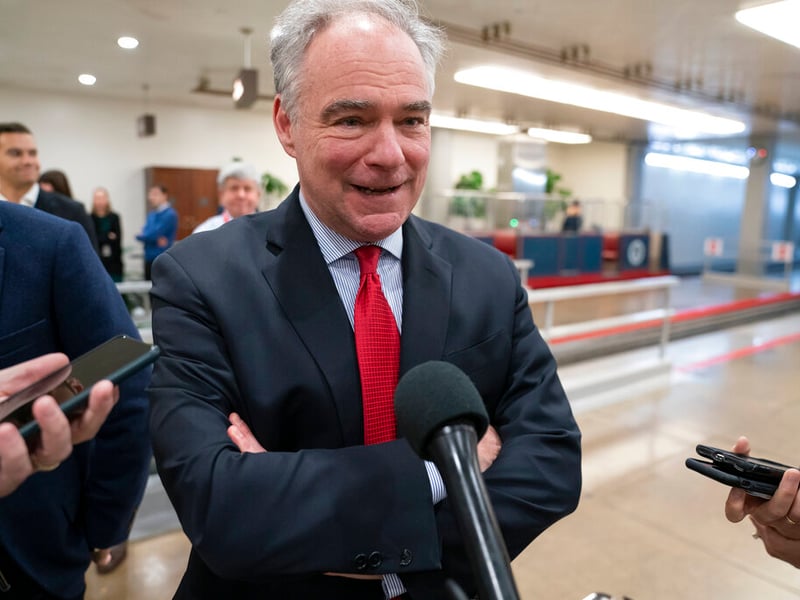
WASHINGTON (CN) — Senate Republicans on Thursday shot down a bipartisan resolution aimed at stopping President Donald Trump from going to war with Venezuela and from continuing an escalating series of military strikes against supposed drug trafficking boats in the Caribbean.
The move comes hours after the measure sponsors said the White House’s legal rationale for the boat strikes was shaky at best and that the administration has made “no effort” to justify potentially invading Venezuela or deposing President Nicolás Maduro, despite fears that such action could be on the horizon.
The upper chamber voted 51-49 to scuttle the war powers resolution, sponsored by Virginia Senator Tim Kaine and California Senator Adam Schiff. Kentucky Senator Rand Paul, a Republican, also backed the measure.
“Let’s not abdicate the most important power that we have,” Kaine said on the Senate floor ahead of the vote. “I would hope that all my colleagues, whatever they think about the virtues and vices of a war against Venezuela, would at least stand strong for the proposition that Congress should have the power, and indeed the responsibility, to have a debate and a vote on it before we order our troops to risk their lives.”
It was the senators’ second attempt to approve such a resolution, aimed at blocking the Trump administration from continuing a series of military strikes against boats off the coast of Venezuela, which the Pentagon has said were operated by drug traffickers headed to the U.S. But this newest measure comes after the White House provided lawmakers with the Office of Legal Counsel’s rationale for the attacks.
Speaking to reporters on Capitol Hill Thursday, Kaine said he had read the legal justification and concluded that its theory of executive war powers was based on a “misreading” of Constitution-era texts, such as the Federalist Papers.
“It advances a legal justification that has been advanced before by other administrations, which says a president can go to war without Congress, if the president determines that it’s in the national interest,” said Kaine. “That has no support in the Constitution.”
The Virginia senator argued the Constitution’s framers were “very plain” that Congress alone has the power to declare war and that the president is only allowed to call up military forces to defend the U.S. from an imminent attack.
“If you allow a president to unilaterally go to war … you basically eliminate Congress completely because every president will always claim it’s in the national interest,” Kaine argued.
Schiff panned the White House’s legal reasoning as “fallacious,” adding that the rationale was so broad it could authorize use of military force anywhere in the world. “I could find no real limiting principle,” he said. “It reads as if you gave a lawyer an assignment to give me the best possible rationale for why this is legal — be as inventive as you like.”
The Democrats’ most recent attempt to constrain the Trump administration’s unilateral military action comes amid fears the White House could be readying for a wider war against Venezuela and Maduro. The military has steadily increased its presence in the Caribbean amid the ongoing boat strikes, with as much as 15% of U.S. naval forces, including an aircraft carrier, stationed in the region.
But Kaine said the Office of Legal Counsel’s justification makes “no effort” to claim legal backing for an invasion.
“I think it’s really an open secret that this is much more about potential regime change,” said Schiff. “If that’s where the administration is headed, if that’s what we’re risking … then Congress needs to be heard on this.”
The Senate last month narrowly defeated the senators’ last attempt to rein in the Trump administration’s military adventurism. Kaine and Schiff said at the time that they hoped their measure, even in failure, would increase momentum for asserting Congress’ power over declarations of war.
Kaine repeated that sentiment on Thursday, saying Democrats were planning to propose more war powers resolutions in an effort to “exercise a muscle that’s completely flabby.” But he expressed concern that the Senate striking down a war powers resolution that would have blocked an invasion of Venezuela could be viewed by Trump as a green light.
“My theory on this is, this is a power that is clearly given to Congress,” said Kaine. “I just want to shine a spotlight on whether Congress is willing to act or not. Presidents overreaching is exactly what the framers understood — they wouldn’t be surprised in this moment at all. But Congress abdicating is a problem.”
A vote on the proposed war powers resolution comes just hours after U.S. Solicitor General Dean John Sauer was forced to admit to the Supreme Court that the Trump administration did not claim unreviewable authority over the power to declare war.
“We don’t contend that,” Sauer told Justice Neil Gorsuch during oral arguments in Trump’s tariffs case on Wednesday. He added that it would be an “abdication, not a delegation” for Congress to hand the White House unilateral power over war.
“I’m delighted to hear that,” Gorsuch replied.
And while the proposed war powers resolution went down in the Senate Thursday evening, even some Republicans expressed concern about the Trump administration’s recent military strikes.
In a statement, Indiana Senator Todd Young said he was “troubled” by the White House’s posture toward Venezuela and said that while he voted against the resolution, it was “not an endorsement of the administration’s current course in the Caribbean and Eastern Pacific.”
“The American people deserve a transparent strategy — not ad hoc military maneuvers conducted without a clearly defined objective,” said Young. “The administration must keep the people’s representatives better informed if and before this situation escalates in any way.”
Meanwhile, the Senate took another crack at a war powers resolution as Trump floated the idea that the U.S. military could intervene in Nigeria amid reports that Christians have been killed in the country by terrorist group Boko Haram.
Asked by Courthouse News Thursday whether he had asked the Pentagon for more information about Trump’s threat to go into Nigeria “guns blazing,” Kaine said he planned to talk about the issue with his staff and signaled that another war powers resolution could be on the way.
“We may well contemplate that once we’re through with this vote,” he said.
 Follow @BenjaminSWeiss
Subscribe to our free newsletters
Our weekly newsletter Closing Arguments offers the latest about ongoing trials, major litigation and rulings in courthouses around the U.S. and the world, while the monthly Under the Lights dishes the legal dirt from Hollywood, sports, Big Tech and the arts.