
 Search Articles


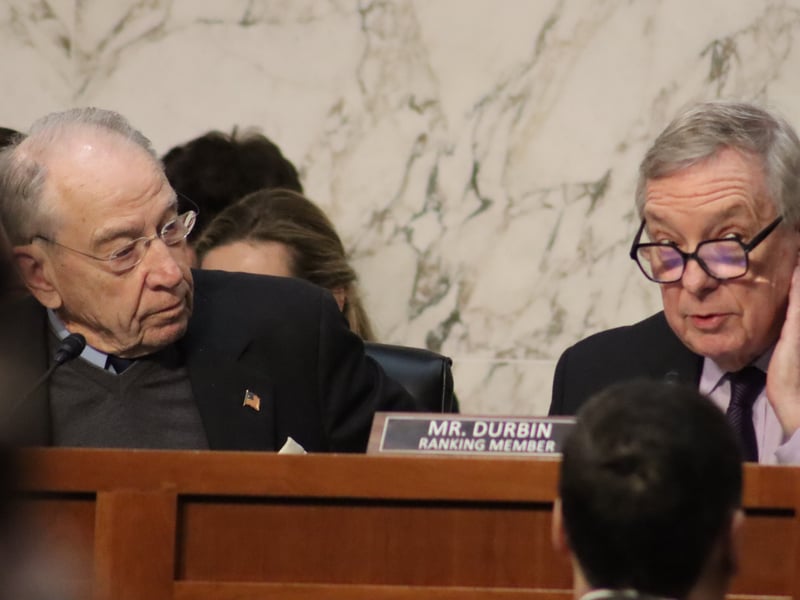
WASHINGTON (CN) — The Senate Judiciary Committee on Thursday voted to advance the Donald Trump administration’s first slate of federal judges, including one appointed to a powerful circuit court vacancy, to a final ballot before the full chamber.
It was a milestone for Senate Republicans and the White House — not only because the group of five judicial nominees may form the inaugural confirmation class of Trump’s second term, but also because they are the first federal court appointees in years to head to a final vote without direct involvement from the country’s preeminent legal organization.
The upper chamber’s Judiciary Committee on Thursday morning voted along party lines to approve Whitney Hermandorfer, nominated by the president to fill a vacancy on the U.S. Court of Appeals for the Sixth Circuit.
And the panel held similar partisan votes advancing a squad of Missouri federal district court picks, including Eastern District of Missouri nominees Maria Lanahan, Zachary Bluestone and Cristian Stevens — as well as Joshua Divine, who if confirmed would become a judge presiding over both the Eastern and Western Districts of Missouri.
All those nominees, however, cleared the Judiciary Committee without formal ratings from the American Bar Association, which has for decades advised senators and the White House on the qualifications of would-be federal judges. The Trump administration last month excised the ABA from the nominations process altogether, stripping them of their longstanding access to non-public information on appointments used to develop its ratings.
The ABA’s excommunication comes as Senate Democrats worry about the political loyalties of judges nominated by the Trump administration.
Speaking during Thursday’s business meeting, Senate Minority Whip Dick Durbin, the top-ranking Democrat on the Judiciary Committee, framed Hermandorfer as the emblem of what Trump looks for in judicial nominees, including “loyalty and willingness to rule in favor of him.”
“His nomination of Ms. Hermandorfer shows that he expects her to be a reliable ally on the Sixth Circuit for many years to come,” said Durbin.
Hermandorfer, currently director of the Tennessee attorney general’s strategic litigation division, faced sharp questions from lawmakers during a nomination hearing earlier this month about her work supporting the Trump administration’s policy priorities. Among other things, the nominee submitted an amicus brief to the Supreme Court backing the White House executive order rolling back birthright citizenship. The justices are expected to rule on the case Friday.
She told lawmakers at the time that her friend-of-the-court brief had been cited as “especially well-written” and that she was “hopeful” that it provided helpful information to the justices as they deliberated.
Hermandorfer also faced scrutiny from Democrats over her professional record, which Delaware Senator Chris Coons described as having a “striking brevity.”
The Sixth Circuit nominee was previously a clerk for now-Supreme Court Justice Brett Kavanaugh when he was a judge on the D.C. Circuit Court of Appeals. She also clerked for Justice Samuel Alito and Justice Amy Coney Barrett and has worked as a private practice attorney.
Hermandorfer’s experience came up once again at Thursday’s Judiciary Committee meeting, as Durbin pointed out that she graduated law school in 2015 and has less than 10 years of professional experience.
“Ms. Hermandorfer’s record is extreme, and it is very short,” said the Illinois Democrat. “That lack of experience is a serious concern as we consider her for a lifetime position.”
A perceived lack of experience proved to be a theme in Democrats’ opposition to the first slate of Trump judicial nominees. Durbin pointed out that Bluestone, one of the White House picks to join the Eastern District of Missouri, had only been out of law school for roughly seven years and did not have the experience necessary to “handle the demands of the federal bench.”
Democrats also railed on Divine, who if confirmed would oversee cases in both the Eastern and Western Districts of Missouri. Vermont Senator Peter Welch said that he had a “real problem” with the nominee, pointing to an essay he wrote in 2010 as a university student which advocated for the return of literacy tests to determine voting eligibility.
Divine has chalked his calls for reinstating literacy tests, which were made illegal by the Voting Rights Act of 1965, up to a college indiscretion.
“I don’t get that,” Welch said Thursday. “I was in college … the views that he’s expressed, and I think still adheres to, have no place on the bench.”
Despite those concerns from Democrats, the Judiciary Committee advanced all the judicial nominees on its agenda on a 12-10 vote along party lines.
Those prospective federal judges, meanwhile, head to confirmation votes in the full Senate without any formal input from the ABA. Attorney General Pam Bondi in a letter last month slammed the legal association as an “activist” group and blocked it from accessing information such as bar records that the ABA has long used to develop its ratings. Bondi contended that the organization has favored nominees offered by Democratic administrations.
In a scathing response, ABA president William Bay excoriated the White House for cutting his organization out of the judicial nominations process, arguing that the move will result in less transparency and that Bondi’s assertions about the ABA’s political affiliation were “based on incorrect information.”
The ABA, Bay said, has rated nearly 97% of judicial nominees as either qualified or well-qualified over the last 20 years — including during the first Trump administration.
Though the organization no longer has access to information it needs to provide its usual review of nominees, the ABA has published ratings for the slate of judicial picks who cleared the Judiciary Committee on Thursday. Every nominee except Bluestone received a rating of “well-qualified.” The ABA did not provide any rating for Bluestone.
 Follow @BenjaminSWeiss
Subscribe to our free newsletters
Our weekly newsletter Closing Arguments offers the latest about ongoing trials, major litigation and rulings in courthouses around the U.S. and the world, while the monthly Under the Lights dishes the legal dirt from Hollywood, sports, Big Tech and the arts.