
 Search Articles


WASHINGTON (CN) — Senate Republicans chafed once again Thursday at the White House’s process for selecting appellate court nominees, fuming over the Biden administration’s refusal to honor candidates suggested by red state senators.
But Democrats and legal experts have argued that the GOP bears the brunt of the responsibility for cratering bipartisanship on judicial appointments.
The Senate Judiciary Committee, the first line of defense for White House court nominees, for years followed a longstanding tradition which gave home state senators the opportunity to object to would-be federal judges with jurisdiction over their constituents. The process, known as blue slipping, was designed in part to encourage compromise on nominees.
Under then-President Donald Trump, however, the Senate’s Republican majority stepped away from the blue slipping process for appellate nominees — advancing several circuit court judges with no Democratic input. When Democrats seized control of the Senate in 2020, they signaled their intent to continue that trend while still honoring blue slips for lower court appointments.
But the majority’s rationale has not stopped Republicans from complaining that the Biden administration has left red state senators in the lurch when selecting circuit court candidates.
Speaking during a Judiciary Committee business meeting Thursday morning, Tennessee Senator Marsha Blackburn seethed that the White House had ignored reservations from the Volunteer State’s Republican delegation about Karla Campbell, tapped to fill a vacancy on the Sixth Circuit Court of Appeals.
“This is the fourth time that the White House has disregarded Senator [Bill] Hagerty and I in this process,” the Tennessee Republican said. “They tell you one thing, but the actions they have had with us are something completely different.”
In April, Blackburn levied similar criticism at the White House for its nomination of U.S. attorney Kevin Ritz to another Sixth Circuit vacancy.
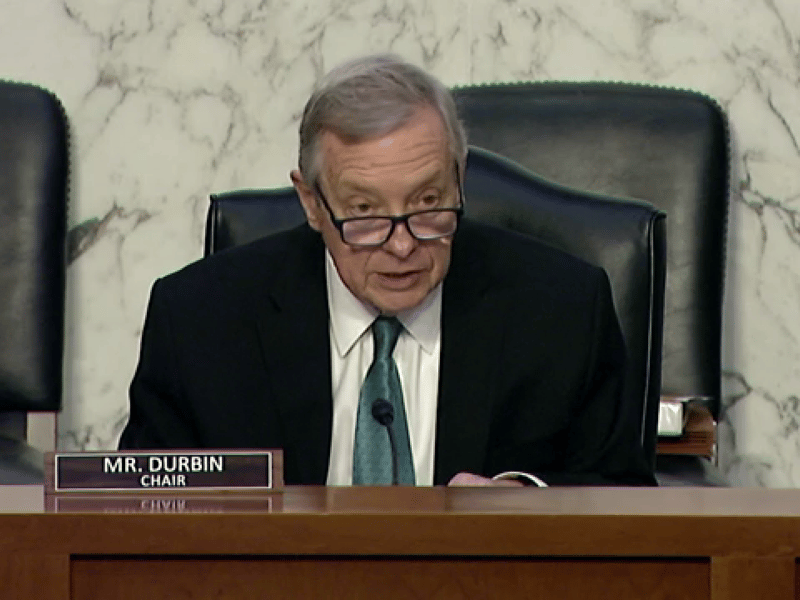
But Illinois Senator Dick Durbin, chair of the Judiciary Committee, refused to budge on his argument that Republican and Democratic nominees should be held to the same standard.
“When the shoe was on the other foot, your party eliminated the blue slip on circuit court nominees,” he told Blackburn Thursday. “This is one of the results of that. I’m sorry that you feel you have been mistreated in this context.”
Blackburn, though, claimed Democrats and the White House lack respect for the process and for her constituents.
“I know we don’t have a blue slip for the circuit court,” she said. “I’m not asking for veto power or to handpick a candidate … what we have asked for the basic courtesy of providing that advice and consent of working with the White House.”
But contrary to Blackburn’s complaints, the White House did its due diligence in working with the Tennessee delegation according to Carl Tobias, chair of the University of Richmond School of Law. The Biden administration interviewed candidates brought forward by the Republican senators.
“It is the constitutional prerogative of the president to make the final choice on nominations,” Tobias said in an interview.
Ultimately, the Judiciary Committee voted along party lines, 11-10, to advance Campbell’s nomination to the Senate floor Thursday morning.
The panel also voted on a slate of other nominees including Noel Wise, tapped by the Biden administration to join the Northern District of California. Wise took flak from Republicans during a July confirmation hearing over a 2017 article she penned exploring the legal and constitutional challenges facing people born with ambiguous gender.
The Judiciary Committee advanced Wise’s nomination on an 11-9 vote.
But lawmakers did not take up the nominee — or several others — during the morning business meeting.
The committee was forced to recess Thursday in the absence of a voting quorum — panel rules require two members of the minority to be present for ballots to be cast, but South Carolina Senator Linsdey Graham was the only GOP lawmaker in the chamber midway through the morning’s vote series.
After a brief recess, the committee reconvened behind closed doors to continue voting, according to a memo provided by an aide to Courthouse News. The second session, held in the historical President’s Room in the Capitol, was not open to the media or public as is standard practice for Senate committee business. Panel aides said the change was made to accommodate members’ schedules.
The Senate is set to begin its August recess at the end of the week.
 Follow @BenjaminSWeiss
Subscribe to our free newsletters
Our weekly newsletter Closing Arguments offers the latest about ongoing trials, major litigation and rulings in courthouses around the U.S. and the world, while the monthly Under the Lights dishes the legal dirt from Hollywood, sports, Big Tech and the arts.