
 Search Articles


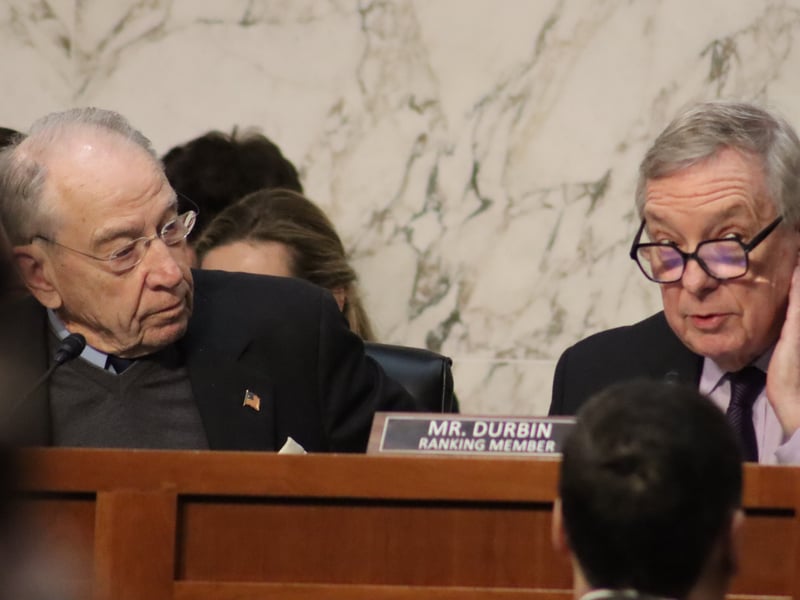
WASHINGTON (CN) — As the Senate Judiciary Committee met Thursday to vote on two more of President Donald Trump’s nominees for key Justice Department positions, Democrats seized the opportunity to once again issue stark warnings about what they see as the administration’s disregard for the rule of law.
And lawmakers contended that such conduct could herald a paradigm shift in executive power — one that may eventually be wielded by a Democratic president.
“I want to caution my Republican colleagues that the precedents that the Trump administration is establishing could be followed by a future Democratic president,” Senate Minority Whip Dick Durbin said during Thursday’s meeting of the upper chamber’s legal affairs panel.
Democrats for weeks have argued that the Trump administration is taking steps to centralize power around the White House and away from Congress and the courts. Lawmakers on the Judiciary Committee have pointed to the administration’s nominees for top Justice Department positions — such as Attorney General Pam Bondi and FBI Director Kash Patel — who they say are little more than Trump loyalists who threaten the political independence of federal law enforcement.
Trump’s Justice Department has drawn the ire of Democrats especially for its recent moves to dismiss the prosecution of New York Mayor Eric Adams and a spate of firings and reassignments of FBI agents who were assigned to cases related to the Jan. 6, 2021, Capitol riot.
In recent days, Democrats have also sounded the alarm about suggestions from the White House that it could defy orders from federal courts which have placed temporary restrictions on the administration’s executive actions.
During a Judiciary Committee hearing Wednesday, lawmakers pressed John Sauer, Trump’s nominee for solicitor general, on whether the president can ignore court orders. Sauer did not answer directly; he said that while litigants “generally” are bound by such orders, there may be “extreme cases” that could warrant defiance.
The nominee pointed to overturned Supreme Court rulings, such as in the case Korematsu v. United States which upheld Japanese internment during World War II, as possible examples.
Durbin on Thursday called Sauer’s waffling “breathtaking.”
“It raises serious existential, constitutional questions,” he said. “I think we’ve got to step back and have an honest discussion about this.”
But Republicans on the Judiciary Committee were less than convinced. Iowa Senator Chuck Grassley, who chairs the panel, said that he was open to discussing the scope of executive authority, but suggested that what Democrats saw as the Trump administration’s centralization of power was in fact the White House clawing back authority it had lost.
“Whatever power this president says he’s exercising, a lot of it is because we have delegated over the last 60 years too much congressional authority under Article I to anywhere, and that’s our fault for not doing our job right,” Grassley said.
Missouri Senator Josh Hawley argued that, where court orders are concerned, there should be circumstances in which litigants — or the president — should question a judge’s ruling. He contended that “abhorrent” decisions such as the one in Korematsu should not be “followed blindly” and accused Democrats of defending adherence to rulings considered to be morally reprehensible.
“I think there should be a clear distinction between defending or explaining a court decision which you find repugnant … and whether you’re required under our Constitution and laws to follow it until it’s changed,” Durbin replied.
Hawley’s argument struck a nerve with Hawaii Senator Mazie Hirono, who fumed over his invocation of the Korematsu decision as an obvious example of a ruling that would justify defiance.
“I don’t remember when Korematsu was decided that there was this human outcry about how wrong that decision was,” she said. “It took until 2018 for the court to say ‘that was wrongly decided.’ Give me a break.”
Durbin urged his colleagues to consider the implications of allowing the Trump administration to run roughshod on the justice system. “I hope we have a Congress that survives this process, and I hope that members on both sides will realize our obligation to the Constitution more than to a single political party,” he said.
Meanwhile, the Judiciary Committee on Thursday advanced Todd Blanche’s nomination for U.S. solicitor general on a 12-10, party-line vote. Blanche, a lawyer who represented Trump in his New York criminal case, faced sharp questions during his nomination hearing about his independence from the president.
In a statement following the vote, Durbin lumped Blanche in with some of Trump’s other Justice Department nominees who he said “simply don’t understand” that they swear an oath to the Constitution and not the president.
“I sure hope that Mr. Blanche conducts himself to the contrary, and that all my colleagues consider these flashing alarms before voting on the Senate floor.”
The Judiciary Committee also voted to advance Abigail Slater, tapped by the White House to become deputy attorney general for antitrust issues. Her nomination cleared the panel on a bipartisan, 20-2 vote. Hirono and Connecticut Senator Richard Blumenthal were the only Democratic ‘no’ votes.
Explaining his opposition, Blumenthal said he thought Slater, formerly a tech policy adviser in the Senate office of Vice President JD Vance, had an impressive background but that he was “deeply distrustful” of the Trump Justice Department given recent events.
“I think that you have to take a stand,” the Nutmeg State Democrat said, adding that while Slater has the expertise for her proposed role, he could not shake the perception that the Trump administration was “dead set” on undermining the independence of the Justice Department and using it as a tool against the president’s political enemies.
“That is despicable, disgusting and a complete betrayal of the traditions and ethos of an institution that many of us have served and that we revere,” Blumenthal said.
 Follow @BenjaminSWeiss
Subscribe to our free newsletters
Our weekly newsletter Closing Arguments offers the latest about ongoing trials, major litigation and rulings in courthouses around the U.S. and the world, while the monthly Under the Lights dishes the legal dirt from Hollywood, sports, Big Tech and the arts.