
 Search Articles


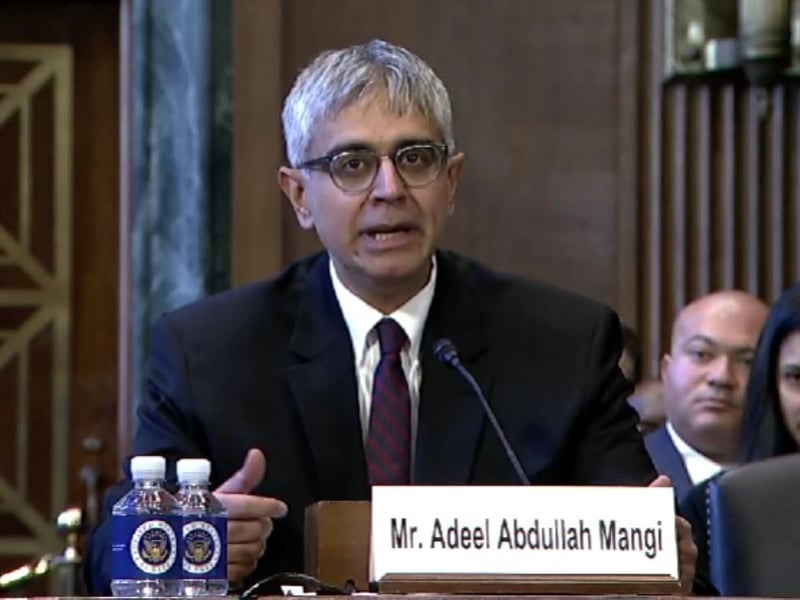
WASHINGTON (CN) — The Senate will no longer vote on four of President Joe Biden’s nominees for federal circuit courts after Democrats reached an agreement with Republicans to ease a weeklong procedural headache, party leadership said Thursday.
The deal, struck between Senate Republican leaders and Senate Majority Leader Chuck Schumer, appears to give Democrats the green light to push through a backlog of federal district court nominees — but it also hands President-elect Donald Trump a set of crucial appellate-level vacancies that he can fill once he takes office in January.
Fox News first reported on the agreement Thursday morning.
Republicans have sought to make Democratic efforts to confirm Biden’s remaining judicial nominees a painful process this week, pulling procedural levers to drag out votes on each appointment and forcing lawmakers to remain on Capitol Hill late into the night.
But this deal, struck between the GOP and Schumer late Wednesday night, may end those delay tactics and allow Democrats to vote on and confirm as many as 15 more lower court judges between now and the end of this Congress. Many of those confirmation votes would likely take place after the Thanksgiving recess.
In return, however, Schumer pulled four of Biden’s outstanding appellate nominees from Senate consideration.
“The trade was four circuit nominees — all lacking the votes to get confirmed — for more than triple the number of additional judges moving forward,” a spokesperson for the majority leader told Courthouse News in a statement.
Among the circuit court nominees who will no longer get a vote are Third Circuit nominee Adeel Mangi and Fourth Circuit nominee Ryan Park. Karla Campbell, tapped by the White House to fill a vacancy on the Sixth Circuit, and Julia Lipez, nominee for the First Circuit, have also been removed from consideration.
For at least some of those nominees, it was already an uphill path to confirmation. Republicans for months waged an assault on Mangi, attempting to tie him to a controversial university research program and a prison reform nonprofit. Democrats and some legal experts have long branded the attacks on the nominee, who is Pakistani-American, as blatantly Islamophobic.
Despite that, some Senate Democrats — namely, Nevada senators Catherine Cortez Masto and Jacky Rosen — pulled their support for Mangi in March. Their defections put the nominee in a holding pattern for months — though until Thursday, Democrats insisted that the Senate would ultimately vote to confirm him.
Fourth Circuit nominee Park, meanwhile, found himself at the center of a battle between the White House and North Carolina’s Senate delegation. Senators Thom Tillis and Ted Budd have accused the Biden administration of shirking their input when designating someone to fill the vacancy on the appellate court with jurisdiction over their constituents. But the White House has argued that the Tar Heel State lawmakers are playing fast and loose with the facts.
Senior administration officials have told Courthouse News that the White House has done more than the Trump administration to seek input from home state senators on nominees.
Either way, Tillis said as recently as last week that he had corralled enough Democratic votes to sink Park’s nomination on the Senate floor, though he never said which lawmakers had agreed to break ranks. It’s unclear if Tillis’ threats had any influence on Schumer’s move to drop the Fourth Circuit nominee.
Campbell had also faced similar criticism from Tennessee Senator Marsha Blackburn, who accused the Biden administration in June of making “backroom deals” on nominees without approval from home state senators.
The Senate long abided by a tradition known as blue-slipping, under which senators could approve or disapprove of White House court nominees with jurisdiction over their home states. But Republicans abandoned that precedent for appellate nominees during the Trump administration, and Democrats have said they are merely continuing that trend.
Democrats’ decision to give up four circuit court nominees to Republicans blindsided some legal experts.
“It just doesn’t make any sense to me,” said Carl Tobias, chair of the University of Richmond School of Law. “Why are they falling on their sword?”
Tobias argued that there was still plenty of time for lawmakers to ram through the White House’s remaining judges, even with GOP obstruction. Democrats could work nights and weekends to finish the backlog.
“The appellate judges are so critical, everybody knows that,” he said. “Both parties have gone to the mat every time. It just doesn’t compute for me.”
Although Democrats have apparently given up on the Biden administration’s remaining circuit court nominees, top lawmakers on the Senate Judiciary Committee remain bullish about their ability to confirm more federal judges than the first Trump administration.
A spokesperson for Judiciary Committee chairman Senator Dick Durbin told Courthouse News Thursday that the panel is on track to report out 242 judicial nominees by the end of this Congress. That posture puts them in a good place to surpass Trump’s 234 confirmations.
“Chair Durbin aims to confirm every possible nominee before the end of this Congress and will continue to push for votes on the floor with the time we have left,” the spokesperson said.
 Follow @BenjaminSWeiss
Subscribe to our free newsletters
Our weekly newsletter Closing Arguments offers the latest about ongoing trials, major litigation and rulings in courthouses around the U.S. and the world, while the monthly Under the Lights dishes the legal dirt from Hollywood, sports, Big Tech and the arts.