
 Search Articles


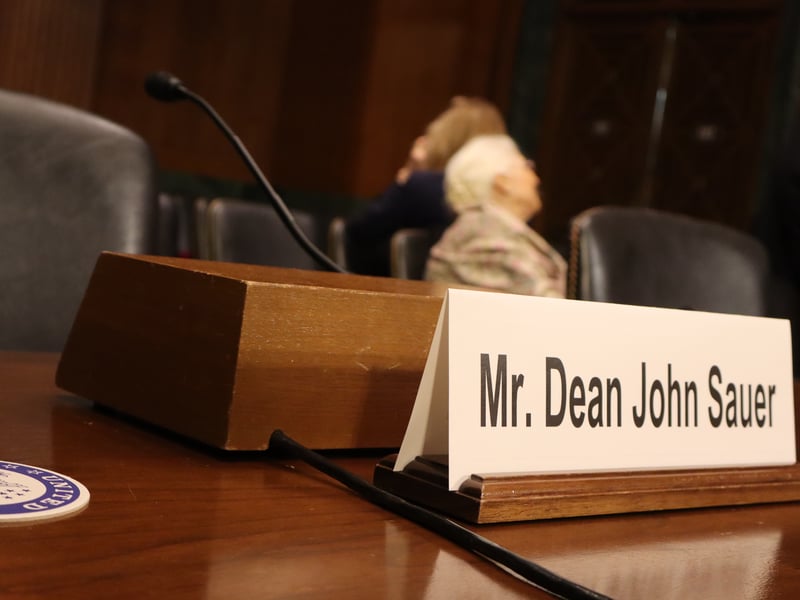
WASHINGTON (CN) — President Donald Trump’s nominees to represent the government before the Supreme Court and to coordinate policy decisions at the Justice Department faced sharp questions on Wednesday from lawmakers concerned about whether the administration could ignore orders from federal courts.
But even as Democrats on the Senate Judiciary Committee put them under a microscope, neither of the president’s nominees for key Justice Department positions would directly say whether they believed the Trump administration should adhere to such rulings.
The Senate’s legal affairs panel met Tuesday to examine a trio of nominations, including John Sauer, tapped by Trump to become U.S. solicitor general; and Aaron Reitz, appointed to lead the Justice Department’s Office of Legal Policy.
If confirmed, Sauer — the former Missouri solicitor general who represented the president in his 2024 immunity case before the Supreme Court — would be the federal government’s top appellate lawyer, representing the U.S. in appellate courts as well as the high court. Reitz, currently chief of staff for Texas Senator Ted Cruz, would head up the Justice Department’s office charged with developing and enacting the agency’s major policy decisions.
The nominees appeared before the Judiciary Committee as questions swirl about how the Trump administration will engage with federal courts, some of which have already taken steps to temporarily block several of the White House’s ambitious executive orders. Some Trump allies have accused federal judges of political bias and demanded that they be impeached. And the president himself, echoing a quote attributed to Napoleon Bonaparte, wrote in a social media post last week that “he who saves his country does not violate any law.”
Democrats on Tuesday demanded that the nominees weigh in on this issue, asking Sauer and Reitz whether they believed that the president was legally bound to adhere to a federal court’s rulings.
But both nominees, while they agreed that litigants are generally required to follow a lawful order from a judge, did not directly address Trump’s mandate to do so.
Sauer told lawmakers that he would not engage in hypotheticals but said that there could be “extreme cases” that would raise questions about whether a federal official should comply with a court order. As examples, he pointed to controversial Supreme Court cases, such as Korematsu v. United States , which upheld Japanese internment during World War II, as well as Dred Scott v. Sandford , the case that ruled that enslaved people were not U.S. citizens.
The nominee, however, cited his history of representing Trump and argued that it was “not a plausible scenario” that the president would defy a lawful court order.
“I represented President Trump for two years, and I’ve never been put in any situation like that,” he told Vermont Senator Peter Welch.
Sauer later sparred with New Jersey Senator Cory Booker, who asked whether the Trump administration could defy a court order that it found morally objectionable. He demurred on the question, arguing that it was too broad to answer directly.
“Just a general reference in this hearing to a litigant morally disagreeing with the decision of the court is too hypothetical for me to be able to answer,” he told Booker.
The New Jersey Democrat was far from satisfied with that reply. “You understand that this is not a comfortable assurance for me,” he told Sauer. “You’re not giving me great confidence by not stating unequivocally that we are a nation that respects the separation of powers and the role of the courts.”
Reitz, for his part, faced scrutiny for a Tweet he posted in response to a 2020 order issued by a federal court in Texas which blocked the state from shuttering abortion clinics during the Covid-19 pandemic. Illinois Senator Dick Durbin, the top Democrat on the Judiciary Committee, said the post referenced Andrew Jackson’s apocryphal statement refusing to comply with a Supreme Court ruling.
But Reitz said that his Tweet merely reflects a “conservative view” of the constitutional role of federal courts. Responding to questions about whether federal officials should be bound by judicial orders, he argued that there were some instances in which litigants should be forced to follow a court’s directives but that he could not speak for all cases.
“Generally speaking … parties to a case are bound to a lawful holding from that court,” Reitz told the committee.
The Judiciary Committee on Wednesday also heard from Harmeet Dhillon, a former Trump lawyer and his 2020 campaign legal adviser tapped as assistant attorney general for the Justice Department’s civil rights division.
Asked by Delaware Senator Chris Coons whether she would refuse an illegal or unconstitutional request from the president in her role, Dhillon said that Trump had never asked her in the past to do anything she found to be objectionable and that she “can’t fathom” such a circumstance if she were to be confirmed.
Political independence has been a key theme in Democrats’ cross-examination of the Trump administration’s nominees for key Justice Department positions. Lawmakers have worried that the agency’s newest officials, such as Attorney General Pam Bondi and FBI Director Kash Patel, could reject the Justice Department’s history of political impartiality in favor of loyalty to the president.
So far, though, those concerns have done little to prevent the Republican-led Senate from confirming all of Trump’s nominees for these top positions in federal law enforcement.
 Follow @BenjaminSWeiss
Subscribe to our free newsletters
Our weekly newsletter Closing Arguments offers the latest about ongoing trials, major litigation and rulings in courthouses around the U.S. and the world, while the monthly Under the Lights dishes the legal dirt from Hollywood, sports, Big Tech and the arts.