
 Search Articles


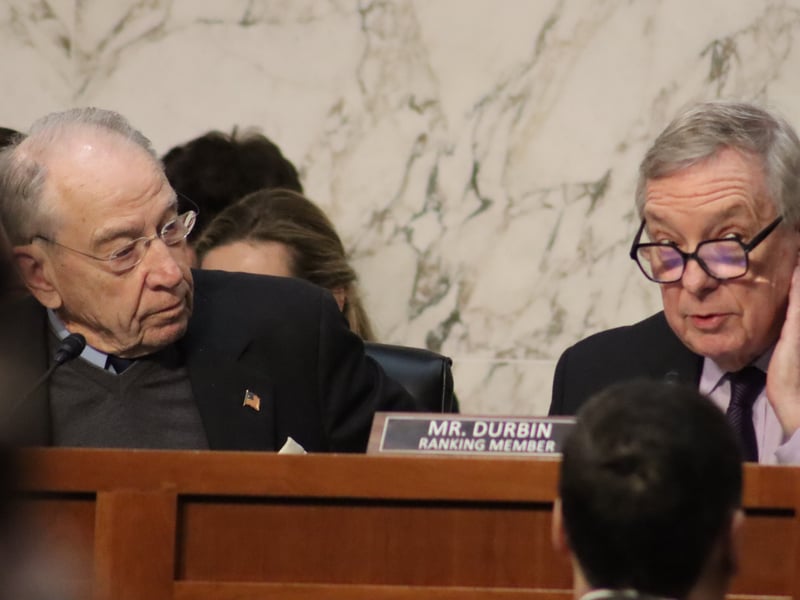
WASHINGTON (CN) — Senate Democrats on Wednesday hammered President Donald Trump’s second nominee for a key federal appellate court, arguing that she was missing the necessary expertise to serve a lifetime appointment on the bench.
And lawmakers needled Jennifer Mascott, a university professor and White House legal counsel tapped to join the U.S. Court of Appeals for the Third Circuit, on her past comments on major legal issues such as abortion rights and presidential immunity.
If confirmed to the appellate court, Mascott would fill the Third Circuit’s Delaware seat. But during a Senate Judiciary Committee hearing Wednesday morning, Democrats pointed out that the nominee had little experience practicing law in the First State.
“[Y]our record of scholarship and public commentary advocacy is quite lengthy, but I’m concerned that your actual practice is quite short,” Delaware Senator Chris Coons told Mascott.
Since early this year, Mascott has worked in the Trump administration as general counsel at the Education Department and is on leave from her position teaching law at the Catholic University of America in Washington. During Trump’s first term, she was deputy assistant attorney general in the Justice Department’s Office of Legal Counsel.
Mascott also clerked for Supreme Court Justice Clarence Thomas as well as for now-Justice Brett Kavanaugh, then an appellate judge in the D.C. Circuit.
But Coons contended Wednesday that the nominee was missing crucial litigation experience in Delaware. The Democratic lawmaker noted that she was not a member of the First State’s Bar and argued she had not filed any briefs in Delaware. He added that Mascott’s academic specialty in constitutional law did not gel with the criminal, bankruptcy and patent cases she might consider as an appellate judge.
“You’ve been nominated to essentially rule on appeals from the district courts, in particular the district courts of Delaware,” said Coons. “This long, long tradition of states getting to choose a member of their bench and their bar to go to the circuit is so that the values, traditions and legal concerns of the state are respected.”
Mascott, for her part, defended her experience, telling the Judiciary Committee that she had filed “dozens” of appellate briefs, including in the Third Circuit. If confirmed, she said she would plan to base her judicial chamber in Wilmington, Delaware. She was admitted into the Third Circuit in May.
“Right now, my practice has been as an academic and a public servant here in Washington, D.C.,” she added.
Facing further questioning from Rhode Island Senator Sheldon Whitehouse about her connections to Delaware, Mascott admitted that she had never voted in the First State and was not registered to vote there. The nominee also said that she did not have a Delaware driver’s license but that she did own a car insured there — because her family has a “long-time” home in the state.
Though lawmakers, including Delaware’s senior senator, chafed at what they saw as Mascott’s tenuous connection to the state she’d have jurisdiction over as a Third Circuit judge, there’s little recourse for the state’s Democrats to oppose her. The Senate has long refused to honor its longstanding blue slip tradition — effectively a veto for home state senators — when it comes to appellate nominees.
Still, Whitehouse asked Mascott Wednesday if she had blue slip support from Coons and his fellow Delaware Senator Lisa Blunt Rochester. The nominee replied that she didn’t but clarified that the tradition no longer applies to circuit court appointments.
“That was undone by our friends on the other side of the aisle,” Whitehouse replied. “And now that is the new tradition.”
During the first Trump administration, then-Judiciary Committee chairman Chuck Grassley said he would no longer allow blue slips for appellate nominees, reasoning that one senator should not have veto power over judges whose jurisdiction often covers multiple states.
Meanwhile, Mascott also sparred with Democrats over her previous positions on a number of issues, including some on which she had already testified in the Judiciary Committee.
California Senator Adam Schiff pressed the nominee on her comments at a 2024 panel hearing on the Supreme Court’s presidential immunity ruling, during which she said that the decision handing broad legal authority to the executive had been “significantly mischaracterized.”
Schiff employed a now-familiar hypothetical to test Mascott’s opinions on presidential immunity, asking her whether a president would be immune from prosecution if he ordered SEAL Team Six to assassinate a political rival.
Mascott answered that the Supreme Court’s immunity preceded “specifically” did not provide answers to such a question.
“Under the contours of Trump v. United States , which deals with criminal immunity, I’m not sure that it fully answers all of the political mechanisms that would be in place to address and keep such a horrific situation from ever occurring,” she told Schiff.
The nominee also faced questions on charitable comments she made about the high court’s 2022 ruling in Dobbs v. Jackson Women’s Health Organization, the decision that overturned the constitutional right to abortion. Responding to Connecticut Senator Richard Blumenthal, Mascott said that she had “spoken highly” of the Dobbs ruling and that her scholarly and academic work on abortion has been “consistent” with the court’s conclusions.
Mascott also reiterated her previous belief that the Dobbs ruling would not have a knock-on effect on other possible cases involving the issue of substantive due process, such as ones challenging interracial marriage or access to contraception.
“I read the court in Dobbs to be very specifically grappling with the issues before it and looking case by case at the relevant history of its own reasoning in that line of cases,” she told Blumenthal.
Mascott is the Trump administration’s second nominee to the Third Circuit in recent weeks. The Senate over the summer confirmed Emil Bove, a former Justice Department official and personal lawyer to the president, to the appellate bench where he will primarily oversee cases in New Jersey.
Bove, who was sworn into his position this week, has faced criticism for reports that he continued to work at the Justice Department even after his confirmation to the federal bench.
 Follow @BenjaminSWeiss
Subscribe to our free newsletters
Our weekly newsletter Closing Arguments offers the latest about ongoing trials, major litigation and rulings in courthouses around the U.S. and the world, while the monthly Under the Lights dishes the legal dirt from Hollywood, sports, Big Tech and the arts.