
 Search Articles


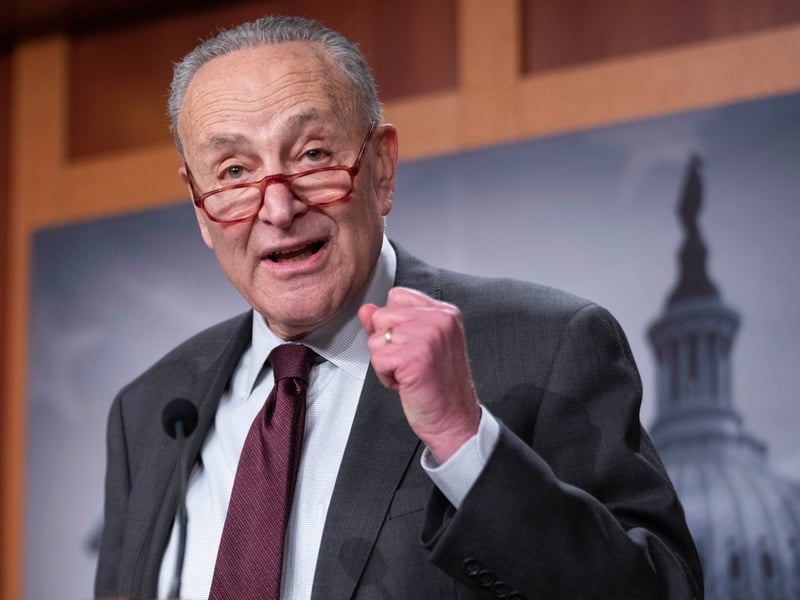
WASHINGTON (CN) — Senate Minority Leader Chuck Schumer said Wednesday that he would use a procedural tool to block a pair of President Donald Trump’s nominees for U.S. attorney positions in New York.
And, amid uncertainty about Congress’ role as a check on the executive branch, the Senate Judiciary Committee’s top Republican signaled that he would honor the longstanding chamber tradition allowing lawmakers to halt White House judicial nominees in their home states.
Democrats have for months sought ways to stymie what they see as a Trump administration effort to stuff the Justice Department with political loyalists. So far, they’ve had little recourse — the Republican-controlled Senate has confirmed all of the White House’s picks to run the agency.
But senators have unique veto power when it comes to state-level judicial nominees. Known as blue slipping, the age-old upper chamber tradition allows lawmakers to formally disapprove of certain administration appointees.
Schumer on Wednesday became the first Democrat to use this blue slip power against a Trump nominee, rejecting the president’s U.S. attorney nominees for the Southern and Eastern districts of New York.
“Donald Trump has made clear he has no fidelity to the law and intends to use the Justice Department, the U.S. attorney offices and law enforcement as weapons to go after his perceived enemies,” the Democratic leader said in a statement. “Such blatant and depraved political motivations are deeply corrosive to the rule of law and leaves me deeply skeptical of Donald Trump’s intentions for these important positions.”
Trump in November nominated Jay Clayton to serve as U.S. attorney for the Southern District of New York, the federal jurisdiction which includes the island of Manhattan. Clayton previously served as chairman of the Securities and Exchange Commission during the president’s first term.
For the U.S. attorney slot in the Eastern District of New York, Trump had selected Joseph Nocella, who had previously been assistant U.S. attorney for the Brooklyn federal judicial district and is currently a judge on the Nassau District Court on Long Island.
Schumer’s blue slip rejection of Clayton and Nocella effectively kills their nominations — unless the Senate’s Republican leadership chooses not to honor longstanding procedure. But so far, top GOP lawmakers appear willing to keep the tradition alive.
“The Judiciary Committee has long honored the traditional blue slip process for U.S. attorney nominees,” said a spokesperson for Iowa Senator Chuck Grassley, who chairs the Senate Judiciary Committee.
The spokesperson did not directly say whether the chairman would honor Schumer’s decision not to return blue slips for the New York attorney nominees.
Speaking to The New York Times on Tuesday, though, Grassley said “yes,” he would honor blue slips for senators if they are from the state the nomination comes from.
But while Grassley appears to back blue slips and has done so in the past, the Judiciary Committee under his leadership has also restricted their use.
During the first Trump administration, the then-panel chairman announced that he would move forward with nominees for appellate-level judgeships in spite of blue slip refusals from home state senators. He argued at the time that circuit courts cover multiple states and that there was “less reason” to defer to a single state’s senator on nominees for those courts.
Under the Joe Biden administration, the Democrats’ Senate majority kept up that precedent, moving ahead with the president’s appellate nominees without Republican input — a move which riled some GOP senators. Illinois Senator Dick Durbin, who chaired the Judiciary Committee, argued at the time that Democrats and Republicans should both be held to the same standard.
Despite the reduced scope of blue slips, lawmakers on both sides have largely continued to honor them for district court nominees and U.S. attorneys.
But that hasn’t always been the case. Several Judiciary Committee Republicans last year refused to vote for one of then-President Biden’s nominees for a U.S. attorney in the Northern District of Iowa, despite the appointee getting blue slip endorsements from Grassley and fellow Hawkeye State Senator Joni Ernst.
And Vice President JD Vance, then a senator from Ohio, carried a monthslong blockade on Biden’s U.S. attorney nominees in spite of their blue slip status.
Carl Tobias, chair of the University of Richmond School of Law, told Courthouse News that Grassley has been “respectful of tradition” and that his apparent posture on Schumer’s blue slip use is likely a sign of how he will treat the mechanism as Judiciary Committee chairman. But he added that Grassley would likely continue the so-called circuit court exception and continue not to honor blue slips for appellate nominees.
Still, Tobias pointed out, blue slips will open an avenue for Democrats to force bipartisanship on some Trump administration nominees.
“This means that the White House will need to cooperate with all Democratic senators in home states to seek consensus on U.S. attorney nominees,” he said.
While U.S attorneys need confirmation votes in the Judiciary Committee, they usually are not required to appear before the panel for a hearing. Democrats in recent weeks have demanded that Grassley convene such a hearing for Ed Martin, tapped to becomes the federal prosecutor for D.C.
On Wednesday, Durbin again renewed calls for a hearing on Martin’s nomination, pointing to reports that he had failed to disclose as many as 150 guest appearances on Russian state television networks Russia Today and Sputnik. In a statement, the Illinois Democrat said the reports were “further evidence” that the Judiciary Committee should be allowed to cross-examine Martin in a hearing.
 Follow @BenjaminSWeiss
Subscribe to our free newsletters
Our weekly newsletter Closing Arguments offers the latest about ongoing trials, major litigation and rulings in courthouses around the U.S. and the world, while the monthly Under the Lights dishes the legal dirt from Hollywood, sports, Big Tech and the arts.