
 Search Articles


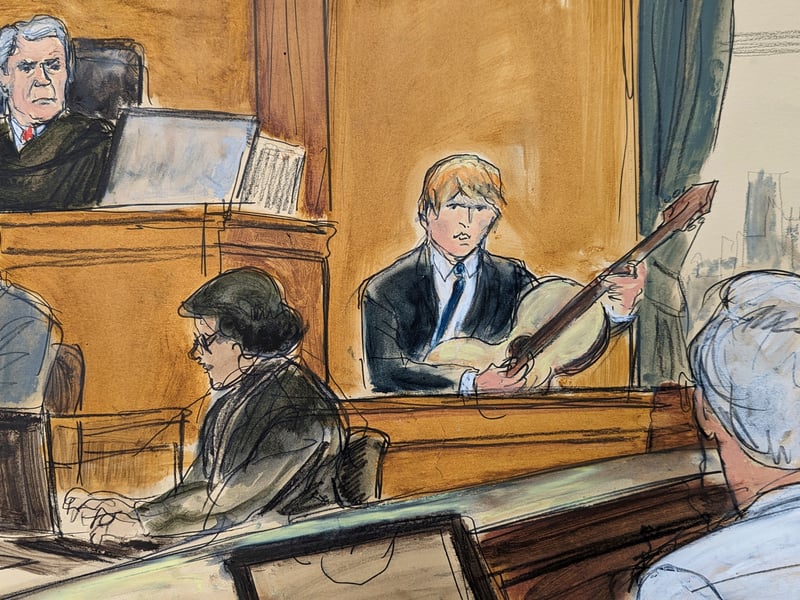
MANHATTAN (CN) — A Second Circuit panel on Friday rejected a music company’s copyright claims against Ed Sheeran, after it claimed that the English singer-songwriter’s pop hit “Thinking Out Loud” infringed Marvin Gaye’s 1970s anthem “Let’s Get It On.”
The panel agreed with a lower court’s decision to grant Sheeran summary judgment because the four-chord progression and syncopated harmonic rhythm in Gaye’s song is too “unoriginal for copyright protection.”
While Structured Asset Sales — the group that also owns a share of the copyright to “Let’s Get It On" — argued that the chord progression and syncopated rhythm together are enough to warrant protection, the panel found that the combination of those elements has been used in other songs that predate “Let’s Get It On” including The Seekers’ “Georgy Girl” and The Temptations’ “Since I Lost My Baby.”
“The four-chord progression at issue — ubiquitous in pop music — even coupled with a syncopated harmonic rhythm, is too well-explored to meet the originality threshold that copyright law demands,” U.S. Circuit Judge Michael Park, a Donald Trump appointee, said.
Donald Zakarin, an attorney with Pryor Cashman representing Sheeran, praised the panel’s decision.
“We are gratified that the Second Circuit agreed with Judge Stanton that Ed Sheeran and Amy Wadge did not infringe ‘Let’s Get It On’ in creating ‘Thinking Out Loud,’” Zakarin said in a statement.
Structured Asset Sales’ attorney Hillel Parness, a former head of litigation at Warner Music, did not respond to a request for comment.
The three-judge panel also agreed with the lower court’s decision to exclude Structured Asset Sales’ musicology experts from testifying as to how skilled musicians would play that sheet music, and instead relying on what is called the deposit copy, the original handwritten sheet music for “Let’s Get It On,” in analyzing what elements are copyright protected.
The panel pointed out that when Gaye’s song was registered at the copyright office, only the deposit copy was submitted.
“Elements of Gaye’s popular audio recording of ‘Let’s Get It On’ that do not appear in the deposit copy are thus not protected by the registration,” Park said in the decision.
Park added that material and elements that are not included in the deposit copy are “irrelevant to an action alleging infringement of the registered work.”
The decision comes after a New York jury in 2023 found Sheeran was not liable to the estate of Gaye’s co-writer for “Let’s Get It On” in their yearslong fight over similarities between the two songs.
U.S. District Judge Louis Stanton had also separately dismissed another suit against Sheeran over the two songs brought by Structured Asset Sales.
U.S. Circuit Judge Guido Calabresi, a Bill Clinton appointee, and U.S. Circuit Judge Barrington Parker, a George W. Bush appointee, also joined in the decision.
The Los-Angeles-based Structured Asset Sales, which was founded by music executive David Pullman, securitizes future royalties to musical intellectual property and then sells them as asset-backed securities to other investors.
In 1997, Pullman first orchestrated a trailblazing $55 million bond backed by the future royalties and publishing rights of David Bowie’s 25 albums recorded prior to 1990.
The “Ziggy Stardust” singer was then able to use the loan he received upfront to buy out the rights to his songs, gleaned in a notoriously bad deal by an early manager Tony Defries.
The practice of securitizing musical artists’ catalogues into investment vehicles became known as “Bowie bonds,” and Pullman became known for them.
He also worked out bond deals for the publishing royalties for the catalogues of The Isley Brothers and soul and funk legend James Brown.
 Follow @NikaSchoonover
Subscribe to our free newsletters
Our weekly newsletter Closing Arguments offers the latest about ongoing trials, major litigation and rulings in courthouses around the U.S. and the world, while the monthly Under the Lights dishes the legal dirt from Hollywood, sports, Big Tech and the arts.