
 Search Articles


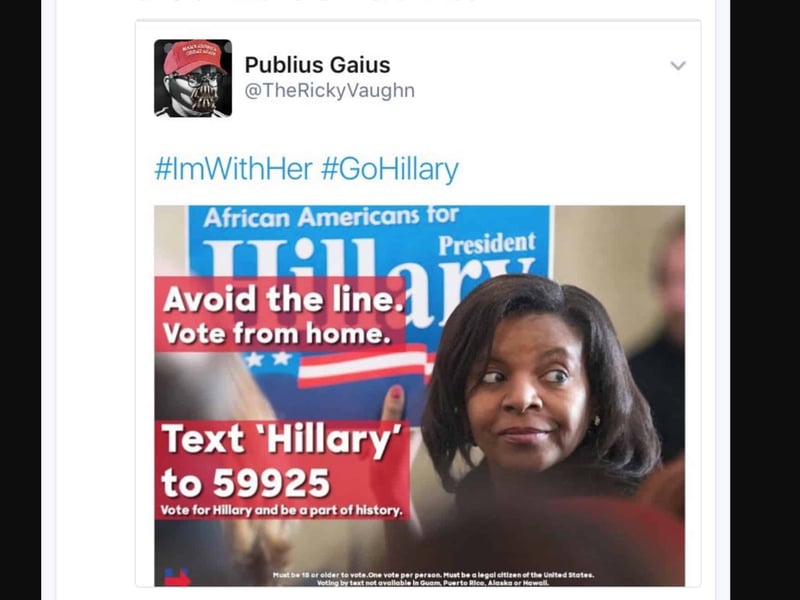
MANHATTAN (CN) — The United States Court of Appeals for the Second Circuit reversed a far-right social media influencer’s conviction for election interference due to insufficient evidence on Wednesday.
Douglass Mackey was sentenced to seven months in prison in 2023 by the Eastern District of New York for conspiring to interfere in the 2016 election by posting fake ads on his far-right Twitter account urging Clinton supporters to vote by text.
“Avoid the line. Vote from home,” one fake advertisement reads. “Text ‘Hillary’ to 59925.”
Mackey was found guilty under the “Conspiracy Against Rights” Act, originally known as the “Ku Klux Klan Act,” which was enacted to protect emancipated Black Americans from Klan efforts to block their voting rights. Mackey was convicted under the law for seeking to stop Clinton voters from exercising their constitutional right to vote.
“The mere fact that Mackey posted the memes, even assuming that he did so with the intent to injure other citizens in the exercise of their right to vote, is not enough, standing alone, to prove a violation of (the Ku Klux Klan Act),” Chief Judge Debra Livingston wrote for the majority. “The government was obligated to show that Mackey knowingly entered into an agreement with other people to pursue that objective. This the government failed to do.”
Mackey’s lawyer, Jacob Roth of Jones Day, told the court in April 2024 that these acts of deception shouldn’t be prosecuted under the “Ku Klux Klan” statute because Mackey and his conspirators did not directly bar Clinton supporters from voting.
At trial, prosecutors showed Mackey used private X groups to coordinate deceptive messages aimed at misleading voters in the 2016 election.
The group agreed to share fake images designed to resemble official Hillary Clinton campaign ads, falsely telling supporters that they could vote by using a hashtag on social media or by text message.
Roth argued in court that deception is not the same as violating constitutional rights and falls outside the original intent of the 150-year-old statute.
“When the statute was enacted, it was about physical acts of coercion. Then, it was extended … to ballot manipulation, destroying ballots, stuffing the ballot box,” Roth said in court last year. “But deception is just different from those wrongs.”
During his trial, prosecutors also pointed to Mackey’s tweets where he’s prejudiced against Black people, women, and immigrants.
In one tweet, he described Black people as “gullible” and wrote, “Black people will believe anything they read, okay Twitter. And we let them vote, why?”
In other tweets, he said immigrants “cannot be trusted to vote” and said, “women are children with the right to vote.” He also implied his disapproval of women voting, tweeting the hashtag “#Repealthe19th.”
The court eventually agreed with Roth, saying that Congress expressly intended to limit the Act’s reach to conspiracies.
“Here, the government conceded that Mackey downloaded his text-to-vote 41 tweets from 4chan,” Livingston wrote. It failed to establish, in accordance with its theory of the case, that Mackey became aware of the text-to-vote memes in the War Room and tweeted them as part of a conspiracy launched there. That theory was possible, but so was an alternative one: that Mackey became aware of the memes independently and decided on his own to post them.”
Subscribe to our free newsletters
Our weekly newsletter Closing Arguments offers the latest about ongoing trials, major litigation and rulings in courthouses around the U.S. and the world, while the monthly Under the Lights dishes the legal dirt from Hollywood, sports, Big Tech and the arts.