
 Search Articles


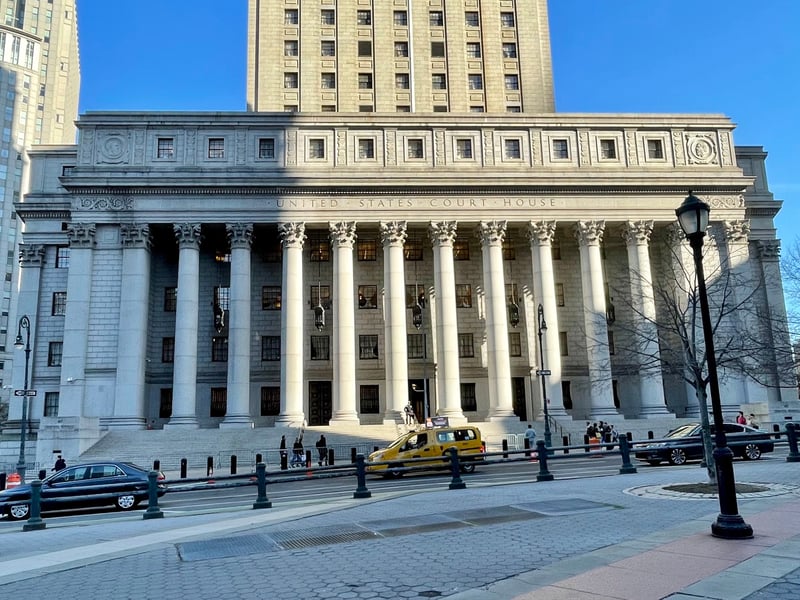
MANHATTAN (CN) — A Second Circuit panel Thursday in part reversed a top Long Island official’s corruption conviction, finding there wasn’t enough evidence to convict him for conspiracy to commit federal programs bribery.
Former Nassau County Executive Edward Mangano, who occupied the highest seat of power in the county, was convicted in 2019 for taking bribes from restaurateur Harendra Singh to persuade the town of Oyster Bay to guarantee loans to improve concessions that Singh operated at a beach and golf course.
Prosecutors say the bribes included a “no-show” marketing job for Mangano’s wife, Linda, who received more than $450,000. The couple also used the bribes to secure five vacations, new hardwood flooring, a custom-made office chair, a massage chair, and a watch.
The 62-year-old Long Island Republican was sentenced to 12 years in prison and ordered to pay $10.6 million in restitution, plus a $200,000 fine and more than $500,000 in forfeitures. Linda Mangano was sentenced to 15 months for obstructing a grand jury by lying to the FBI about her supposed job with Singh.
The three-judge panel agreed with Mangano’s argument that prosecutors failed to show he acted in his official capacity to benefit Singh.
In particular, the panel pointed out the government conceded Mangano was not an official agent of Oyster Bay.
“The government presented no evidence at trial that Mangano had authority to act on behalf of the town, nor that he was an employee or representative of the town,” U.S. Circuit Judge Debra A. Livingston, a George W. Bush appointee, said in the panel’s decision.
At trial, prosecutors argued that Oyster Bay Supervisor John Venditto convinced Mangano to hire some of his associates into the county government. But the panel said there’s no evidence to suggest Mangano agreed to do so because of the bribes he accepted.
“Nor was there proof at trial to suggest that Mangano accepted bribes from Singh intending to be influenced in Nassau County hiring practices,” Livingston wrote. “Rather, the indictment and the evidence at trial concerned Mangano’s accepting Singh’s bribes for Mangano’s own benefit in return for influencing town activity.”
While the panel overturned Mangano’s conviction for federal programs bribery, it affirmed his convictions for honest services fraud and obstruction of justice. The panel also upheld his wife’s conviction.
Honest services fraud is a form of mail or wire fraud intended to address instances in which public officials accept a bribe or kickback in exchange for “dishonest conduct” that did not necessarily cause their employers to suffer a financial loss.
At oral arguments, Mangano argued the government failed to establish a fiduciary relationship between him and Oyster Bay because he was never elected to any town office.
But the panel said Mangano’s position as a high-ranking Nassau County official impeded his ability to provide “honest services” to county residents, despite the fact he was not an acting representative of the town of Oyster Bay. Instead, he used his position to exercise “tremendous political clout” over the town.
“Singh testified that he only began to bribe Mangano after Mangano was elected to county office,” Livingston said. “And when Mangano organized a meeting for the town to devise a way of guaranteeing Singh’s loans, he listed it on his official county calendar and agreed to provide favorable treatment to certain people in county government.”
The panel also upheld Lisa Mangano’s conviction for making false statements to federal officials, pointing to numerous witness testimony that she did not show up at work during the period she first started receiving paychecks from Singh.
Despite her claims that she told Singh she was leaving her employment in an attempt to explain her no-show record at work, the panel pointed to evidence of subsequent paychecks from Singh she received and cashed.
“We cannot see how she could have stated any of the above claims in a literally true way based on the substantial trial evidence demonstrating that the claims were demonstrably false, in sum and substance,” Livingston said.
U.S. Circuit Judge Gerard E. Lynch, a Barack Obama appointee, and U.S. Circuit Judge Beth Robinson, a Joe Biden appointee, also participated in the panel’s decision.
In a statement, a spokesperson for the U.S. Attorney’s Office of the Eastern District of New York said the government will request that the court reimpose Mangano’s 12-year sentence he is currently serving for the honest services fraud and conspiracy to obstruct justice charges.
“Taken together, the decisions reflect a resounding vindication of the government’s investigation and prosecution of both defendants,” the spokesperson said.
Mangano’s attorneys did not respond to a request for comment.
 Follow @NikaSchoonover
Subscribe to our free newsletters
Our weekly newsletter Closing Arguments offers the latest about ongoing trials, major litigation and rulings in courthouses around the U.S. and the world, while the monthly Under the Lights dishes the legal dirt from Hollywood, sports, Big Tech and the arts.