
 Search Articles


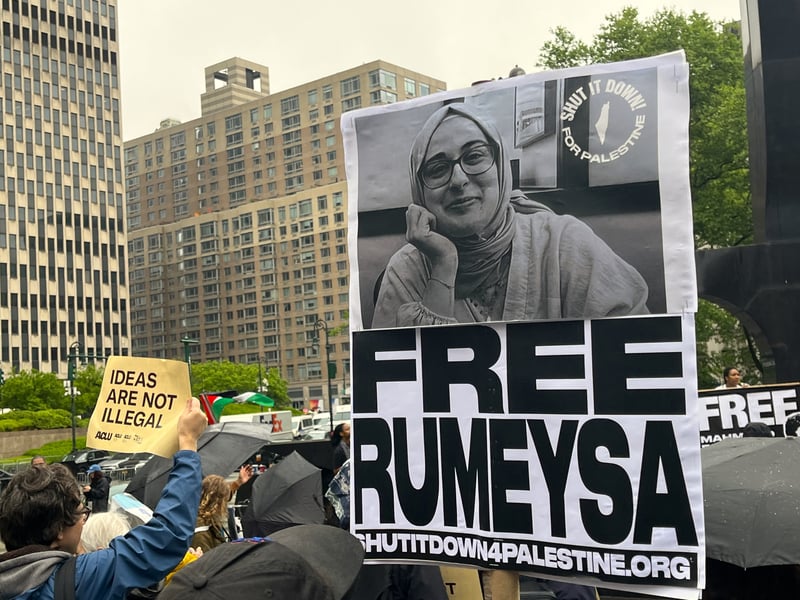
MANHATTAN (CN) — A federal appeals court on Tuesday heard challenges from the Trump administration in two cases involving university students jailed for their pro-Palestine advocacy.
Turkish Tufts University Ph.D. student Rumeysa Ozturk and Palestinian Columbia University Mohsen Mahdawi both say they were jailed for their protected speech about Israel’s bombing campaign in Gaza. Ozturk has been locked up in a Louisiana ICE facility for the past six weeks, while Mahdawi was ordered to be released by a federal judge in Vermont last week.
Ozturk is expected to be transferred to Vermont to fight her detention after another federal judge in the state ordered that it has jurisdiction to hear her challenge.
But arguing to a three-judge Second Circuit panel on Tuesday, a Trump administration attorney claimed that neither Mahdawi’s release nor Ozturk’s transfer is an issue that the federal court in Vermont had power to rule on.
Deputy Assistant Attorney General Drew Ensign said that the result in these cases is “precisely what Congress took particular care to avoid: simultaneous proceedings in both immigration court and district courts considering the same issues regarding removals of aliens from the United States.”
Ozturk was arrested on March 25 by six masked plainclothes federal agents near her home in Somerville, Massachusetts. She claims that her arrest was in retaliation to an article she co-authored in student paper The Tufts Daily , in which she criticized the university’s response to pro-Palestine protests on campus.
Ozturk’s lawyer, Esha Bhandari of the American Civil Liberties Union, called her detention “unprecedented and shocking” on Tuesday.
“She has been held behind bars for six weeks while her health deteriorates for writing an op-ed,” Bhandari told the panel, a seeming reference to Ozturk’s claims of asthma attacks while in ICE custody.
Mahdawi was arrested on April 14 after he was lured to a U.S. Citizenship and Immigration Services office in Vermont under the guise of an appointment to obtain citizenship. He was released about two weeks later, pursuant to a ruling in federal court.
Both Ozturk and Mahdawi are facing deportation proceedings, which are separate from their respective detention issues, amid the Trump administration’s unprecedented move to revoke student visas from those who engage in speech that challenges U.S. foreign policy directives.
Bhandari reminded the Second Circuit panel that detention “is not the norm” for visa revocation cases.
“The executive branch made a specific decision to detain Ms. Ozturk that was motivated by her speech,” she said.
Tuesday’s hearing was not focused on the legitimacy of the students’ detention, only whether the federal court in Vermont has the jurisdiction to rule as it did. Still, one of the judges — U.S. Circuit Judge Barrington Parker, a George W. Bush appointee — pressed the government on the free speech issue that overshadows both cases.
“Does the government contest that the speech in both cases was protected speech?” Parker asked.
“Your Honor, we have not taken a position on that,” Ensign replied.
“Help my thinking along, take a position,” Parker demanded.
“Your Honor, I don’t have the authority to take a position on that right now,” Ensign said.
The Trump administration likely has an uphill battle to climb in its effort to toss both rulings. U.S. Circuit Judge Susan Carney, a Barack Obama appointee on Tuesday’s panel, appeared skeptical at Ensign’s claim that the government faces irreparable harm and “irrecoverable costs” if it’s forced to change jurisdiction.
Mahdawi’s attorney, Naz Ahmad, lambasted the government’s argument.
“The harm would be to Mr. Mahdawi and others, the chilling of his speech and others’, the fear, the broad chilling effect others would experience if he were re-detained,” Ahmad said.
Joining Carney and Parker at the bench was U.S. Circuit Judge Alison Nathan, a Joe Biden appointee. The three-judge panel could rule as soon as Tuesday.
 Follow @Uebey
 Follow @uebey.bsky.social
Subscribe to our free newsletters
Our weekly newsletter Closing Arguments offers the latest about ongoing trials, major litigation and rulings in courthouses around the U.S. and the world, while the monthly Under the Lights dishes the legal dirt from Hollywood, sports, Big Tech and the arts.