
 Search Articles


MANHATTAN (CN) — The Second Circuit on Tuesday killed a long-running lawsuit filed by three Muslim men who accused FBI agents of bullying them to inform on the Muslim community by placing them on the “No Fly List.”
The 16 FBI agents are entitled to qualified immunity, preventing the plaintiffs from collecting monetary damages against them in their personal capacities, the appellate panel ruled roughly four years after a favorable ruling from the U.S. Supreme Court.
In that 2020 ruling the high court affirmed an earlier Second Circuit ruling that the men could seek damages for their treatment, but didn’t address the qualified immunity issue.
Muhammad Tanvir, Jameel Algibhah and Naveed Shinwari sued in 2013 after they were placed on the No Fly List, despite no evidence that they were a threat to aviation safety.
Tanvir, a New York City truck driver living in Queens, says he discovered he was on the list after trying to board a flight home from Atlanta, Georgia, and was assured he would be removed from the list only if he cooperated with the FBI as a confidential informant. Algibhah and Shinwari joined later, citing similar experiences.
All three eventually had their names removed from the No Fly List — but not before Tanvir had to quit his job and stop seeing his children and sick mother in Pakistan for years, thanks to his inclusion, according to the lawsuit.
“Nothing in this ruling should be construed as approving the conduct alleged in the complaint,” U.S. Circuit Judge Gerard Lynch, a Barack Obama appointee, wrote in the 37-page ruling Tuesday. “At its core, the complaint alleges that government agents pressured individuals to serve as informants — at risk to their own and their families’ safety — and to report on the activities of their neighbors and community members by falsely and in bad faith accusing them of terrorism to deny them significant liberties under a program designed to protect lives from genuine terrorists.”
Acknowledging that the agents’ actions in this case was “improper,” Lynch wrote that qualified immunity still prevents Tanvir, Algibhah and Shinwari from targeting the FBI agents personally under the Religious Freedom Restoration Act since they never told the agents that their religious beliefs were being violated.
“That is improper behavior, regardless of whether the agents knew of the appellants’ particular religious beliefs,” Lynch wrote. “But in this case, the appellants’ only remaining legal claim is that the appellee agents are personally liable in damages for violating their free exercise of religion under RFRA. On the facts alleged, for the reasons discussed above, that claim fails.”
The Religious Freedom Restoration Act was designed to protect religious beliefs from infringing laws. It originally applied to Native Americans who wanted to use peyote and other hallucinogens without federal interference. Providing “appropriate relief” for successful plaintiffs, the law’s language has left much up for interpretation.
While Tuesday’s decision was a blow to his collection efforts, Tanvir said in a statement to Courthouse News that he still sees the whole case as a victory.
“We sued and won back our ability to fly to see our families and for work,” Tanvir said. “Then the Supreme Court agreed we could try to make federal agents pay for violating our religious rights. But it was never just about money. We fought for a decade so people would know what happened to us and so the same thing would not happen to others. Even if this decision does not give us everything, we still won.”
Baher Azmy, legal director of the Center for Constitutional Rights who argued the case for the plaintiffs, said the case was an “important step,” even if her clients can’t collect damages.
“Going forward, federal agents are on notice that using the No Fly List to coerce someone to become an informant against their religious beliefs breaks the law,” Azmy said in a statement to Courthouse News.
A spokesperson for the office of U.S. Attorney Damian Williams declined to comment.
Lynch wrote for a three-judge panel, which also included U.S. Circuit Judges Susan Carney, a Barack Obama appointee, and Michael Park, a Donald Trump appointee. The judges affirmed the case’s dismissal from U.S. District Judge Ronnie Abrams in the Southern District of New York.
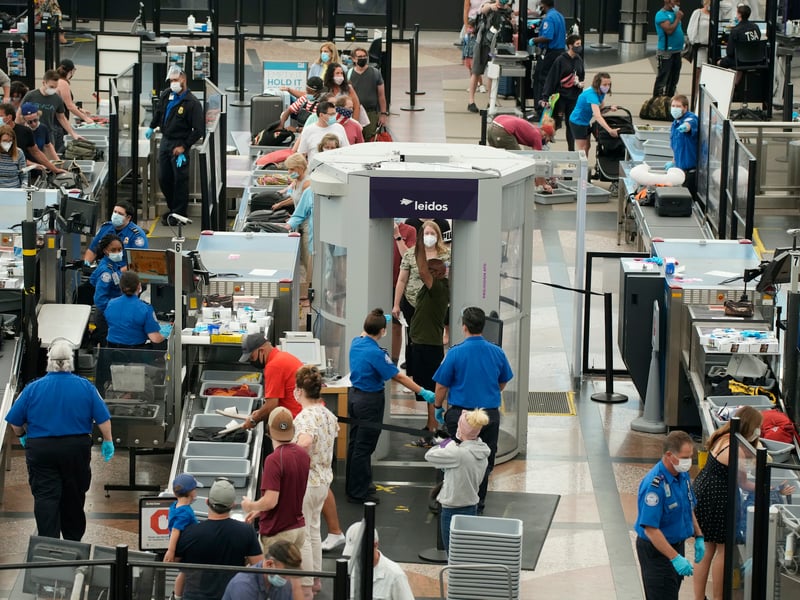
George W. Bush’s presidential administration created the No Fly List shortly after 9/11. The controversial list — which has mistakenly included a number of celebrities, politicians and children as young as 18 months old — aims to keep suspected terrorists off U.S. aircraft by flagging them at airport security.
 Follow @Uebey
 Follow @uebey.bsky.social
Subscribe to our free newsletters
Our weekly newsletter Closing Arguments offers the latest about ongoing trials, major litigation and rulings in courthouses around the U.S. and the world, while the monthly Under the Lights dishes the legal dirt from Hollywood, sports, Big Tech and the arts.