
 Search Articles


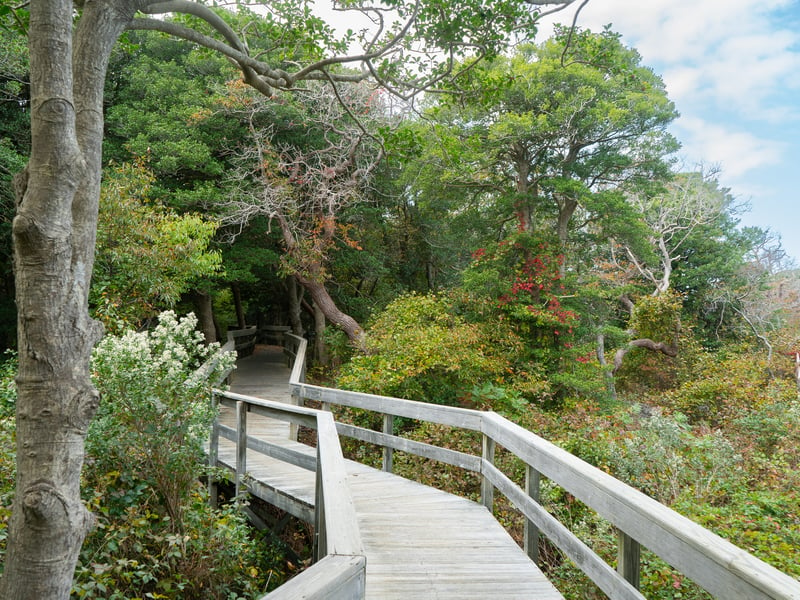
(CN) — The federal government got a green light from a Second Circuit panel to restrict deer populations at Sunken Forest on New York’s Fire Island.
In an opinion issued Friday, the panel ruled to allow the National Park Service to construct fencing in the reserve. The panel also approved both lethal and nonlethal methods to reduce the deer population.
Wildlife Preserves, a nonprofit conservation group, gave a large portion of the forest to the federal government with two deeds in the 1950s and ’60s. But there was a condition: The land had to be maintained in its natural state.
The government determined in 2016 that a heavy deer population was threatening flora and fauna throughout the Fire Island National Seashore, where the Sunken Forest is located. The preserve — 44 acres of old-growth maritime holly forest — is a “rare ecological community,” the Park Service says.
Wildlife Preserves sued that same year, after the government’s deer-culling plans were publicized.
While both the feds and the conservation group agree that the forest should be maintained as a nature preserve, they have competing visions for how to do so. The Park Service wants to use sharpshooting and other methods of “direct reduction” to reduce the deer numbers in the fenced zone to zero. Wildlife Preserves says hunting and trapping is prohibited under the deed, and it doesn’t want new fencing, either.
Leaving aside arguments about whether the complaint was time-barred, the panel simply concluded that a 2016 deer-culling plan does not violate deed restrictions.
The panel determined the sheer amount of deer in the forest does in fact threaten to adversely impact other plant and animal life in the preserve.
U.S. Circuit Judge Alison Nathan, a Joe Biden appointee, wrote the majority opinion.
“White-tailed deer are the ‘dominant herbivore in the Sunken Forest’ and are responsible for the depletion of ‘important canopy constituents,’ including American holly,” she wrote. She said Wildlife Preserves did not challenge the Park Service’s research and factual findings that deer are negatively impacting the ecological site.
The group said installing fencing would remove about 1.31 acres of vegetation and prevent deer from accessing land in violation of deed restrictions. But the group conceded that it didn’t consider another construction project — a 1.25-mile boardwalk built in the forest in the 1970s — to violate the deed.
In fact, the deed restrictions specifically allow for the culling of deer in certain circumstances, Nathan noted. She added that the government is not hunting or trapping deer for food, recreation or commercial purposes.
By interpreting the deed as they did, Nathan wrote, lawyers for Wildlife Preserves were left to argue that “even if, for example, an arboreal disease threatened to destroy the entire Sunken Forest … the government would be under no obligation to protect the primeval holly.”
“This cannot be,” she continued. She said the group’s interpretation “produces ‘absurd’ results.”
In a concurring opinion, Circuit Judge Matthew Park, a Donald Trump appointee, agreed the plan does not violate the deed restrictions but argued the case was not constitutionally ripe because the plan had not been implemented.
Circuit Judge Myrna Pérez, a Joe Biden appointee, dissented in part. She said the Park Service’s plan was ecologically sound but that the deed did not allow for the killing of deer.
Subscribe to our free newsletters
Our weekly newsletter Closing Arguments offers the latest about ongoing trials, major litigation and rulings in courthouses around the U.S. and the world, while the monthly Under the Lights dishes the legal dirt from Hollywood, sports, Big Tech and the arts.