
 Search Articles


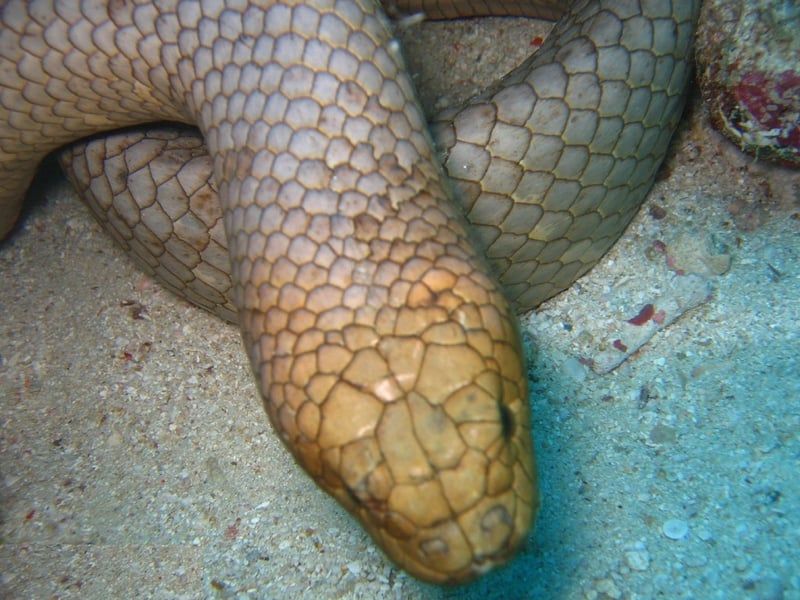
(CN) — New research suggests that scuba divers attacked by sea snakes might actually be unsuspecting recipients of a courtship attempt from a confused and annoyed male.
Attacks from rogue sea snakes — whose bite can often be highly toxic and even deadly to humans — have become an unavoidable reality for many scuba divers operating off tropical coral reefs. Reports often tell of sea snakes charging at underwater divers without provocation and seemingly out of the blue, with the snakes often attempting to bite or even wrap their coils around the divers’ limbs.
There is, however, a small problem with these unprovoked attacks: they don’t make much sense. Numerous studies have shown that snakes will often go out of their way to avoid conflict with humans and seem to prefer escape as their main method of survival when faced with larger threats.
“First, why would a free-ranging snake approach and bite a person that has not harassed it, is too large to be a prey item, and could readily be evaded in the complex three-dimensional world of a coral reef,” experts ask.
In an effort to help unravel this mystery, researchers from Australia’s Macquarie University looked at data from Olive sea snake encounters with humans and found that these attacks may not be attacks at all, but rather misdirected attempts at courtship.
In a study published Thursday in Scientific Reports, experts studied information gathered from over 100 interactions between Olive sea snakes and human scuba divers — including data from sea snake interactions with one of the study authors, Tim Lynch. Experts used this data to help them explore possible explanations for these nonsensical attacks and determined that confused courtship stands as the most likely candidate.
For one, experts say they noticed these encounters most often occurred during sea snake breeding season. While some sea snakes can breed year-round, many opt to breed in the cooler winter months and experts found it was during this time that sea snakes particularly the male ones — would suddenly approach a human diver.
On top of that, experts noticed that the male sea snakes usually approached a human target after they had experienced a sour mating-related event earlier. This was usually due to a run-in with a rival male snake or due to a male losing sight of a female they were attempting to court and give chase to.
Once the snake approached the humans, their behaviors also seemed to take a mating-centric turn. They were observed flicking their tongue towards the human’s body, would wrap themselves around diver’s scuba fin and, if a human tried to flee as female sea snakes are known to do during mating selection, would try to pursue them.
Researchers say that while encounters with female snakes were also possible, they happened far less frequently and happened most often whenever they were being chased by another male.
As for why so many male sea snakes are mistaking human divers for possible mates, experts believe it all comes down to shapes.
Previous research on sea snakes show that the creatures often have a hard time discerning different shapes underwater and scientists think this handicap is causing males to confuse humans for mates. Females, meanwhile, likely see humans as large potential hiding places that can be used to escape the gaze of unwanted suitors.
On top of shedding some interesting light on the courtship behaviors of sea snakes, experts say these findings should help future scuba divers deescalate any potential encounters with them. To start, experts say you should not attempt to flee or strike back at an approaching sea snake as this will likely only ramp up their confused behavior. Instead, researchers say a diver can reduce their chance of being bitten by simply staying still and allowing the sea snake to study you so that they might realize their error and turn their attention elsewhere.
Follow Carson McCullough on Twitter
 Follow @CarsonAndLloyd
Subscribe to our free newsletters
Our weekly newsletter Closing Arguments offers the latest about ongoing trials, major litigation and rulings in courthouses around the U.S. and the world, while the monthly Under the Lights dishes the legal dirt from Hollywood, sports, Big Tech and the arts.