
 Search Articles


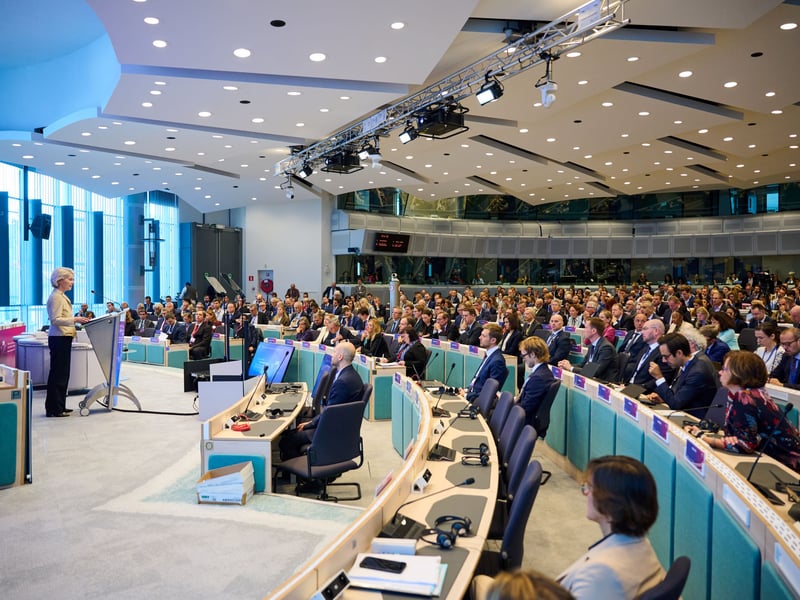
BRUSSELS (CN) — One year after a report warning Europe faced “slow agony” without major economic reforms, the continent has mobilized over 1 trillion euros ($1.18 trillion) for competitiveness — yet finds itself more vulnerable than ever to U.S. and Chinese pressure.
The paradox was on full display Tuesday at a Brussels conference marking the first anniversary of Mario Draghi’s landmark report: European leaders can write massive checks but struggle to make the structural changes that would matter most for long-term economic survival.
While European Commission President Ursula von der Leyen rattled off impressive statistics — 230 billion euros in private AI investment promises, record defense spending, 33 out of 65 major policy initiatives delivered — Draghi painted a darker picture of a continent that’s “in a harder place” than when he first sounded the alarm.
In September 2024, Draghi — former European Central Bank president and Italian prime minister — delivered a stark warning to the EU executive: Europe must invest roughly $850 billion annually to compete with the United States and China or face irrelevance. The 400-page report demanded massive investments in technology, energy and defense — plus deeper economic integration among EU nations — to prevent what Draghi calls the continent’s “slow agony” of economic decline.
“Over the past year, each of these challenges has grown worse,” said Draghi on Tuesday. China’s trade surplus with Europe has jumped almost 20% since December, while Europe was forced to accept a trade deal “largely on American terms” because it depends heavily on U.S. military protection.
The money problem has mushroomed. Europe’s central bank now estimates the continent needs nearly 1.2 trillion euros annually through 2031 — up from the 750-800 billion euros Draghi originally recommended, with defense spending alone pushing government investment needs from 24% to 43% of the total.
“Without this new spending, EU public debt is set to rise 10 percentage points over the next decade, reaching 93% of GDP,” Draghi warned. European governments are running out of borrowing room just as threats mount.
The disconnect between Europe’s financial firepower and its political constraints explains why massive spending hasn’t solved underlying weaknesses. Von der Leyen’s 1 trillion figure includes a mix of actual spending, government commitments and private sector proposals rather than money in the bank. Much of the 200 billion euros “mobilized” for AI data centers, for instance, represents proposed investments and government promises rather than cash actually deployed.
Brussels’ approach has been described as “Draghi on a shoestring” — adopting his ambitious goals while avoiding the most expensive and politically difficult parts. Rather than Draghi’s preferred centralized EU funding, the commission is pushing “flexible” state aid rules that essentially let richer member states subsidize their own companies more easily.
The real barriers aren’t fiscal but institutional. France and Germany — traditionally Europe’s driving force — “have been caught up in their own domestic politics and have not provided the type of leadership necessary to really take a big leap forward,” said Rebecca Christie, a senior fellow at the Brussels-based Bruegel think tank.
This leadership vacuum leaves Europe stuck on fundamental reforms that money alone can’t fix. “We’re moving in the right direction but it’s nowhere near the extent and the pace that is needed,” said Philipp Lausberg, senior policy analyst at the European Policy Centre.
Brussels has rolled out initiatives including simplification packages and competitiveness strategies, “but they have not become law yet,” Lausberg noted. “All of that takes a lot of time. So we have this lack of speed in the EU.”
The Trump administration’s return has made Draghi’s warnings about reducing dependencies even more pressing. “Unless this gap narrows, the transition to a high-tech economy will stall,” Draghi said. Electricity demand by European data centers will rise 70% by 2030, with power already eating up 40% of operating costs.
European officials have thrown money at energy relief but avoided the hard political choices needed for structural change. The continent still lacks integrated energy markets, with von der Leyen citing International Monetary Fund research showing internal barriers between European countries acting like a 45% tax on goods and 110% tax on services.
“It should not be easier to find fortune across an ocean than across European borders,” von der Leyen said.
The pattern repeats across policy areas. Europe can mobilize billions for defense but struggles with joint procurement that would reduce costs. It can fund AI research but can’t streamline data protection rules that make European companies 20% less competitive than American rivals in handling information.
Draghi bluntly criticized this institutional paralysis. “Too often, excuses are made for our slowness,” he said. “Sometimes inertia is even presented as respect for the rule of law. I think that’s complacency.”
Draghi’s most striking recommendation captured this dilemma: Europe “must act less like a confederation and more like a federation” in key areas — essentially becoming more like the United States as a single economic unit. But he admitted such changes “will take time, time we may not have.”
“For Europe’s survival, we must do what has not been done before and refuse to be held back by self-imposed limits,” he said.
But the rule of law raises questions about democratic governance across the bloc. The lengthy EU decision-making process, while frustrating, reflects the reality of governing 27 sovereign democracies with different legal systems, economic priorities and political cultures.
His proposed solutions highlight the political constraints. His call for a “28th regime” — allowing companies to operate under EU-wide rules instead of navigating 27 different national systems — appeals to businesses but “risks alienating the same member states whose buy-in will be essential for anything big to get done,” Christie said.
“Where a 28th regime gets into trouble is when it attempts to ‘solve’ issues of national labor laws, tax structures and other regulations that are core parts of national economies,” she explained. Countries that spent decades developing their own systems won’t easily surrender sovereignty to Brussels bureaucrats.
The political reality forces European leaders into what Christie calls treating Draghi’s recommendations as “a menu of issues that need attention” rather than “a checklist of action items.” They cherry-pick easier initiatives while avoiding reforms that would threaten national prerogatives.
This explains why Europe can mobilize unprecedented resources yet remain dependent on others for security and vulnerable to economic pressure. The continent’s ability to spend money has outpaced its willingness to integrate politically — leaving it rich in resources but poor in strategic coherence.
Despite a year of mounting challenges and massive mobilization, the fundamental tension remains. European leaders know what needs doing but can’t summon the political will to do it.
Christie noted the bind: “The EU is stuck about how to rein in public debt, increase defense spending and jumpstart investment all at the same time.” Navigating domestic political pressures also make bold moves risky for national leaders.
The result is a continent that can marshal enormous resources but struggles to deploy them effectively, leaving Europe more financially committed but not necessarily more competitive than when Draghi first issued his warning a year ago.
Courthouse News correspondent Yuval Molina is based in Brussels, Belgium.
Subscribe to our free newsletters
Our weekly newsletter Closing Arguments offers the latest about ongoing trials, major litigation and rulings in courthouses around the U.S. and the world, while the monthly Under the Lights dishes the legal dirt from Hollywood, sports, Big Tech and the arts.