
 Search Articles


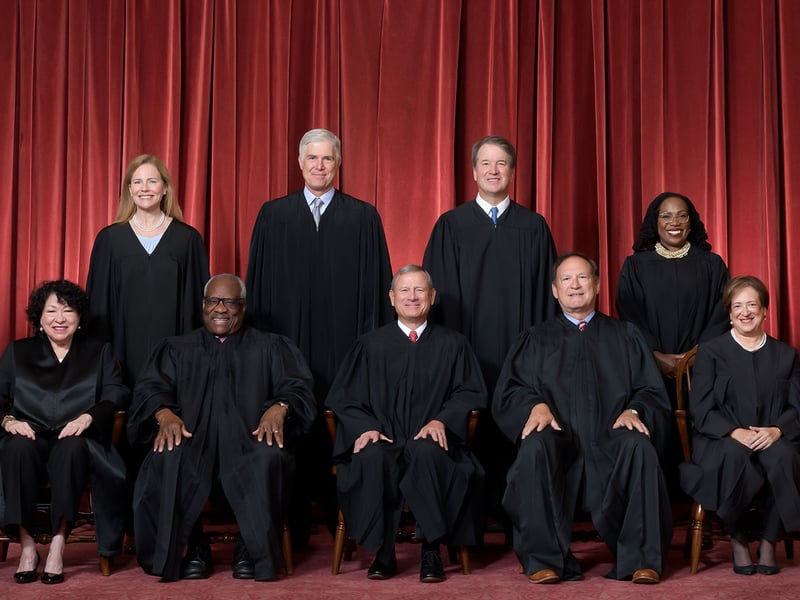
WASHINGTON (CN) — The Supreme Court is increasingly working as a fixer for President Donald Trump, clearing away lower court losses holding up the administration’s policies.
District court judges ruled against the administration 94.3% of the time between May and June, according to data collected by Adam Bonica, a professor of political science at Stanford University. The Supreme Court, however, sided with the administration in 93.7% of its cases.
Court watchers see not only a trend of favoring the Trump administration but also the justices’ authority, at the cost of fact-bound findings from lower court judges and potentially judicial authority writ large.
“This is six lawyers in Washington trying to manage the entire federal judiciary in a way that is just puzzling, dangerous and unprecedented,” Eric Segall, a federal courts and constitutional law professor at Georgia State University College of Law, said.
District courts in disarray
In six months, the administration has filed nearly two dozen emergency Supreme Court appeals, making the justices key players in partisan debates. While some view the rulings as a vindication of policy preferences, others see them as a threat to the rule of law.
Georgetown University law professor Steve Vladeck warns the Court is favoring the government and ignoring the usual caution applied to emergency appeals.
“I think that’s a big part of why it feels to so many of us like the court is siding with the Trump administration — even without saying yes, this is legal — because it’s not taking this very different reality we’re in today nearly as seriously as I think it ought to be,” Vladeck said.
Unlike lower court rulings, often grounded in case facts, the Supreme Court’s decisions have drawn concern for overlooking lower court judgments. Justice Ketanji Brown Jackson repeatedly voiced alarm this term about her colleagues’ disregard for lower court rulings in opinions throughout this term, including a lone dissent when the Court lifted a lower court block on Trump’s federal firing spree, calling it “hubristic and senseless.”
“From its lofty perch far from the facts or the evidence, this court lacks the capacity to fully evaluate, much less responsibly override, reasoned lower court factfinding about what this challenged executive action actually entails,” Jackson wrote.
In May, the court issued one of many unexplained orders allowing Trump to revoke the legal status of over half a million migrants from Cuba, Haiti, Nicaragua and Venezuela who are temporarily in the U.S. for humanitarian needs. Aaron Reichlin-Melnick, a senior fellow at the American Immigration Council, criticized the court for not considering the human impact of its decision without explanation.
“The Supreme Court allows the administration to go forward with mass stripping of legal status that it prevented in [Trump’s] first term, and yet offered no explanation whatsoever, which is particularly egregious given the number of similar cases that are still working their way through the system and are still being adjudicated, leaving the lower courts absolutely no guidance as to explain why these decisions were overturned,” Reichlin-Melnick said.
Unlike the court’s merits docket, emergency appeals happen mostly out of sight. Orders from the so-called shadow docket are issued based on expedited briefs, often arguing whether a policy can be enforced while litigation over its legality is ongoing.
“Given that there were six or seven different potential reasons why the Supreme Court could have ruled in the government’s favor, that leaves the administration with even more discretion to take away status and impact people in ways that are immediately felt,” Reichlin-Melnick said.
In a separate emergency appeal regarding third-country deportations, the justices were compelled to issue a follow-up opinion to address questions left unanswered by their initial ruling.
“Whether you are sympathetic to what the federal government is trying to do or not, the court not explaining itself seems like a huge problem,” Vladeck said.
Coded messages
While not always explicit, court watchers say these decisions still convey a message: executive and Supreme Court authority prevail; congressional and lower court authority is diminished. The conservative supermajority balked at lower court judges issuing nationwide injunctions, but the justices preserved their own power to issue widespread relief.
“You could have had a federal judge looking at what the Supreme Court [ruled], saying, well, there is no precedential value to this, but when the court has stepped in twice, it sends a message,” Reichlin-Melnick said “And that message is, it doesn’t really matter what you think the law says, we just don’t think you could do this no matter what.”
Leah Litman, a law professor at the University of Michigan Law School, said this put judges in a difficult position, impacting their decision making. Trump and other White House officials increasingly attack judges who rule against the administration.
Litman said the administration went further in the third-country deportation appeal that sent a group of migrants to South Sudan without considering whether they’d face violence, torture or death, clearly defying a lower court order. The justices didn’t reprimand the administration; instead, they gave in to its wishes.
“By removing the government of its continuing obligation to comply with a court order it had already defied, I think the Supreme Court pretty clearly signaled that the administration is going to face no penalty for defying lower court orders and invited more of their defiance with lower court orders,” Litman said.
Litman said. “[The court] suggested that the real problem here in our constitutional democracy is not the executive branch shipping people off to places that are on the brink of a civil war or where they are at risk of being trafficked or sold into slavery, but instead, lower court standing to try to prevent that by holding the administration to its legal obligations.”
We’re not in Kansas anymore
Georgetown law professor Frederick Lawrence says the Supreme Court’s rulings for Trump reflect the presumption of constitutionality, where government actions are assumed valid until proven otherwise. Unlike district courts, which rule after reviewing full case records, the justices are siding with the administration early on, based solely on legal issues at very early stages of litigation, raising questions about whether it’s time to rethink this long-held presumption.
“The question that this raises is, has the action of this administration — which is this flurry of activity, so many of which have been enjoined by district court, so many of which were invalid to be unconstitutional by district courts — does that call for a re-examination of that presumption?” Lawrence said.
Reichlin-Melnick said the lower courts are already operating under the new normal, and it’s the Supreme Court that’s playing catch up.
“[District courts] are actually looking at what the Trump administration is doing, and they are seeing the presumption of regularity is gone, broadly ignoring the courts, or in many circumstances, if not ignoring, simply turning a shoulder, a shoulder to and downplaying, or stonewalling,” Reichlin-Melnick said.
Absolute power
Legal experts speculate that many of Trump’s executive orders are unlawful on the merits — particularly new limits on birthright citizenship — but the justices’ rulings put those policies back into effect, often along ideological lines.
The court hasn’t yet endorsed Trump’s broad claims of executive power in the long term, Vladeck said, but in the short term, it is enabling nearly everything the administration is doing.
“I really do think that one way to understand executive power vis a vis the Supreme Court right now is that at least some members of the court may not see themselves as but they’re very much acting like Neville Chamberlain,” Vladeck said, referring to the former UK prime minister’s policy of appeasement toward Nazi Germany.
While elevating executive authority, the justices have also increased the Supreme Court’s power. Legal experts say the justices’ interference preliminary stages of litigation in the lower courts is unprecedented in American history.
“Gone are the days when the court served as a neutral arbiter of the law merely by calling balls and strikes,” Ben Olinsky, senior vice president of structural reform and governance at the Center for American Progress, said. “The majority is guided no longer by precedent or reason, but by political and ideological preference, remaking the country in its desired image, case by case.”
Legal experts say the justices are taking a significant gamble by elevating the Supreme Court’s authority at the expense of lower court judges.
“Maybe the justices can tell a plausible story to themselves that defying a district judge isn’t the same thing as defying the Supreme Court,” Vladeck said. “I got to say it’s the same commission from Article Three of the Constitution on both of those judges walls, and I don’t know what the constitutional principle is that says it’s OK for the president to not comply with an order of a district judge, but it’s not OK to not comply with an order of the Supreme Court.”
 Follow @KelseyReichmann
 Follow @kelseyreichmann.bsky.social
Subscribe to our free newsletters
Our weekly newsletter Closing Arguments offers the latest about ongoing trials, major litigation and rulings in courthouses around the U.S. and the world, while the monthly Under the Lights dishes the legal dirt from Hollywood, sports, Big Tech and the arts.