
 Search Articles


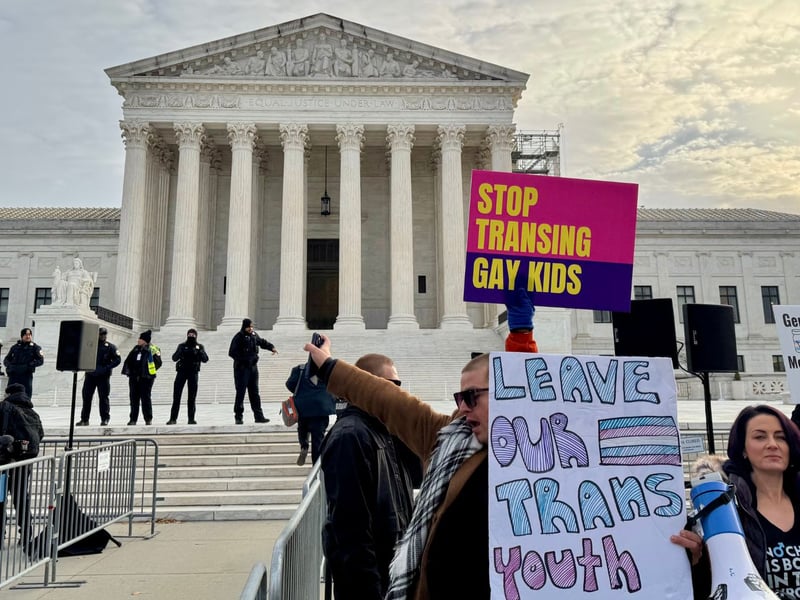
WASHINGTON (CN) — Transgender teens lost the first big Supreme Court battle on gender-affirming health care on Wednesday, finding that Tennessee’s ban on hormone blockers for minors was not subject to heightened scrutiny.
Splitting along ideological lines, the conservative majority said the court should not settle the fierce scientific and policy debates about transgender health care for minors. Chief Justice John Roberts, a George W. Bush appointee, concluded that the equal protection clause does not resolve those disagreements or give the justices a license to do so themselves.
“Our role is not ‘to judge the wisdom, fairness, or logic’ of the law before us, but only to ensure that it does not violate the equal protection guarantee of the 14th Amendment,” Roberts wrote for the majority. “Having concluded it does not, we leave questions regarding its policy to the people, their elected representatives, and the democratic process.”
The three liberal justices dissented.
“The court abandons transgender children and their families,” Justice Sonia Sotomayor said, reading her dissent from the bench. “In sadness, I dissent.”
In a lengthy statement, the Barack Obama appointee chastised her conservative colleagues, who were seated at her side, for doing “irreparable damage” to the equal protection clause and called the ruling indefensible and dangerous.
The Tennessee Legislature adopted Senate Bill 1 in 2023, prohibiting health care providers from prescribing, administering or dispensing any puberty blocker or hormone aimed at helping a minor identify with a gender that is inconsistent with the minor’s sex.
Three transgender minors, their families and a Memphis-based doctor claim that the ban is unconstitutional. The Biden administration intervened in their suit, viewing the case as a matter of public importance.
The Sixth Circuit reversed a lower court’s finding that Tennessee’s law was unconstitutional after applying a rational basis review, prompting the Biden administration to say a higher level of scrutiny was necessary.
When the Trump administration took over, however, the federal government notified the justices that its position had changed. Under Trump, the Justice Department said it wouldn’t have intervened in the suit, stating that Tennessee’s law was lawful.
President Donald Trump’s return to office has resulted in numerous attacks on transgender rights.
Trump issued executive orders rejecting the idea that people can transition to a gender that differs from their sex assigned at birth, banning transgender service members from the military and prohibiting federal funding of gender-affirming health care.
The White House described the court’s ruling as a victory for the Constitution, rule of law and common sense.
“Elected representatives have the right — and obligation — to protect children from falling victim to irreversible chemical and surgical mutilation. President Trump will continue to speak out and take action to protect innocent American children from these barbaric procedures that are based on junk science,” Liz Huston, an assistant press secretary for the administration, said in an email.
Major American medical associations say gender-affirming care is evidence-based and medically necessary for children suffering from gender dysphoria.
The central disagreement between the transgender teens and Tennessee was over how harshly courts should scrutinize the ban. Most laws are reviewed under rational basis review, the lowest level. Sex-based classifications — such as regulating the actions of only women or, in this case, transgender children — typically receive intermediate scrutiny, requiring the state to show that the classification serves an important government objective and that the discriminatory means employed further that goal.
Roberts said Tennessee’s ban did not meet any classifications to warrant heightened review. Instead of viewing the statute as a regulation based on transgender status, the conservative majority said that the law classified based on age and medical use.
“Neither of the above classifications turns on sex,” Roberts wrote. “Rather, SB1 prohibits health care providers from administering puberty blockers and hormones to minors for certain medical uses , regardless of a minor’s sex.”
Going one step further, the majority determined that Tennessee’s law should be upheld under rational basis review.
The court, however, declined to weigh in on whether transgender individuals should be considered a quasi-suspect class — a group of people, who, when discriminated against, receive intermediate scrutiny.
Although the six conservative justices agreed that Tennessee’s law should be upheld under rational basis review, the coalition split on how transgender individuals should be viewed under the law. Justices Clarence Thomas, Amy Coney Barrett and Samuel Alito would have gone further than the majority, holding that transgender status does not constitute a suspect class.
In a withering dissent, Sotomayor tore into the majority’s conclusions, stating that the ruling “contorts logic and precedent.” She said Tennessee’s law is explicitly sex-based discrimination because minors who are not transgender can receive the same care that their transgender peers cannot.
“The problem with the majority’s argument is that the very ‘medical purpose’ SB1 prohibits is defined by reference to the patient’s sex,” Sotomayor wrote. “Key to whether a minor may receive puberty blockers or hormones is whether the treatment facilitates the ‘medical purpose’ of helping the minor live or appear ‘inconsistent with’ the minor’s sex.”
Sotomayor explained that a more extensive review is necessary when the rights of a minority are involved because of the systematic barriers to vindicating their rights through the political process.
While the majority said it was not wading into the contentious debate over transgender rights, Sotomayor said deciding that Tennessee’s ban served an important government purpose. She would have sent the case back to the Sixth Circuit to decide that question.
Sotomayor said the majority refused to “call a spade a spade,” muddying a sex classification that is clear on the face of the statute. She claimed that the court acted to prevent another court from striking down Tennessee’s law or other similar health care bans.
“The court’s willingness to do so here does irrevocable damage to the equal protection clause and invites legislatures to engage in discrimination by hiding blatant sex classifications in plain sight,” Sotomayor wrote. “It also authorizes, without second thought, untold harm to transgender children and the parents and families who love them.”
Tennessee Attorney General Jonathan Skrmetti called the ruling a historic win for common sense over judicial activism.
“A bipartisan supermajority of Tennessee’s elected representatives carefully considered the evidence and voted to protect kids from irreversible decisions they cannot yet fully understand,” Skrmetti said in a statement. “I commend the Tennessee legislature and Governor Lee for their courage in passing this legislation and supporting our litigation despite withering opposition from the Biden administration, LGBT special interest groups, social justice activists, the American Medical Association, the American Bar Association, and even Hollywood.”
Chase Strangio, co-director of the ACLU’s LGBTQ & HIV Project, called the ruling a “devastating loss for transgender people, our families and everyone who cares about the Constitution.” Strangio, who represented the families in this case, was the first openly transgender attorney to argue before the Supreme Court.
Lambda Legal was also part of the legal team challenging the ban.
“This is a heartbreaking ruling, making it more difficult for transgender youth to escape the danger and trauma of being denied their ability to live and thrive,” Sasha Buchert, counsel and director of the Nonbinary and Transgender Rights Project at Lambda Legal, said in a statement.
Stangio and Buchert were resolved to continue the fight for transgender rights.
“Though this is a painful setback, it does not mean that transgender people and our allies are left with no options to defend our freedom, our health care, or our lives,” Strangio said in a statement. “The court left undisturbed Supreme Court and lower court precedent that other examples of discrimination against transgender people are unlawful.”
 Follow @KelseyReichmann
 Follow @kelseyreichmann.bsky.social
Subscribe to our free newsletters
Our weekly newsletter Closing Arguments offers the latest about ongoing trials, major litigation and rulings in courthouses around the U.S. and the world, while the monthly Under the Lights dishes the legal dirt from Hollywood, sports, Big Tech and the arts.