
 Search Articles


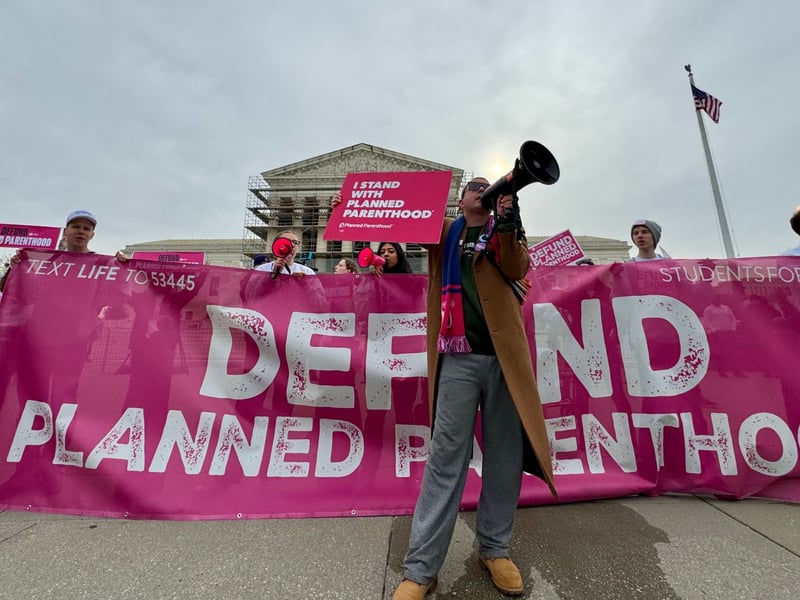
WASHINGTON (CN) — For nearly two hours on Wednesday, the Supreme Court considered whether South Carolina could undercut Medicaid funding for health care services at clinics that also provide abortions.
Given the state’s strict ban on the procedure, Planned Parenthood can only offer limited abortion services in South Carolina, however its clinics are still an essential resource for people with low incomes to access health care — until now. Even though Medicaid funding never covered abortion care, South Carolina halted all funding for clinics that provide the procedure, claiming that any support for the facilities indirectly contributed to abortions.
The state ran into a roadblock, however: A provision in the Medicaid Act requires state plans to let people choose their own doctors.
Julie Edwards, a 31-year-old South Carolinian, was denied this option when South Carolina revoked coverage at Planned Parenthood clinics. Whether Edwards could sue the state for violating the “free-choice-of-provider” provision was at the center of Wednesday’s argument session.
South Carolina argues that the provision conveyed a benefit, not a right — meaning Edwards doesn’t have standing for her lawsuit. She could sue only if a right to access had been explicitly granted by Congress, according to the state.
“It’s missing the connective tissue to the rights-creating language,” said John Bursch, an attorney with the Alliance Defending Freedom, a conservative Christian legal advocacy group, in support of South Carolina. “You need clear rights-creating language that the beneficiaries are subject to and that is directed to the regulated entity, here, a state. And all of that connective tissue is missing because there are no clearly rights-creating words in this statute.”
Justice Brett Kavanaugh and his conservative colleagues appeared to side with South Carolina. “Congress creates rights of actions and remedies, not the courts,” the Donald Trump appointee said.
Justice Elena Kagan, a Barack Obama appointee, said South Carolina wanted a “magic word” — like right, entitlement or privilege — that would decide whether a law could be enforced through individual lawsuits.
“I don’t even know how to say this without saying has a ‘right’ to choose their doctor,” she said. “That’s what this provision is. It’s impossible to even say the thing without using the word ‘right.’"
Congress enacted the free-choice-of-provider provision after states strictly limited Medicaid benefits. Justice Sonia Sotomayor, another Obama appointee, said it didn’t make sense that the states wouldn’t know they had to give people the freedom to choose their doctor when the provision was enacted to do just that.
Planned Parenthood said South Carolina disqualified its clinics not based on medical competency but instead on policy views. Nicole Saharskey, an attorney with Mayer Brown representing the clinic, said it wouldn’t be receiving any damages from its lawsuit; instead, it just wanted to provide care for its neediest clients.
“These aren’t people getting rich,” Saharskey said. “They’re just trying to get health care here.”
Edwards, who is mostly blind in one eye and has nerve damage to her feet, is a pharmacy college graduate who was sidelined from the workforce by complications from type 1 diabetes. Planned Parenthood’s South Atlantic Columbia location was one of her view options for health care after a hospital in her area shuttered.
While its clinics are best known for abortion services, Planned Parenthood provides a variety of services including cancer screenings, STD treatment and prenatal and postpartum services.
South Carolina is in the middle of a health care crisis. Almost all of the state’s residents live in primary care shortage areas. Women’s health care providers are especially hard to come by, with 14 state counties lacking even a single practicing OB-GYN. One-fifth of South Carolinians insured by Medicaid could see further cuts to access if Planned Parenthood clinics can’t participate in the state’s Medicaid program.
If the justices side with South Carolina, Planned Parenthood has worried that other states would take similar action. Advocacy groups said restricting health services based on political agendas would limit health care options for millions of Americans with lower incomes.
“States cannot disqualify Medicaid providers like Planned Parenthood because they disagree with the types of care they provide,” Jill Habig, Public Rights Project CEO and founder, said in a statement. “Illegally stripping away the right to choose your provider will have devastating impacts on patients and local health systems. Local government leaders are on the frontlines defending the health of their communities, and we’re proud to support them.”
 Follow @KelseyReichmann
 Follow @kelseyreichmann.bsky.social
Subscribe to our free newsletters
Our weekly newsletter Closing Arguments offers the latest about ongoing trials, major litigation and rulings in courthouses around the U.S. and the world, while the monthly Under the Lights dishes the legal dirt from Hollywood, sports, Big Tech and the arts.