
 Search Articles


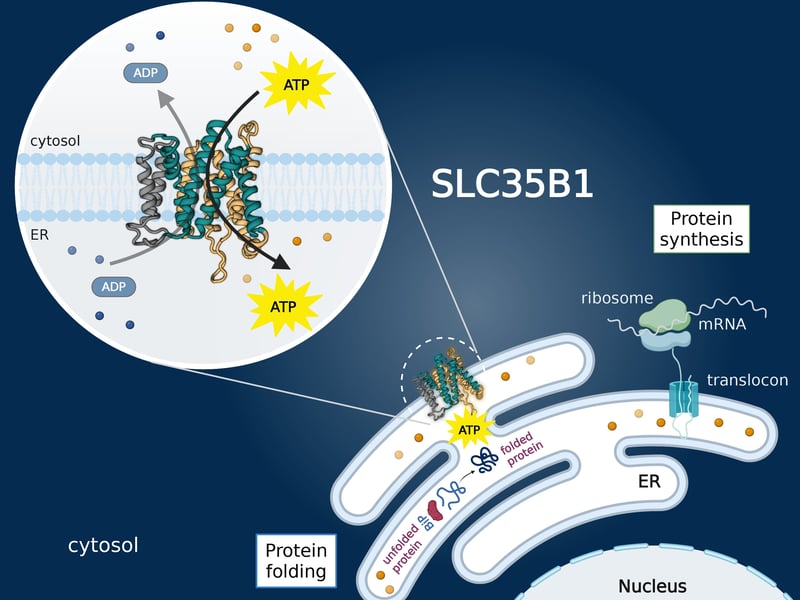
(CN) — In a breakthrough discovery driven by international collaboration, scientists have finally clarified how cells manage one of their most essential functions: energy processing.
The research sheds light on how cells use ATP — the molecule that powers nearly all cellular activity — and opens new doors for drug development targeting conditions such as cancer, Type 2 diabetes and neurodegenerative disorders.
In the study published Wednesday in the journal Nature, researchers confirm that ATP enters a cell’s endoplasmic reticulum using a transporter protein called SLC35B1 as the “key gateway.”
“Despite decades of research into ER function, the question of how ATP reaches the inside of the ER has been unclear. By confirming SLC35B1 as the transporter and resolving its structure with cryo-electron microscopy, we’ve not only answered a fundamental biological question, but also opened up new opportunities for therapeutic intervention,” said David Drew, Stockholm University Professor of Biochemistry and lead researcher of the study, in a statement.
The endoplasmic reticulum’s relationship with ATP is essential, as it processes proteins and lipids and performs like a “shipping port” for the cell. How ATP has accessed the endoplasmic reticulum, however, has long been debated amongst cell biologists due to conflicting prior studies.
SLC35B1 had previously been proposed as a possible transporter, but until now, the evidence had not been conclusive.
The research began in Austria at CeMM Research Center for Molecular Medicine of the Austrian Academy of Sciences, where the university’s Giulio Superti-Furga Lab took a new look at the SLC35B1 protein.
Using a large-scale CRISPR/Cas9 knockout screen — a complex gene-editing system — the team documented that the protein was consistently one of the “five most essential transporters” for cell growth.
Soon after, researchers at Kyoto Medical School in Japan, led by Associate Professor Norimichi Nomura, developed an antibody against SLC35B1. This innovation allowed scientists to increase the protein’s visibility and study its structure using cryo-electron microscopy — a critical step for further analysis.
Drew took the findings a final step further and used the SciLifeLab research center to capture high-resolution images of SLC35B1. His team was able to visualize the protein recognizing ATP and actively transporting it into the endoplasmic reticulum.
The discoveries have broader implications than originally believed. Disrupted energy transport in the endoplasmic reticulum is commonly observed in individuals with Type 2 diabetes, neurodegenerative diseases, and other disorders linked to cellular stress.
“Understanding how energy is delivered into the ER gives us powerful new ways to tackle a range of diseases that stem from ER dysfunction. Modulating SLC35B1 activity could become a new strategy for restoring ER balance in disease states.” Drew said.
Drew’s team is now microscopically screening for small molecules that affect the function of SLC35B1, aiming to further develop targeted therapies.
The researchers also identified critical amino acid residues within SLC35B1 that could serve as potential targets for new drugs designed to protect the endoplasmic reticulum from damage.
Now that scientists have access to a detailed molecular blueprint of the transporter, targeting SLC35B1 is no longer just theoretical — it’s a tangible path forward for therapeutic development.
Subscribe to our free newsletters
Our weekly newsletter Closing Arguments offers the latest about ongoing trials, major litigation and rulings in courthouses around the U.S. and the world, while the monthly Under the Lights dishes the legal dirt from Hollywood, sports, Big Tech and the arts.