
 Search Articles


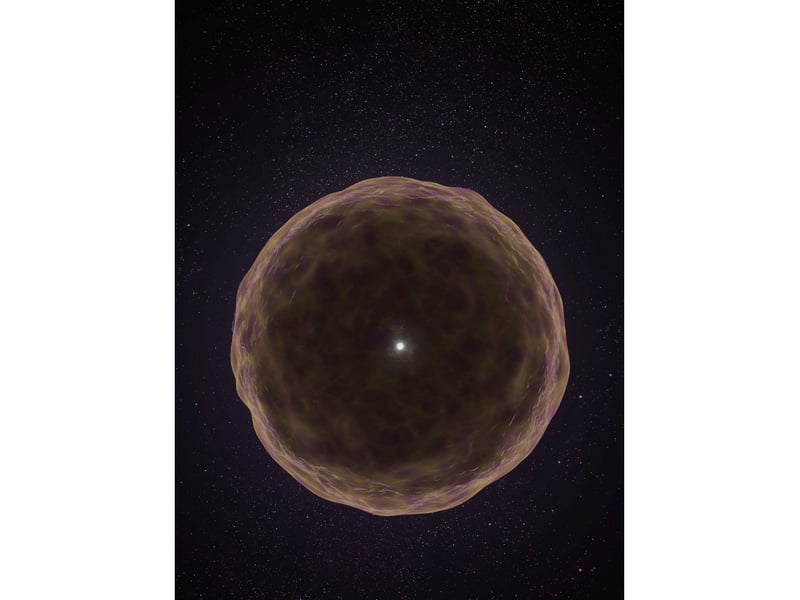
NEW YORK (AP) — Scientists for the first time have spotted the insides of a dying star as it exploded, offering a rare peek into stellar evolution.
Stars can live for millions to trillions of years until they run out of fuel. The most massive ones go out with a bang in an explosion called a supernova.
Using telescopes that peer deep into space, researchers have observed many such explosions. The cosmic outbursts tend to jumble up a dying star’s layers, making it hard for scientists to observe the inner structure.
But that wasn’t the case for the new discovery, a supernova called 2021yfj located in our Milky Way galaxy.
The collapsing star’s outermost layers of hydrogen and helium had peeled away long ago, which wasn’t surprising. But the star’s dense, innermost layers of silicon and sulfur had also shed during the explosion.
“We have never observed a star that was stripped to this amount,” said Northwestern University’s Steve Schulze, who was part of the discovery team that published the research Wednesday in the journal Nature.
The finding lends evidence to ideas scientists have about how large stars look near the end of their lives, organized into layers with lighter elements on the outside and heavier ones close to the core.
“Because so many of the layers had been stripped off this star, this basically confirmed what those layers were,” said Anya Nugent, who studies supernovas at the Harvard-Smithsonian Center for Astrophysics. She was not involved with the new research.
It’s not yet clear how this star got so whittled down — whether its layers were flung off violently in the final stages of its life or yanked away by a twin star. Future research may yield clues, though scientists acknowledged such an event may be tough to capture again.
By ADITHI RAMAKRISHNAN AP Science Writer
The Associated Press Health and Science Department receives support from the Howard Hughes Medical Institute’s Department of Science Education and the Robert Wood Johnson Foundation. The AP is solely responsible for all content.
Subscribe to our free newsletters
Our weekly newsletter Closing Arguments offers the latest about ongoing trials, major litigation and rulings in courthouses around the U.S. and the world, while the monthly Under the Lights dishes the legal dirt from Hollywood, sports, Big Tech and the arts.