
 Search Articles


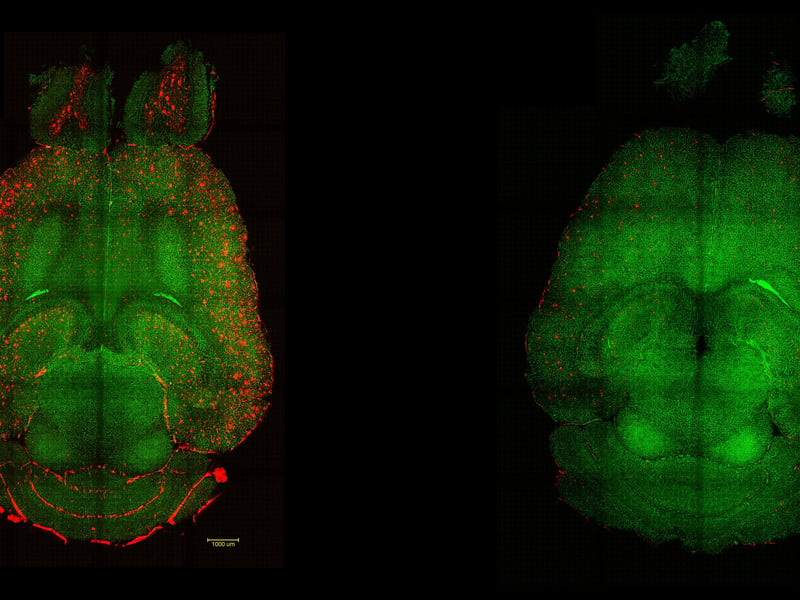
(CN) — Scientists in Spain and China have reversed Alzheimer’s disease in mice by repairing the brain’s protective barrier, demonstrating a new way to treat the disease through blood vessels rather than neurons.
The research, co-led by the Institute for Bioengineering of Catalonia and West China Hospital of Sichuan University, used nanoparticles that acted as drugs themselves rather than carriers for other medicines.
Published Monday in the journal Signal Transduction and Targeted Therapy, findings show that restoring the function of the brain’s blood-brain barrier, rather than targeting neurons directly, can help the brain clear out toxic proteins tied to Alzheimer’s.
The brain burns more energy than any other organ, using about 20% of the body’s supply in adults and up to 60% in children. That energy flows through an enormous network of roughly a billion capillaries, with each neuron linked to its own blood vessel.
Researchers say this tight connection between brain cells and blood supply underscores how important vascular health is, especially in diseases like Alzheimer’s, where damage to this barrier is closely linked to cognitive decline.
By fixing this barrier, researchers say they were able to restore the brain’s natural ability to clear those toxic molecules.
“The long-term effect comes from restoring the brain’s vasculature,” Giuseppe Battaglia, ICREA research professor at the Institute for Bioengineering of Catalonia and lead investigator of the study, said in a press release. “We think it works like a cascade: when toxic species such as amyloid-beta accumulate, disease progresses. But once the vasculature is able to function again, it starts clearing Aβ and other harmful molecules, allowing the whole system to recover its balance.”
To test the therapy, the team used genetically modified mice that produce large amounts of amyloid-beta, which is the sticky protein linked to Alzheimer’s disease, and causes symptoms that mimic human cognitive decline.
Mice received just three doses of the nanoparticles, and researchers tracked their progress over several months.
“Only one hour after the injection we observed a reduction of 50-60% in Aβ amount inside the brain,” Junyang Chen, first co-author of the study and researcher at West China Hospital of Sichuan University, said in the press release.
The treatment’s effects were striking. In one experiment, researchers treated a 12-month-old mouse — roughly equivalent to a 60-year-old human — and followed it for six months. By the end of that period, the mouse behaved like a healthy animal. “The animal … had recovered the behavior of a healthy mouse,” researchers said.
How the nanoparticles work
In a healthy brain, a protein called LRP1 acts as a transporter that helps clear amyloid-beta across the blood-brain barrier into the bloodstream. However, in Alzheimer’s, this system breaks down.
LRP1 either binds too tightly or too weakly to the toxic proteins, clogging the transport pathway and leaving more amyloid trapped in the brain.
The newly developed nanoparticles act as a molecular reset switch.
By mimicking the ligands that bind to LRP1, they reengage this clearance process, helping the brain’s natural waste-removal system start working again.
“Our study demonstrated remarkable efficacy in achieving rapid Aβ clearance, restoring healthy function in the blood–brain barrier and leading to a striking reversal of Alzheimer’s pathology,” Lorena Ruiz Perez, a researcher at the Institute for Bioengineering of Catalonia and Serra Hunter assistant professor at the University of Barcelona, said in the press release.
A new direction for Alzheimer’s treatment
Researchers say the results highlight the importance of brain vasculature — the network of blood vessels that keeps neurons alive and functioning.
The human brain, they note, contains about a billion capillaries that supply the energy needed to sustain thought and memory.
While the therapy has only been tested in mice, the team says the findings could open a new path for tackling Alzheimer’s and other neurodegenerative diseases by focusing on vascular health rather than directly on brain tissue.
Battaglia said the work marks a step toward a more holistic understanding of Alzheimer’s.
“What’s remarkable is that our nanoparticles act as a drug and seem to activate a feedback mechanism that brings this clearance pathway back to normal levels,” he said.
Subscribe to our free newsletters
Our weekly newsletter Closing Arguments offers the latest about ongoing trials, major litigation and rulings in courthouses around the U.S. and the world, while the monthly Under the Lights dishes the legal dirt from Hollywood, sports, Big Tech and the arts.