
 Search Articles


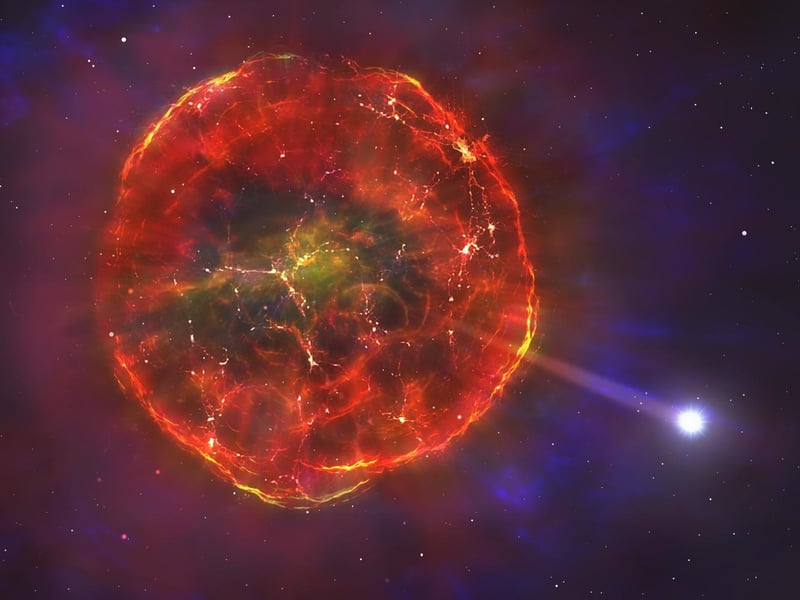
(CN) — Researchers have discovered evidence of a new kind of supernova that is caused by the merging of two massive stars.
Supernovae are explosions of giant stars that are estimated to happen in the universe as often as every 10 seconds. These explosions create huge reactions and are considered one of the original sources of elements that are heavier than iron in the universe.
While scientists have identified or theorized about several types of supernovae, one common type is referred to as a core collapse supernova. A core collapse supernova happens when a large star loses enough of its fuel that it cannot withstand its own gravity any longer. Once this happens, the star’s core collapses, which triggers a supernova explosion that leaves behind a neutron star or black hole.
Most massive stars are born in what is called a binary system where two stars orbit the same center of mass, and it has been theorized that if the two massive stars remain close and spiral towards each other, they could merge and cause a “merger-triggered” core collapse supernova.
This type of supernova has not been observed until now, as researchers have identified radio emissions that they believe are consistent with the theorized type of merger triggered supernova.
The researchers released their findings on Thursday in the journal Science and claim that using data from the Very Large Array Sky Survey or VLASS, they have uncovered evidence of this theorized but never observed type of supernova.
The survey uses antennas located in New Mexico from the Karl G. Jansky Very Large Array, to observe radio sources in deep space. Using this data, researchers found a radio source that is consistent with the prevailing theory on merging caused supernovas.
First author of the paper Dillon Dong, from the California Institute of Technology, thinks that these findings from he and his colleagues might help others find similar events in space.
“Yes, I think that people will be on the lookout for such events after our paper comes out. Hopefully it will inspire theoretical work that will refine what observers should be looking for, and observations (or filters on large data sets) that are designed to identify similar events,” Dong said.
The researchers searched for radio sources and followed up using radio and optical spectroscopy which showed that that one was consistent with that of an expanding supernova remnant.
In order to determine this, the researchers studied the radio source and found that the way it interacted with the nearby materials showed that this material was likely ejected from the star about a few hundred years before the explosion.
Taking this information and coupling it with a found unidentified x-ray emission suggests to the researchers that the explosion produced a jet of radiation and particles. This information taken in totality is consistent with previous forecasts and points to a merger-triggered supernova.
Gaining more insight into supernovae can help us understand the phenomena that helps create so many elements found in the galaxy.
“The universe is a mind bogglingly vast place, and on the scale of the universe, a supernova is pretty small. However, all scales in the universe are connected, and supernovae are one of the events that reach across many different scales,” Dong said. “On the smallest scales, the heavy elements that make up our planet, our bodies and our bones were all created in supernovae.”
The VLA Sky survey being done by the Very Large Array continues on its path to collect data from cosmic sources to help scientists and researchers image things like supernova explosions, gamma-ray bursts and the collision of neutron stars that are hidden from telescopes by thick clouds of dust.
Subscribe to our free newsletters
Our weekly newsletter Closing Arguments offers the latest about ongoing trials, major litigation and rulings in courthouses around the U.S. and the world, while the monthly Under the Lights dishes the legal dirt from Hollywood, sports, Big Tech and the arts.