
 Search Articles


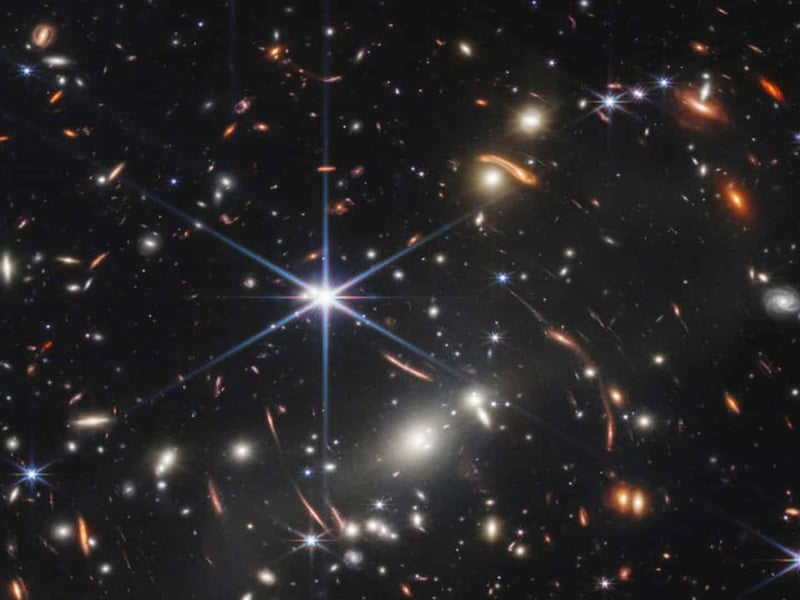
(CN) — Scientists utilizing the James Webb Space Telescope have detected carbon dust in galaxies dating to the first 600 million years of the universe, a paper published Wednesday in the journal Nature announced.
As elements heavier than hydrogen and helium are typically considered features of older galaxies, finding carbon in young galaxies formed less than a billion years after the Big Bang challenges theories of where the dust originated and how stars evolved in the early universe.
“In the early universe, heavier elements such as carbon are thought to have been scarce,” a press statement accompanying Wednesday’s study said. “By contrast, older galaxies such as the Milky Way are thought to host carbonaceous dust grains … owing to observations of a ‘bump’ in the absorption of specific ultraviolet frequencies of light.”
The team behind Wednesday’s article in Nature, led by postdoctoral research associate Joris Witstok of Cambridge University’s Kavli Institute for Cosmology, detected a similar “bump” of UV light absorption in galaxies over 13 billion light years away. This suggests these galaxies, which we see as they appeared near the start of cosmic time, likewise hosted significant amounts of carbon dust.
Main-sequence stars like our sun are powered by the continuous fusion of hydrogen, the lightest element, into helium, the second-lightest element. But as they age, they exhaust their supply of hydrogen and begin fusing helium into carbon. More massive stars with higher internal temperatures and pressures go even further, fusing carbon into oxygen, neon and other heavier elements, all the way up to iron and nickel.
These heavier elements — essential to the development of planets and eventually life — are released into the universe when the star dies. But it takes billions of years for a garden-variety star like the sun to reach that point, ruling out common star death as an explanation for the presence of carbon dust in such early galaxies. Instead, the article by Witstok and his team suggests, the dust may have been produced in part by a rarer type of stellar body known as a Wolf-Rayet star.
“[Wolf-Rayet stars] are very hot stars reaching the end of their lifetime. Having shedded their outer layers, they reveal a bare core where hydrogen and helium have been converted into heavier elements,” Witstok explained in an email. “Importantly, some of these have carbon-rich atmospheres and it has been shown carbonaceous dust is able to form in the ejected material. It could be that in the early universe, a larger fraction of stars are of this type.”
Witstok also identified the supernovae of giant stars — those with a mass at least ten times greater than the sun — as possible engines for dust production. Supermassive stars burn through their supply of hydrogen faster, giving them a lifetime measured in mere millions, not billions, of years. And unlike smaller stars, which simply shed their outer gaseous layers as they die, these giants explode violently in supernovae, expelling gas and dust clouds that can spread for light years through the surrounding space.
According to the article, it’s possible giant stars that lived fast and died young in the early universe spread some of the carbon dust the scientists observed.
“Indeed, dust production in [supernovae] ejecta has been regarded as a potential rapid channel for significant dust production in the early universe,” the scientists wrote.
Witstok also rejected the proposal that the universe, and therefore the early galaxies and carbon his team observed with the JWST, was simply older than previously thought. A work published in the Monthly Notices of the Royal Astronomical Society earlier this month proposed that the Big Bang actually occurred over 26 billion years ago, making the universe more than twice as old as a majority of scientists currently suspect. But Witstok criticized this hypothesis as out of step with the majority of available evidence.
He suggested instead that scientists simply have a lot to learn about the evolution of stars in the infant universe.
“I know there has been some discussion about the precise age of the universe in the media recently, but I’ll just say that there is very little reason to think it is any different than previously thought (there are multiple lines of evidence all agreeing well on our current best estimate of ~13.7 billion years),” Witstok said. “Our finding can be explained much more simply by the fact that we haven’t yet fully understood stellar evolution and subsequent dust production in the early universe.”
 Follow @djbyrnes1
Subscribe to our free newsletters
Our weekly newsletter Closing Arguments offers the latest about ongoing trials, major litigation and rulings in courthouses around the U.S. and the world, while the monthly Under the Lights dishes the legal dirt from Hollywood, sports, Big Tech and the arts.