
 Search Articles


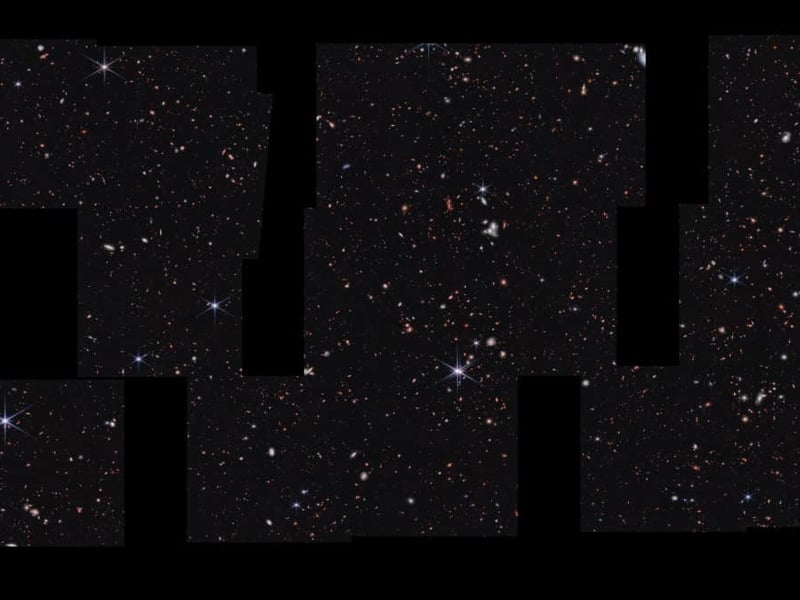
(CN) — NASA announced Thursday that scientists utilizing the James Webb Space Telescope had discovered the most distant — and ancient — supermassive black hole found to date. Lying at the center of a galaxy deemed CEERS 1019, it dates back some 13 billion years, only 570 million years after the Big Bang.
The scientists who discovered it were part of the Cosmic Evolution Early Release Science Survey, a research team led by astronomy professor Steven Finkelstein with the University of Texas at Austin. They conducted their observations with the James Webb Telescope between June and December 2022, with their initial results published in the science journal Astrophysical Journal Letters.
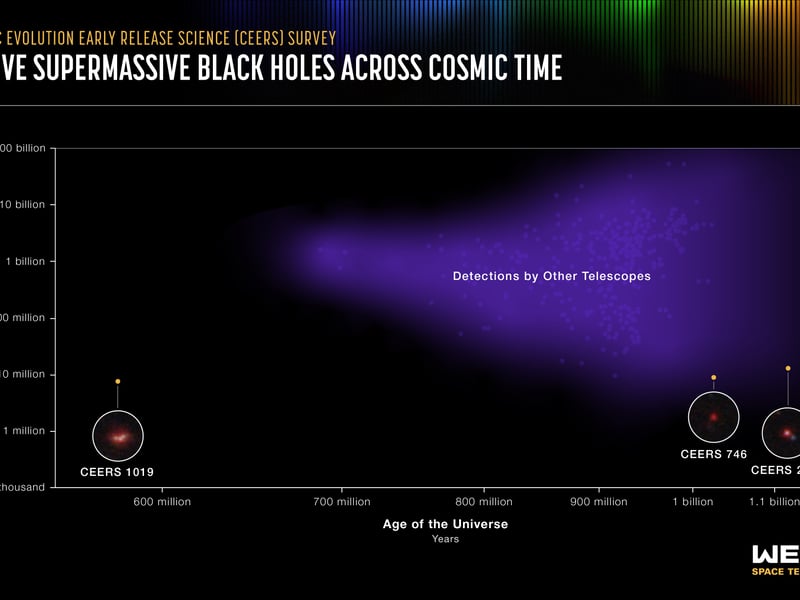
Besides its age, the supermassive black hole at the center of CEERS 1019 is notable for its small size. Supermassive black holes lie at the center of many galaxies, including our own, and those detected from the early universe can be billions of times more massive than the sun. Yet the one found in CEERS 1019 has only about 9 million solar masses. This makes it the lightest as well as the oldest supermassive black hole yet discovered from the universe’s first billion years, bearing more of a resemblance to the Milky Way’s own supermassive black hole Sagittarius A*, which is about 4.5 million times more massive than the sun, than it does to its near-contemporaries.
Rebecca Larson, the post-doctoral associate at the Rochester Institute of Technology who led the research into CEERS 1019’s discovery, said in a phone interview Thursday that there is still much more to learn from observing the similarities — and differences — between CEERS 1019 and supermassive black holes in our own galactic neighborhood.
“One data point is amazing but it’s just one data point. We still don’t know how rare [small supermassive black holes] were,” Larson said.
Larson also pointed out that how supermassive black holes with millions or billions of solar masses could grow so large, so fast, so soon after the universe’s birth is still not fully understood. But like black holes of any size, they grew at least in part by swallowing all matter and energy — including light, stars and even smaller black holes — that passes a gravitational boundary known as the event horizon. It’s the point around a black hole past which not even light can escape.
As matter falls into the supermassive black hole’s gaping maw, it speeds up and heats up, eventually forming an orbital accretion disk of debris so hot and bright that it can be seen across billions of light years. The most energetic of these “quasars,” as the accretion disks around galactic-core, supermassive black holes are sometimes known, can shine thousands of times brighter than the entire Milky Way. Some accretion disk matter moves so fast that it manages to slingshot away from the black hole before reaching the event horizon, forming jets of luminous gas and dust that can stretch for thousands of light years.
The black hole at the center of CEERS 1019 is not nearly so bright, and it took the James Webb Telescope’s infrared imaging devices for scientists to detect it. Larson said it only added to the object’s intrigue.
“What’s interesting about this black hole is that it’s not the brightest thing in its galaxy,” Larson said. “You know, these quasars… they can outshine their whole galaxy. But the black hole at the center of [CEERS 1019] is just starting to peek above that hydrogen emission [of star formation].”
The CEERS 1019 galaxy itself appeared to scientists not as a typical spiral or spheroid shape, but as three dispersed clumps of material. This led researcher Jeyhan Kartaltepe, also of the Rochester Institute of Technology, to hypothesize that the scientists were not observing a single galaxy but an ongoing collision between two or more galaxies. A chaotic galactic merger might drive increased star formation in CEERS 1019, as well as help fuel the growth of a supermassive black hole — even a small one — so early in the universe’s life.
“We’re not used to seeing so much structure in images at these distances,” Kartaltepe said in a prepared statement. “A galaxy merger could be partly responsible for fueling the activity in this galaxy’s black hole, and that could also lead to increased star formation.”
Besides the supermassive black hole in CEERS 1019, the study results announced Thursday also included the discovery of two other supermassive black holes dating to between 1.1 and 1 billion years after the Big Bang. They were found at the center of galaxies dubbed CEERS 2782 and CEERS 746, and as with CEERS 1019 both are relatively small — a mere 10 million solar masses each.
Their discovery has raised the idea that many more “small” supermassive black holes exist in the early universe, perhaps serving as a “missing link” in the evolution of truly gargantuan, billion+ solar mass black holes. Further analysis of these tiny giants could help scientists re-evaluate our understanding of galaxy formation, supermassive black hole formation and the relationship between the two processes.
“Until now, research about objects in the early universe was largely theoretical,” Finkelstein said in a statement. “With Webb, not only can we see black holes and galaxies at extreme distances, we can now start to accurately measure them.”
 Follow @djbyrnes1
Subscribe to our free newsletters
Our weekly newsletter Closing Arguments offers the latest about ongoing trials, major litigation and rulings in courthouses around the U.S. and the world, while the monthly Under the Lights dishes the legal dirt from Hollywood, sports, Big Tech and the arts.