
 Search Articles


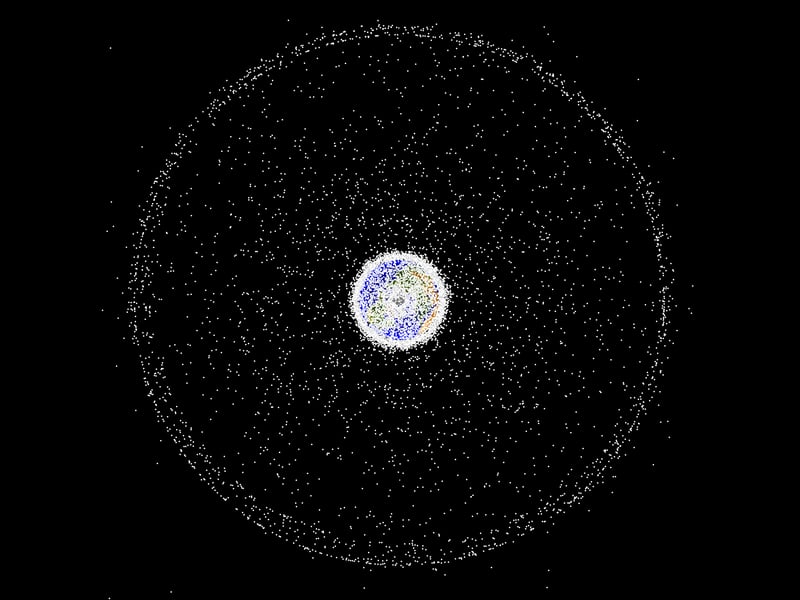
(CN) — The odds seem astronomical: An astronomer who studies satellites and space debris comes face-to-face with the remnants of a spacecraft that fell near her home in Saskatchewan, Canada.
But as the number of satellites and the amount of debris in orbit keep growing, incidents like this are expected to rise exponentially.
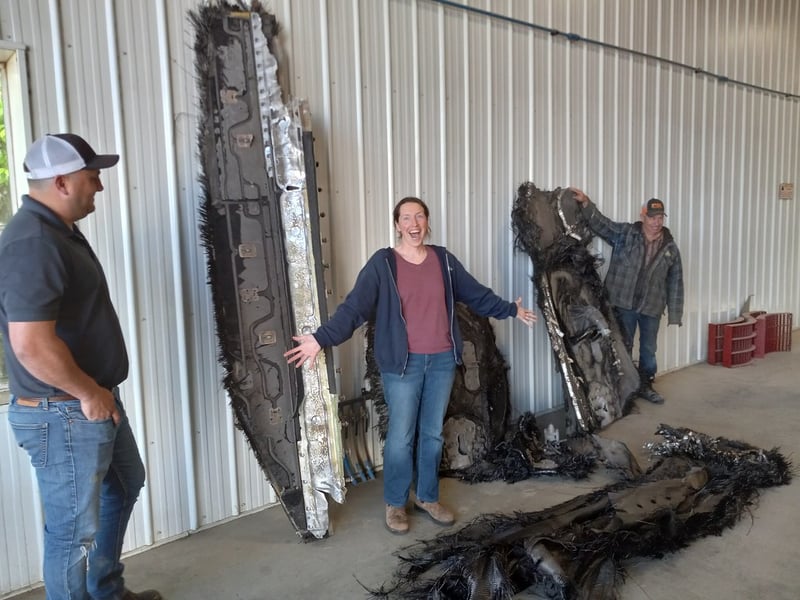
Samantha Lawler, associate professor of astronomy at the University of Regina, Saskatchewan, was both in shock and ecstatic when her neighbor found part of the Crew Dragon, a spacecraft launched by Elon Musk’s company SpaceX.
Lawler looks tiny in a photo of her next to the space junk; some of the pieces found are at least twice her size. SpaceX employees had to come with a U-Haul to retrieve them.
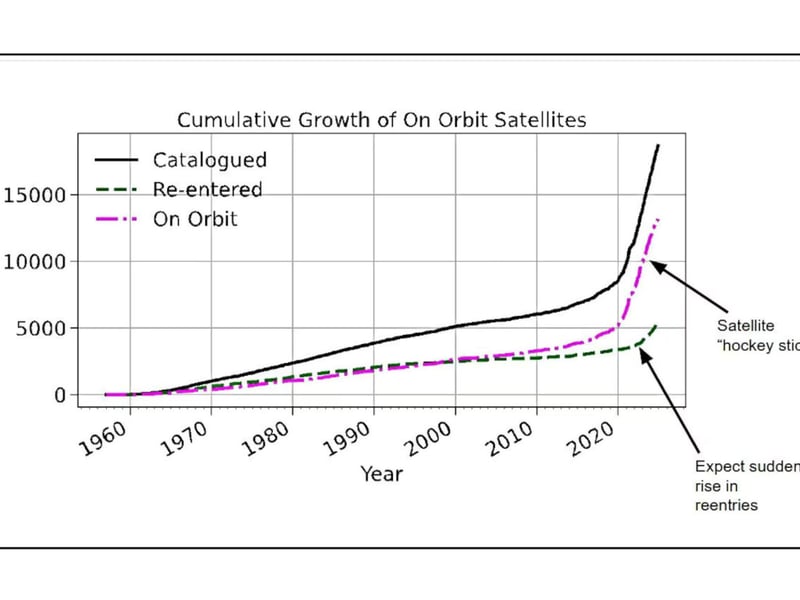
SpaceX, which dominates low Earth orbit, a layer just beyond the atmosphere, is at the forefront of the expansion into space: Of the roughly 14,000 satellites in orbit, about 9,000 are part of Starlink, Lawler said.
Last year, a piece of NASA flight support equipment crashed through the roof of a house in Naples, Florida. No one was hurt, but the family sued NASA seeking $80,000 for damage to their home and emotional distress.
Lawler said despite those high-profile incidents, it is extremely rare for debris to fall to Earth, since most objects burn up before they enter the lower portion of the atmosphere.
“Anybody that I talked to will never be hit by space junk. It’s just such a low probability,” Lawler said.
Kessler Syndrome
But experts warn that with ever more satellites, the risks from space debris will rise.
Aaron Boley, associate professor of physics and astronomy at the University of British Columbia in Vancouver, said we are in the early stages of what is called the Kessler Syndrome, where the amount of debris in orbit grows rapidly. As obsolete satellites or pieces of spacecraft bang into one another, they make exponentially more pieces of junk.
“If I take an object and break it apart, I increase its surface area and what’s called the collision cross section,” Boley said. “In other words, I’m raising the chances of new collisions. You’re constantly creating more pieces that can hit other objects.”
The Kessler Syndrome, theorized by NASA scientists Donald J. Kessler and Burton G. Cour-Palais in the 1970s, can take hundreds of years, Boley said, but once it reaches a certain point, the growth of debris is exponential.
In the worst-case scenario, humans would be trapped on Earth by space junk, Lawler said.
“We can’t launch satellites to higher orbits. We can’t go to other planets. We’re stuck here until that clears out,” she said.
Boley said air travel is already disrupted when authorities temporarily close air space because of the small but increasing risk of planes colliding with debris.
“There is roughly a 25% chance each year that there will be a reentry that covers or goes over airspace as busy as the airspace around Vancouver and Seattle,” he said.
Atmospheric pollution caused by orbital debris also concerns Lawler.
Most satellites are designed to last five years before burning up completely. As they reenter the atmosphere, friction vaporizes their structure and transforms it into metal vapor, including highly reactive aluminum and lithium. The concentration of that vapor could rise significantly and change the composition of the atmosphere, Lawler said.
“This could deplete ozone. This could cause temperature changes in the upper atmosphere. And other consequences that we don’t know yet,” she said.
Researchers found that in 2023 about 10% of stratospheric aerosol particles were made up of aluminum and other metals released by satellites and rocket stages during reentry. SpaceX plans about 42,000 satellites, which Lawler estimates will exceed the natural rate of such particles by at least 25 times.
Lawler worries about light pollution. She first caught the “satellite bug” when their growing presence in the sky started interfering with her observations of the Kuiper Belt.
She said that soon satellites will be one out of 15 points in the sky, making observational astronomy difficult. With long-exposure images such as ones taken by telescopes, satellites look like bright streaks, which can obscure or corrupt data. Satellites have already disturbed images from the Hubble Space Telescope.
New normal
In the future, the sky will look different — just as today’s sky differs from what our grandparents once knew. This is precisely what preoccupied Montreal filmmaker Julien Elie in his new documentary “Shifting Baselines,” which exploresthe dramatic changes in the small town of Boca Chica, Texas, after Musk chose it as the site for Starbase, the main launch and recovery facility for his Starship vehicle.
On one hand, the small town of Boca Chica draws hundreds of space fanatics who wait for months to witness a Starship launch; on the other, residents and scientists worry about the consequences of this rapid, poorly regulated conquest of space.
One hot summer night in Quebec, Elie was stupefied by the number of satellites he saw and disturbed by the light pollution they caused. The seed for his black-and-white film, punctuated by eerie music that almost gives it a science-fiction feel, was born.
“I’ve always had a deep concern for what vanishes, for everything we destroy,” he said. “It’s the law of the strongest. There’s nothing regulating space, so people can more or less do whatever they want. It’s a bit of a wild west out there,” Elie said.
The documentary’s title echoes French marine biologist Daniel Pauly’s concept of “shifting baseline syndrome,” in which each new generation accepts progressively degraded ecosystems as the new normal. This lowers society’s expectations over time and creates self-reinforcing feedback loops that accelerate degradation.

Space law
Two international treaties—the Outer Space Treaty and the Liability Convention — regulate space exploration, but they don’t have specific provisions about debris. When they were created in the ’60s and ’70s, space exploration was new and debris wasn’t a concern, said Andrea Harrington, co-director of the Institute of Air and Space Law at McGill University in Montreal, Quebec.
Harrington said some provisions could be interpreted to target pollution. Article IX of the Outer Space Treaty requires states to act with “due regard” for the interests of other states when conducting space activities and to consult with them if an activity could potentially cause harmful interference with their space operations.
The same article addresses contamination — originally to prevent bacterial contamination of other celestial bodies, but Harrington said scholars wonder if it could be interpreted more broadly to include debris contamination.
Under the Liability Convention, launching states bear absolute liability, meaning they must compensate for any damage on Earth or to aircraft. The convention also requires countries to authorize and supervise national space activities, so a state can be held responsible for violations of the convention, even if the incident involves a private company like SpaceX, Harrington said.
So if space debris damages property, a person must go through their government, which can file a claim against the launching state. Harrington said the other route is to directly sue the private company in domestic courts, like the Florida family chose to do.
Towards sustainable space
International recommendations and guidelines dedicated to mitigating space debris are less binding than treaties, but they are easier to adapt to the fast-evolving realities of space exploration, Harrington said. States are also more willing to follow them because they are non-binding, and eventually, some of these guidelines are incorporated into domestic legislation.
Harrington cites the example of the European Space Agency, an international organization that is pioneering space debris mitigation through various guidelines and initiatives. The ESA is notably at the origin of the Zero Debris Charter, which aims to make all space activities debris-free by 2030.
More recently, the agency released the Space Environment Health Index, which measures how healthy or stressed Earth’s orbital environment is. The agency said Earth is at level 4, well beyond the sustainability threshold.
Boley, who has been working on a similar indicator to monitor the health of the Earth and space system, said it’s “a huge step in the right direction.”
“In order to really address the problem, we need an international understanding and international guidelines, best practices, and maybe a new treaty,” said the professor, who co-directs the Outer Space Institute, an international network of researchers dedicated to addressing challenges facing space exploration.
Solutions to space debris mitigation should be a combination of public and private efforts, he added.
“Some companies do want a greener space environment so they can operate,” Boley points out.
Private companies, such as the Swiss firm ClearSpace and the Japanese company Astroscale, are already offering services to capture “dead” satellites and spacecraft.
But Boley said capturing space junk is a challenge, especially with larger pieces — the most important to remove since a collision with another object could generate a cascade of debris.
“If you’ve got something as big as a school bus tumbling wildly out of control, how do you safely dock with it and bring it down?” he asked.
Harrington also noted that capturing debris isn’t as simple as it seems, since other nations could misinterpret the act as hostile.
“Anything maneuverable in space could be used as a weapon,” she said.
Intellectual property rights over debris can further complicate cleanup efforts, Harrington adds.
Under Article VIII of the Outer Space Treaty, states retain jurisdiction and control over any object they launch, even after it becomes debris. This means no company or country can legally touch, move or capture another nation’s satellite or debris without consent, even if it’s inactive or abandoned.
According to Boley, solving the debris problem is less about technology and more about shifting perspectives.
He wants to take long-term sustainability guidelines and resource management principles and apply them to space.
For instance, companies have rapid development and planned obsolescence of their satellites, following the consumer electronics model used for smartphones and laptops.
“There is a lot of waste involved,” Boley said.
Instead, Boley suggested applying circular economy principles from sustainability research — for example, designing satellites to be repaired and refueled rather than contributing to a “graveyard orbit.”
“We need to rethink space as a finite resource,” he said.
We often view low Earth orbit as an “inexhaustible void.” Boley likens it instead to a limited environment that can become saturated and degraded, just like Earth.
“It is the same kind of misunderstanding that led to the plastics crisis in the oceans and the climate change crisis in the atmosphere. If you throw enough stuff away, even the largest environment will become overloaded and begin to break down,” he wrote.
Courthouse News reporter Daphné Dossios is based in Canada.
Subscribe to our free newsletters
Our weekly newsletter Closing Arguments offers the latest about ongoing trials, major litigation and rulings in courthouses around the U.S. and the world, while the monthly Under the Lights dishes the legal dirt from Hollywood, sports, Big Tech and the arts.