
 Search Articles


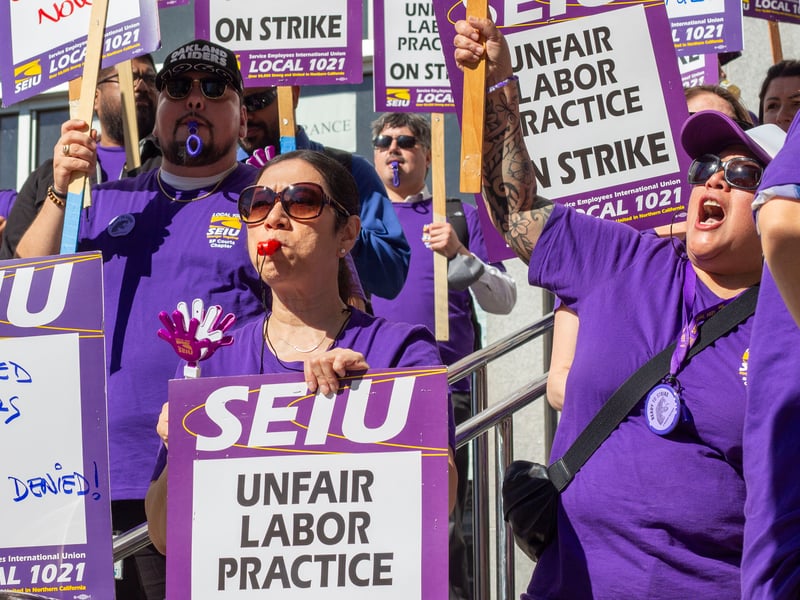
SAN FRANCISCO (CN) — San Francisco Superior Court clerks announced Friday evening they reached a tentative agreement with court management, ending a two-day strike that caused chaos in the courtrooms and delayed hearings across the city’s court system.
“We convened our chapter membership and reached consensus that it was the right thing to do for our families and the public to recommend this agreement for ratification and return to work on Monday morning,” Rob Borders, a courtroom clerk at the San Francisco Hall of Justice and union negotiator, said in a statement.
Union leaders say that management reopened communication with the negotiations team Thursday afternoon and made “important concessions” on cost-of-living adjustments and time off. They add that management made a “more serious commitment” to addressing staffing and training concerns through a “thorough, unit-by-unit” approach.
Additional details of the tentative agreement were not immediately available. The deal will have to be ratified by a majority of union members before it is adopted.
The clerks, represented by Service Employees International Union, Local 1021, have been protesting what they say is management’s failure to address staffing shortages and training deficiencies that have plagued the court since their last strike in October 2024.
In January 2025, the clerks reached a one-year agreement that included language to close loopholes that have allowed positions to remain vacant when clerks were promoted or temporarily moved into other positions. It also mandated that court management provide ongoing, quality training for all court employees and have training manuals in place by May 1.
However, union members said those promises were not kept and the clerks voted to authorize a second strike in October 2025, with similar demands made during the previous strike. That strike was called off following a last-minute agreement with court management, though union members later voted down the agreement by 62%, effectively authorizing another strike if a new deal was not made.
The union announced its intent to strike again on Feb. 23, accusing management of refusing to negotiate on the new measures proposed by the union. Clerks walked off the job Thursday and Friday, the first time San Francisco Superior Court clerks struck for more than one day, according to the union.
“We made it very clear to court management that the court can’t function without us,” Borders said. “We are very thankful to the public who supported us, including the numerous attorneys, other court workers, public officials, and legal experts who stood in solidarity with us and affirmed our importance to the justice system.”
The San Francisco Superior Court did not immediately respond to a request for comment.
At the picket line outside the Thomas J. Cahill Hall of Justice on Thursday, Borders and other union members said an unprecedented caseload had left the court dangerously understaffed, forcing clerks to work in courtrooms where they lacked adequate training. They also raised concerns that overworked clerks were more likely to make errors that could affect court proceedings.
“It’s really affecting us here at the Hall of Justice. The DA’s new position on filings has dramatically increased the caseload here, and the court has done very little to try to accommodate it, other than doubling up trials in the courtrooms and giving double the work to the clerks who are here,” Borders said.
The union has also filed multiple unfair labor practice complaints against court management, accusing San Francisco Superior Court CEO Brandon E. Riley of knowingly entering into the bargaining caucus room, as well as bad-faith bargaining.
“The court was not taking our proposals into consideration, and was just attempting to reject them without adequate attempts to negotiate over the issues that you were bringing to the table,” Carey Dall, lead negotiator for the union, said.
Riley said in a Feb. 24 press release that it was unfortunate that the union disrupted court services after reaching an agreement contract in October that “reflects the economic realities of state funding for the judicial branch.” He maintained that the court was negotiating in good faith.
“The court will continue to provide updates as necessary and remains committed to reaching a fair contract with its valued employees that reflects the current fiscal outlook imposed by ongoing reduced state funding," his office said in the statement.
 Follow @mhattridge_
Subscribe to our free newsletters
Our weekly newsletter Closing Arguments offers the latest about ongoing trials, major litigation and rulings in courthouses around the U.S. and the world, while the monthly Under the Lights dishes the legal dirt from Hollywood, sports, Big Tech and the arts.