
 Search Articles


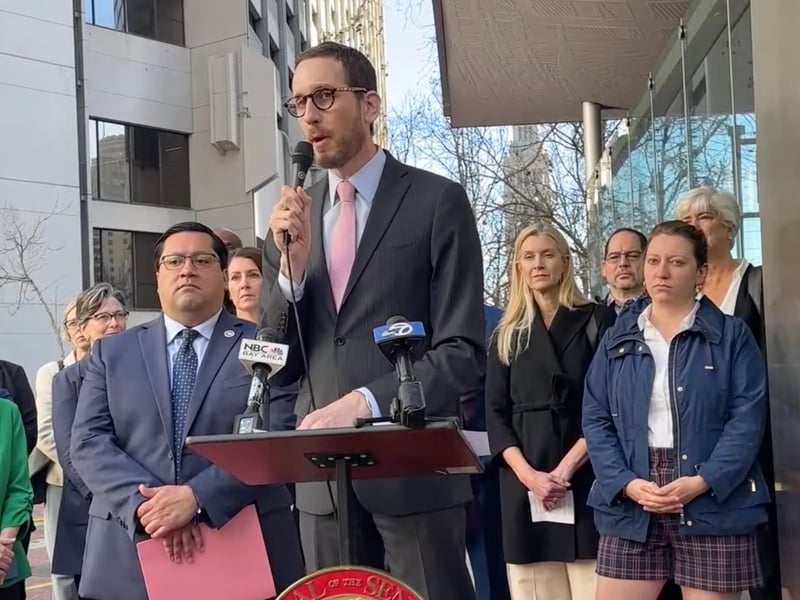
SAN FRANCISCO (CN) — Bay Area leaders on Tuesday praised passage of a bill they say will help clamp down on illegal street vending.
The legislation — Senate Bill 276 — gives the city and county of San Francisco power to write an ordinance requiring permits to sell items on public property. A key aspect of the bill is a list the government will make that includes common stolen items. Vendors selling items on that list must get the permit.
Governor Gavin Newsom signed the bill Monday afternoon. Effectively immediately, it will sunset on Jan. 1, 2031.
“This has been a two-year process,” said state Senator Scott Wiener, a San Francisco Democrat and the bill’s author, of the arduous legislative process. “We came back strong and got it done.”
Announcing the bill early this year, leaders emphasized the legislation wouldn’t apply to hot dog vendors and others selling prepared food. Wiener pointedly said he wasn’t targeting legitimate street vendors, praising what he called “the amazing, beautiful street vending” that occurs in The Mission.
The law specifically exempts food prepared on site, along with prepackaged food like chips or a nonalcoholic drink sold alongside prepared food.
It also contains limitations and requirements for the list and ordinance.
Any ordinance under the law must have written findings supported by evidence. It also must name a permitting entity, other than the police department, that will run this specific permit system. That agency must create rules for those permits. People who get them must show they obtained their own merchandise properly and not by theft or extortion.
A first violation of the ordinance would lead to a warning, while the second within 18 months of the first would be an infraction. A third violation within 18 months of the first could lead to a misdemeanor charge.
An ordinance passed under the law can stay in place for three years. However, the Board of Supervisors must reapprove it every year after seeing an annual report.
“Now, the work begins,” said San Francisco Mayor Daniel Lurie. “Together, we will keep moving forward.”
The city has long had an issue with illegal street vending, particularly in the Mission District and UN Plaza, and a rise in retail theft is a large reason for the bill.
San Francisco has experienced a large increase in such theft since 2014, with a 34% rise in commercial burglary and a 40% increase in shoplifting, authors of a bill analysis said.
The authors pointed to The Mission as a problem area. In November 2023, the city banned street vending within 300 feet of the Mission Street Corridor’s boundaries. They noted that illegal vending and the fencing of suspected stolen property happened on an almost daily basis.
After conditions on the streets improved, San Francisco leaders extended the ban in February 2024.
“San Francisco’s vibrant culture of street vending supports many families and showcases the diversity of our communities,” Wiener said in the analysis. “But that cultural richness is threatened when bad actors are allowed to openly sell stolen goods on our streets, often pushing out legitimate street vendors and undermining public safety.”
Wiener’s office also pointed to Newsom’s signature on another of the senator’s bills: Senate Bill 395. This law will allow San Francisco to create new liquor licenses.
Existing law caps the number of on-sale restaurant and bar liquor licenses to one for each 2,000 county residents. San Francisco hit its limit almost 80 years ago.
That limitation leads businesses to a secondary market, where license costs can climb to $200,000.
Senate Bill 395 allows the city to designate a retail district with at least 1 million square feet of retail shopping space. Up to 20 new general liquor licenses at a cost of $20,000 each could be issued to businesses within that area.
Subscribe to our free newsletters
Our weekly newsletter Closing Arguments offers the latest about ongoing trials, major litigation and rulings in courthouses around the U.S. and the world, while the monthly Under the Lights dishes the legal dirt from Hollywood, sports, Big Tech and the arts.