
 Search Articles


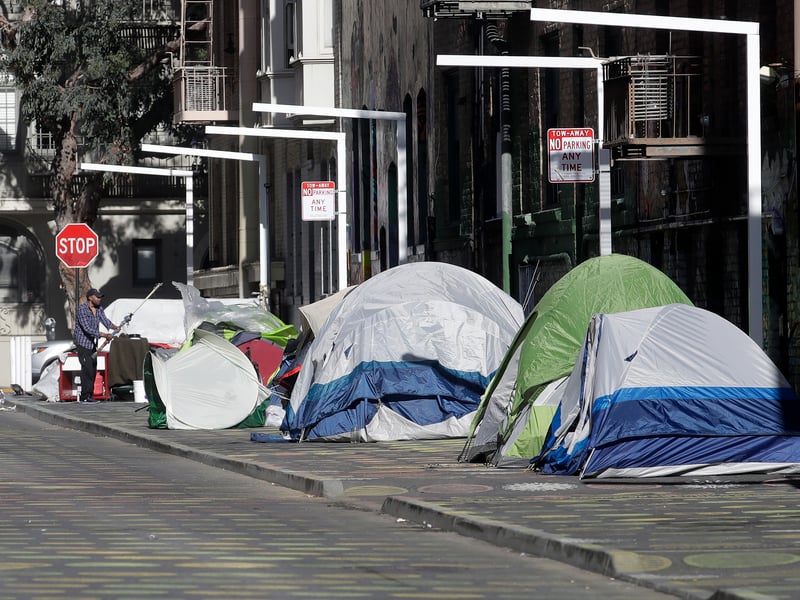
SAN FRANCISCO (CN) — After San Francisco officials lost a bid to modify a federal judge’s order restricting homeless encampment sweeps, the city now must wait for a Ninth Circuit panel to address other pieces of its appeal contesting that order.
The Ninth Circuit Court of Appeals denied without prejudice city officials’ attempt to lift or modify the federal injunction that limits how it can enforce “sit/lie” public sleeping laws that make it illegal to camp on public property.
San Francisco leaders contested U.S. Chief Magistrate Judge Donna Ryu’s ruling, issued last December, which prohibits officials from threatening to enforce the laws against involuntarily homeless individuals — meaning people who do not have access to shelter or permanent housing.
“The city’s motion to modify the preliminary injunction raises the sole issue of the definition of ‘involuntarily homeless,’” the appellate panel wrote in the one-page, unsigned order filed Tuesday night.
“Because the parties agree that a person is not involuntarily homeless if they have declined a specific offer of available shelter or otherwise have access to such shelter or the means to obtain it, and because the district court has denied the plaintiffs’ motion to enforce the injunction, the city’s motion to modify the preliminary injunction is denied without prejudice. The court will address all the other issues raised by the appeal in due course.”
The three-judge panel included U.S. Circuit Judge Patrick Bumatay, a Donald Trump appointee, and Biden-appointed U.S. Circuit Judges Lucy Koh and Roopali Desai.
Zal Shroff, one of the plaintiffs’ attorneys and acting legal director at Lawyers’ Committee for Civil Rights of the San Francisco Bay Area, called the decision a step closer to improving people’s shelter options, “[r]ather than using handcuffs to solve the city’s affordable housing crisis.”
“The Ninth Circuit’s ruling makes clear what the law has always been: San Francisco cannot punish people who lack access to specific and realistically available shelter,” Shroff said in a statement.
“The injunction is in place because San Francisco failed that test by citing, fining and arresting unhoused people who did not have a clear means to access shelter more than 3,000 times over the last several years. The city’s compliance with these requirements will need to be assessed by the district court, where the court has already ordered the city to identify the specific training it has conducted to ensure compliance with the injunction.”
Meanwhile a lawyer for the city took no issue with the panel’s ruling.
“We are pleased that the Ninth Circuit agreed with the city that the preliminary injunction does not apply to those who refuse shelter or those who have a shelter bed and choose to maintain a tent on the street," attorney David Chiu said in a statement to Courthouse News. “This action holds plaintiffs to their statements in court on what it means to be ‘involuntarily homeless.’ We look forward to the court’s decision on the other substantive issues raised in our appeal.”
San Francisco’s attorneys told the panel in August that the city filed the appeal to clarify the court’s definition of “involuntarily homeless,” claiming that Judge Ryu’s injunction is so vague that the city cannot enforce any ordinances regarding public resting on property.
The litigation centers on the city’s communications with people who are subject to enforcements of encampment sweeps, and the high demand for shelter space — an issue on which Ryu will soon rule.
More than 4,000 people may be sleeping on the street on a given night, while the city’s more than 3,000 shelter beds are usually at least 90% full and a shelter waitlist has grown to nearly 500 people.
San Francisco County’s Board of Supervisors decided this summer to increase the budget for the county’s Department of Homelessness and Supportive Housing by 3% to nearly $700 million, according to the San Francisco Chronicle.
Supervisor Dean Preston introduced a resolution Tuesday requesting that the department ramp up its efforts to house at least 500 people in vacant supportive units within the next 90 days, and provide a progress report within four months.
“10% of SF’s supportive housing portfolio sits vacant," Preston said in a statement. “We need to fill these units without further delay.”
 Follow @nhanson_reports
Subscribe to our free newsletters
Our weekly newsletter Closing Arguments offers the latest about ongoing trials, major litigation and rulings in courthouses around the U.S. and the world, while the monthly Under the Lights dishes the legal dirt from Hollywood, sports, Big Tech and the arts.