
 Search Articles


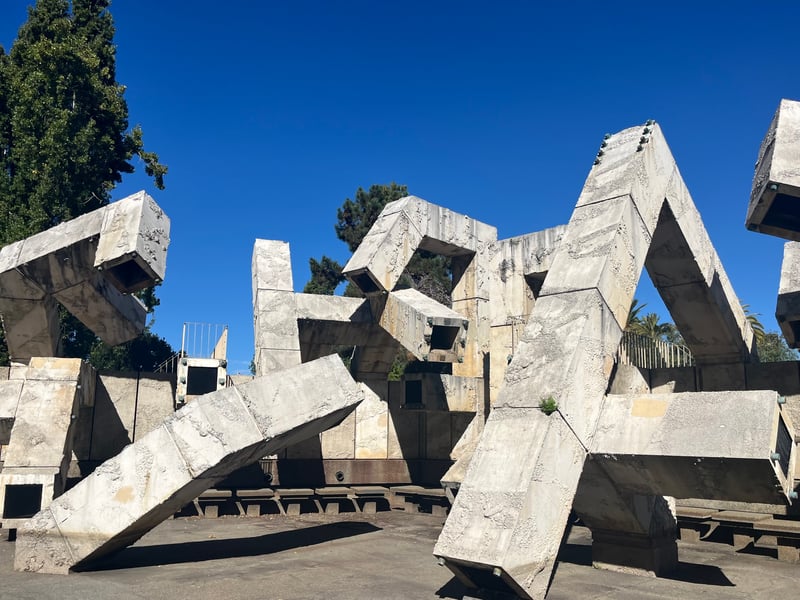
SAN FRANCISCO (CN) — The San Francisco Board of Supervisors Tuesday overwhelmingly shot down an appeal by art advocates to save Vaillancourt Fountain from being removed over concerns about its structural integrity.
The 10-1 vote, with District 9 Supervisor Jackie Fielder in opposition, affirms a plan passed by the San Francisco Arts Commission to disassemble the brutalist structure and store it at an off-site facility for further investigation into its structural integrity.
“Whether or not the Recreation and Parks Department in the past neglected the maintenance of the fountain, the fact is that right now, the fountain is not working and presents a hazard. Even though folks skate on it and do all kinds of things on it, it doesn’t mean it’s safe,” District 7 Supervisor Myrna Melgar said.
Vaillancourt Fountain has severely deteriorated in the decades since it was introduced in 1971. The structure’s sharply angled concrete water feature ran dry when the last functioning pump failed in May 2024, and the San Francisco Recreation and Parks Department, which manages Embarcadero Plaza, fenced off the fountain indefinitely in June.
In October, the city’s planning department determined that the fountain was an immediate safety risk and constituted an emergency project, exempting it from a full review under the California Environmental Quality Act (CEQA). The following month, the San Francisco Arts Commission voted 8-5 to approve a plan to remove the fountain.
“I love this space,” Janine Shiota, vice president of the city’s arts commission, who voted to approve the plan, said in November. “What kind of distressed me and alarmed me was the deaccession and the destruction. And I just thought that was scorched earth.”
“We don’t have the budget for the restoration,” she added.
The Recreation and Parks Department has estimated it would require $29 million to restore the fountain to its original form and function.
Advocates for the fountain appealed the commission’s removal decision to the Board of Supervisors, requesting a full public review process, normally required under CEQA, before a final decision on removal was made.
“The evidence shows no emergency, only that the fountain condition is a predictable result of the city’s own long-term deferred maintenance,” Jack McCarthy, a spokesperson for Docomomo US/Northern California, an organization that advocates for buildings of the modern movement, told the Board.
Susan Brandt-Hawley, an attorney who focuses on CEQA issues, said that the city was using the emergency exemption as a pretext to find a way to remove the fountain to make the planned renovation of Embarcadero Plaza less complex, adding that the issue of removal is “hand-in-hand with the city’s pre-commitment to the renovation project.”
The multi-million-dollar renovation was announced in 2024 and aims to turn the plaza into a 5-acre waterfront park. The project is a partnership between the city, real estate development company BXP and the Downtown SF Partnership.
During questioning by District 1 Supervisor Connie Chan over the cost of the removal, Stacy Bradley of Recreation and Parks said the $4.4 million price tag will be funded in part by BXP, a fact that Fielder emphasized for why she voted in opposition to her colleagues
“It doesn’t sit well; how much money is being put in from outside entities and whoever BXP is," she said. “It’s clear to me, it’s not just about the fountain. It seems like there is a lot of interest from a lot of powerful people downtown in this particular spot. I find it very interesting that when that’s the case, Rec and Parks can move mountains in order to get something done.”
On defense, the city’s planning department laid out the numerous structural deficiencies of the fountain to the Board, including partial structure failure, missing reinforced steel and noncompliance with current seismic and safety standards.
Kei Zushi, a senior environmental planner with the city’s planning department, said that if structural failure were to occur, such as one of the 10-ton concrete arms of the fountain were to fail, it could cause serious injury or loss of life.
“Based on the substantial evidence in the record, the planning department determined that the project qualified for an emergency statutory exemption under CEQA guidelines,” he said.
Eoanna Goodwin, a project manager with the Recreation and Parks Department, added that the deterioration of the fountain is ongoing because of the structure’s location and construction materials.
“Delaying action would allow deterioration to continue and would prolong exposure of the public to known hazards, including asbestos and lead paint used in the fountain’s construction," she said.
“Taken together, the documented structural failures, ongoing environmental degradation and repeated public intrusion constitute a sudden and escalating life safety emergency,” she added.
The fountain is slated for removal in mid-February, according to the Recreation and Parks Department. The disassembly process is expected to take around two months and the fountain’s pieces will be stored at a secure, off-site facility for up to three years.
In a statement to Courthouse News after the vote, McCarthy said that advocates for the fountain “remain invested in the future plans for the plaza” despite the Board’s vote.
“While the Board’s decision today means that we will need to evaluate further options related to the fountain, that does not change that we remain committed to engaging in any and all public processes around the future of Embarcadero Plaza. Many of the issues discussed today, around precommitment and piecemealing, still apply to the larger project and remain critical issues,” he said.
Representatives for the Recreation and Parks Department and the San Francisco Planning Department did not immediately respond to requests for comment.
 Follow @mhattridge_
Subscribe to our free newsletters
Our weekly newsletter Closing Arguments offers the latest about ongoing trials, major litigation and rulings in courthouses around the U.S. and the world, while the monthly Under the Lights dishes the legal dirt from Hollywood, sports, Big Tech and the arts.