
 Search Articles


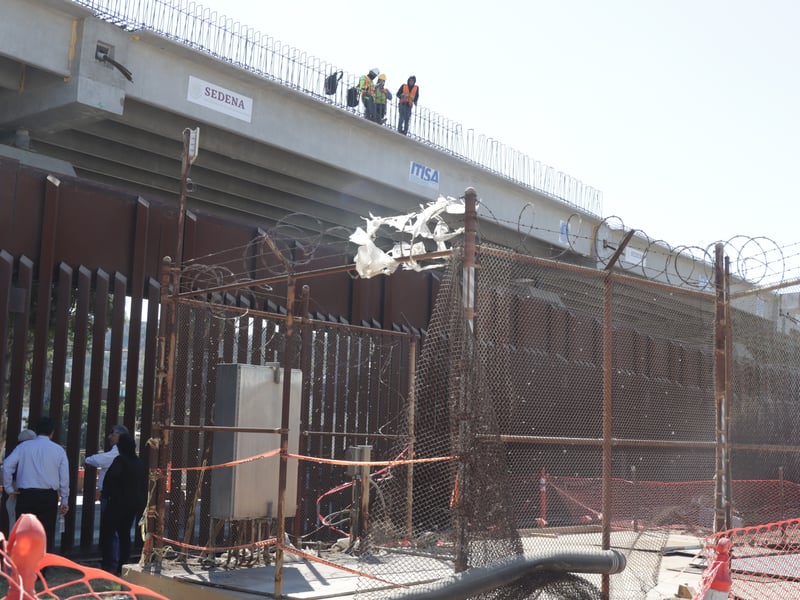
SAN DIEGO (CN) — Elected officials across San Diego said Monday they hope that $5.7 million for the renovation of a key piece of infrastructure at a wastewater treatment plant that straddles the U.S.-Mexico border in San Diego will be the first step in solving a decades long sewage-pollution problem that fouls the air and makes people sick.
“Junction Box-1 is the front door of this treatment plant,” said David Gibson, the executive director of the San Diego Regional Water Quality Control Board, at a groundbreaking ceremony announcing the start of the renovation project on Monday.
The South Bay International Wastewater Treatment Plant — under a joint U.S.-Mexican body called the International Boundary and Water Commission — treats sewage from Tijuana, but hasn’t been doing that since 2021 following the failure of a piece of the plant’s infrastructure.
When Junction Box-1 is operable, it’s supposed to control the amount of wastewater coming into the plant from Tijuana before it’s treated and sent to the Pacific Ocean. Since 2021 though, the box — which sits mere feet away from the border wall — has been inoperable, meaning mounds of sewage passed through the plant without being treated.
With $5.7 million in funding from the commission, the plant will now be able to repair the box and install two gates on a pipe that brings wastewater from Mexico into the plant, allowing it to treat 25 million gallons of sewage per day, with an expected completion date of sometime in spring 2025.
Comparing it to the fires from industrial pollution that caused Cleveland’s Cuyahoga River to catch fire multiple times in the 20th century, Gibson said the goal of the repair is to make sure the “Tijuana River never happens again.”
The Junction Box-1 repair is a critical piece of infrastructure, but it’s only the first step to dealing with the primary source of pollution, the Tijuana River itself, said Imperial Beach mayor Paloma Aguirre.
Residents of Imperial Beach — a border city whose residents have taken the brunt of the health effects of the sewage problem like foul, rotten egg and sewage like smells wafting throughout the city — have reported gastronomical issues, wheezing, migraines, nausea, diarrhea, and other health problem. The city has also borne the plant’s impact to the local environment, including the closures of local beaches.
Contentious investment is needed to completely fix the problem, and possibly diverting the river, Aguire added.
In August, researchers from the Center for Aerosol Impacts on Chemistry at the University of California San Diego’s Scripps Institution of Oceanography and San Diego State University found increased levels of hydrogen sulfide in Imperial Beach.
“If you stay here long enough, you will get a headache,” said San Diego Congressman Juan Vargas, as a wind whipped the smell of raw sewage leaking out of a nearby drain around politicians and journalists assembled outside of the plant near Junction Box-1.
Vargas said he spoke to both outgoing Mexican President Andrés Manuel López Obrador, and incoming President Claudia Sheinbaum about increasing Mexican funding for wastewater infrastructure projects in Tijuana and around Baja California.
San Diego Mayor Todd Gloria added that he’s working to pressure both the U.S. and Mexican federal governments to increase funding for infrastructure projects to deal with the issue so that south San Diegans can breathe clean air and enjoy the area’s beaches.
While Tijuana’s population and industrial sector has grown, the city’s public sewage treatment infrastructure has not. Broken, inoperable and underperforming sewage treatment plants in Tijuana and the joint binational U.S-Mexico sewage treatment center have been leaking and discharging sewage into the Tijuana River for decades.
The sewage not only pollutes the California coastline from Rosario, Mexico, to Coronado in San Diego County, but as the river flows, sewage runs up from Tijuana through the Tijuana River and out into Imperial Beach.
When Hurricane Hilary hit the region in August 2023, it brought the sewage systems in Tijuana and along the border close to collapse.
During and after the storm, two billion gallons of contaminated water flowed across the border, according to the commission.
In response, the commission redirected $25 million to repair damages to the plant in San Diego, including Junction Box-1.
Relentless advocacy efforts led by community and local political leaders like Aguirre have brought awareness and spurred action on the issue.
Earlier this year, Aguirre traveled to Washington and lobbied for $310 million to fund the South Bay treatment plant. Last week Congress passed a $1.2 trillion budget package that includes $156 million for the commission’s construction projects — marking a more than $100 million increase from last year’s budget.
As of now, the commission has about $400 million in secured funding for various rehabilitation, repair and expansion projects.
But International Boundary and Water Commission director Maria-Elena Giner said on Monday that a full rehab of the plant would cost something closer to $600 million.
“It’s a disaster down there,” said John Zarem, a volunteer at the Tijuana River National Estuarine Research Reserve, Border Field State Park, and a member of the commission’s Citizen Forum, about trash he finds from the river that ends up in the estuary.
With the repair of Junction Box-1 though, he added he’s “hopeful that we can see some progress.”
Subscribe to our free newsletters
Our weekly newsletter Closing Arguments offers the latest about ongoing trials, major litigation and rulings in courthouses around the U.S. and the world, while the monthly Under the Lights dishes the legal dirt from Hollywood, sports, Big Tech and the arts.