
 Search Articles


SAN DIEGO — A federal judge in San Diego on Monday appeared ready to rule in favor of parents and teachers opposed to a policy that prevented schools from disclosing students’ preferred gender identities and pronouns to their parents without consent.
The fate of that policy hangs in the balance of the judge’s decision and could have statewide implications.
The complaint, initially filed on behalf of former Escondido Unified School District teachers Elizabeth Mirabelli and Lori Ann West, challenges a school district policy that prevented teachers from disclosing students’ preferred gender identities and pronouns to their parents. The plaintiffs say the policy violated their First and 14th Amendment rights, and they asked the court to prohibitstate officials from enforcing policies that exclude parents from accessing student information.
U.S. District Court Judge Roger Benitez, a George Bush appointee, did not issue a ruling on from the bench but seemed skeptical of the state’s claims that the gender identity policy did not violate parents’ rights, after delivering what he admitted was a “horse whipping” to the defense during a heated hearing in a packed courtroom that lasted nearly the entire day.
“What this is really about is the fact that you are depriving the parents of the opportunity to decide what’s going to happen to those kids who are experiencing gender incongruity,” Benitez told the courtroom. “It doesn’t make a bit of difference whether this is medical, psychological, or social issue, because you know what’s really important is the fact that the parents are being denied the ability to seek whether its a medical, psychological or social treatment of their children if their children are showing the slightest indication that they have a gender incongruity issue.”
The judge had previously ruled in favor of the plaintiffs and issued a preliminary injunction to prevent the enforcement of the policy, which the school then updated. In October, he certified the lawsuit as a class action to also include California public education employees and parents who object to the policy.
The policy undermines families and parents who want to instill religious teachings to their children that sex is limited to male and female and that those things cannot be changed, said Paul Jonna, an attorney with the Thomas More Society, representing the plaintiffs.
“These are families that have to send their kids to public schools and these schools have state mandated policies that give them the power to facilitate a social transition that the parents are unaware of,” he said. “The message being sent with these policies is that gender is fluid and that’s a matter of fact.”
Jonna characterized the issue as 80-20, saying that most people, regardless of political persuasion, will likely believe that parents should be notified of any decision about their children.
Proceedings started with an order to show cause hearing after the plaintiffs accused the state of secretly maintaining de facto policies on the California Department of Education website that prevented the disclosure of students’ preferred gender identities, despite the judge’s earlier injunction. The judge did not rule on that issue, either.
The proceedings incited heated discussion over uncomfortable questions about the autonomy of children and the role of public education in children’s lives when it comes to mental health and suicide, sometimes eliciting emotional responses from those in attendance.
There are 2.8 million people aged 13 and older in the U.S. who identify as transgender, according to the Williams Institute, a UCLA gender policy think tank. Of those, 76% are under 35 years old.
LGBTQ youth face higher levels of mental health issues than others, according to most metrics. About 25% of transgender youth attempted suicide in 2023, according to a 2024 youth risk survey by Center for Disease Control.
“The compelling state interest here is in fostering the entire learning environment for every student in that environment,” said California Deputy Attorney General Kevin Quade. “If a parent’s unilateral insistence is that a teacher not recognize their pronouns, that sends a message in that environment that trans students are wrong and not to be respected.”
Additionally, attorneys for the defendants said the policy protects students from potential abuse from parents who disprove of their identity expressions.
However, Benitez argued many parents may prove supportive. Ultimately, he said that questions about childhood mental health are the concern of parents and children and not the state.
He said that a child’s right to privacy does not supersede a parent’s 14th Amendment right to custody of that child. Benitez characterized the state’s involvement in student gender identity as overreach.
“We’re having this wonderful discussion, but guess what? In the end, the people who are going to suffer the most as a result of the gender incongruity are going to be the children and the parents,” he said.
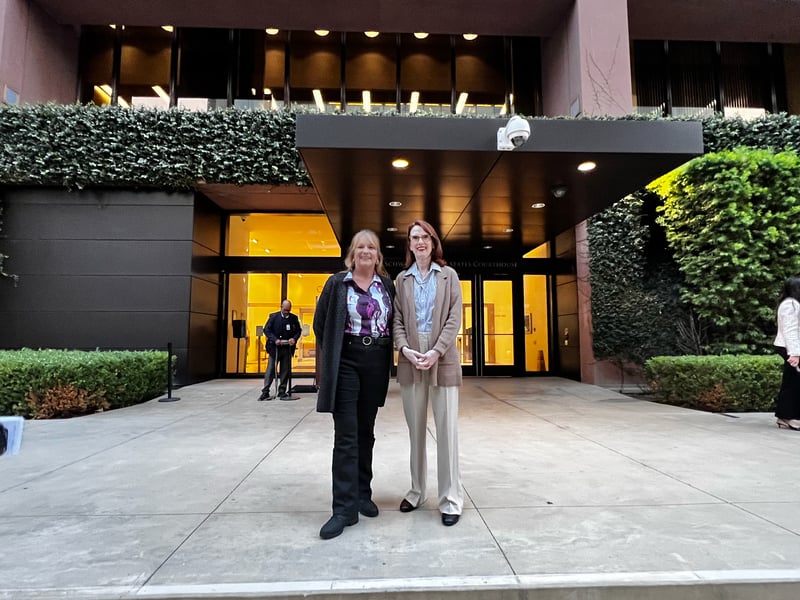
Mirabelli and West, both present during the hearing, said they were pleased with the judge’s characterization of the case.
“We are going to win,” Mirabelli said after the hearing. “We 100% support our LGBTQ students, but we don’t do it by cutting out their family. That is not the right way. That just assumes the worst case scenario and that’s too rush, it’s too broad, and it’s illegal."
If you are having thoughts of suicide, call or text 988, or call the National Suicide Prevention Lifeline at 1-800-273-8255 (TALK). Visit SpeakingOfSuicide.com/resources for a list of additional resources .
Subscribe to our free newsletters
Our weekly newsletter Closing Arguments offers the latest about ongoing trials, major litigation and rulings in courthouses around the U.S. and the world, while the monthly Under the Lights dishes the legal dirt from Hollywood, sports, Big Tech and the arts.