
 Search Articles


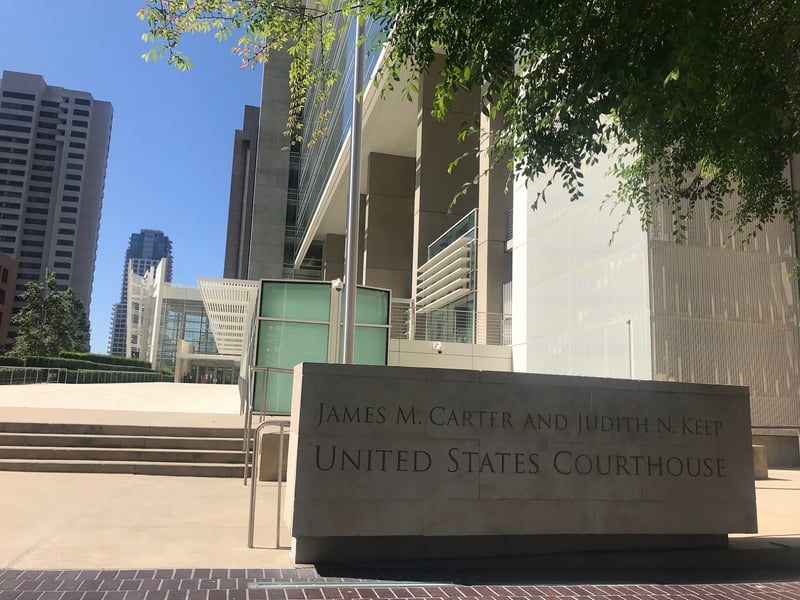
SAN DIEGO (CN) — The city of San Diego will have to face claims its police officers violated the civil and First Amendment rights of a cop watcher after they reportedly drew guns, beat and detained him and dragged him while he was already in handcuffs.
Muslah Abdul-Hafeez says he suffered a fractured shoulder and back and wrist injuries after being arrested in 2023 while attempting to document San Diego Police Department bike team officers’ response to a shooting.
As a cop watcher who’s well known to the local police department, especially its bike unit, Abdul-Hafeez claims that not only were his First Amendment rights violated, but officers conspired to unlawfully detain and search him and use excessive force. They ultimately arrested him, he adds, because he’s Black.
The city of San Diego filed a motion to dismiss those charges, but in his ruling, U.S. District Judge Robert Huie, a Joe Biden appointee, let most of Abdul-Hafeez’s claims stand.
“Here, plaintiff’s attempt to film police activity in public was constitutionally protected by the First Amendment,” Huie wrote in his order. “Next, plaintiff’s arrest constituted an adverse action that would have chilled a person of ordinary firmness from the future exercise of their First Amendment rights.”
The nature of Abdul-Hafeez’s arrest, “suggests a retaliatory motive.” he added.
In his complaint, Abdul-Hafeez points out that out of a crowd of twenty to thirty people of different ethnic backgrounds who were at the scene when he was detained, officers only arrested three people, him and two people who were reportedly involved in the shooting. All three people were Black.
The city argued that rather than being motivated by race, it was more likely the police officer’s actions were based on probable cause because they believed a crime might have occurred.
The city added that officers did not arrest other Black people in the crowd around the scene.
But in his order issued Friday, Huie noted that Abdul-Hafeez cited two studies, one commissioned by the local police department in 2021 and one commissioned by the city in 2016.
The 2021 report analyzed data on traffic stops and use of force incidents between 2016-2020. It found that Black people were 4.2 times more likely to experience nontraffic stops than white individuals. The 2016 study found that Black people were disproportionately subject to searches compared to white people.
“At this early juncture, the court concludes plaintiff’s allegations concerning the circumstances of his own arrest, combined with the data allegedly set forth in the 2021 Center for Policing Equity and 2016 San Diego State University reports, are together sufficient to allege an equal protection claim,” Huie wrote.
Abdul-Hafeez also submitted video clips of new reports of SDPD’s bike team using excessive force against Black people to bolster his argument that the police department, especially the bike team and the city have a de facto policy, custom or practice of harassing, intimidating, citing and threatening to arrest people who are exercising their First Amendment rights or are African American.
The city argued that the clips were short and out of context, but Huie pushed back, ruling that they showed multiple specific instances in which SDPD officers used force against Black people “in a manner that could plausibly be considered excessive.”
“Plaintiff has plausibly alleged the city maintains an unconstitutional custom, practice or policy of discriminatory conduct directed towards African Americans,” he added.
However, the judge said Abdul-Hafeez did not sufficiently claim that police conspired to violate his rights because it’s predicated on a claim that the officer that detained and arrested him, an officer named Dominic Lazaga, should have intervened to stop other officers from depriving him of his rights.
Lazaga still can face claims he used excessive force though.
The San Diego City Attorney’s Office declined to comment on pending litigation.
“I think that the judge made a good call in letting most of the claims survive. It’s not about one person, it’s about patterns of misconduct, racial bias and patterns of violations that harm Black San Diegans and whether these practices will continue to be unchecked,” said Genevieve Jones-Wright, Abdul-Hafeez’s attorney . “On top of everything else that we’re seeing, we’re seeing a level of excessive force that continues to go on unaddressed within the San Diego Police Department.”
She noted that her client has been intimidated and harassed, ticketed, detained and arrested by the police even after this incident. It’s quelled his cop watching activities, but it hasn’t stopped him completely, she added.
In his suit filed last year in San Diego federal court, Abdul-Hafeez describes how an officer in the San Diego Police Department’s bike team drew a gun on him and ordered him to get on the ground after he grabbed his phone from his car to begin filming. Abdul-Hafeez, who was wearing a neon green vest that identified himself as a cop watcher, says he complied with the officer’s demand.
Still, officers jumped on him, digging their nails into his skin, kneeled on him when he was on the ground, then handcuffed him and pulled at his shoulders, he claims. After tightly handcuffing him, officers dragged him by his arms and detained him for hours and cited for obstructing a police officer, he claims. He ultimately was never charged.
Subscribe to our free newsletters
Our weekly newsletter Closing Arguments offers the latest about ongoing trials, major litigation and rulings in courthouses around the U.S. and the world, while the monthly Under the Lights dishes the legal dirt from Hollywood, sports, Big Tech and the arts.