
 Search Articles


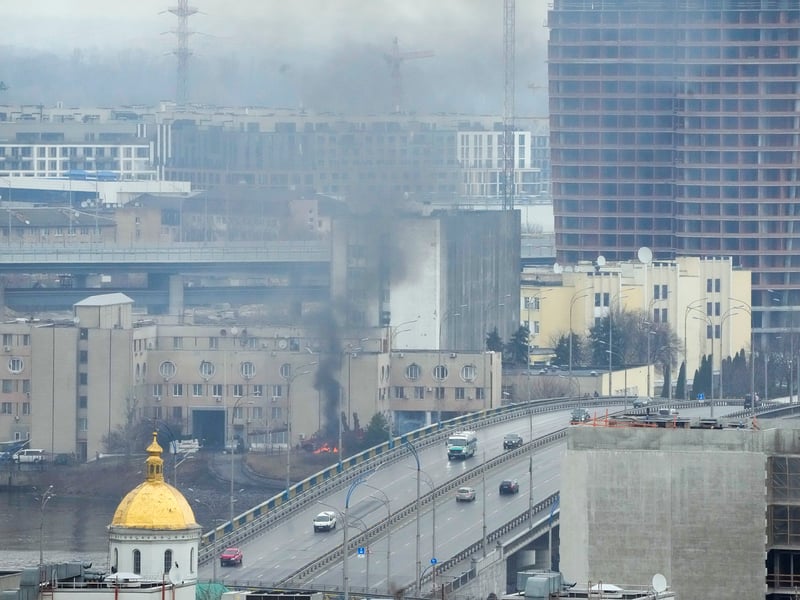
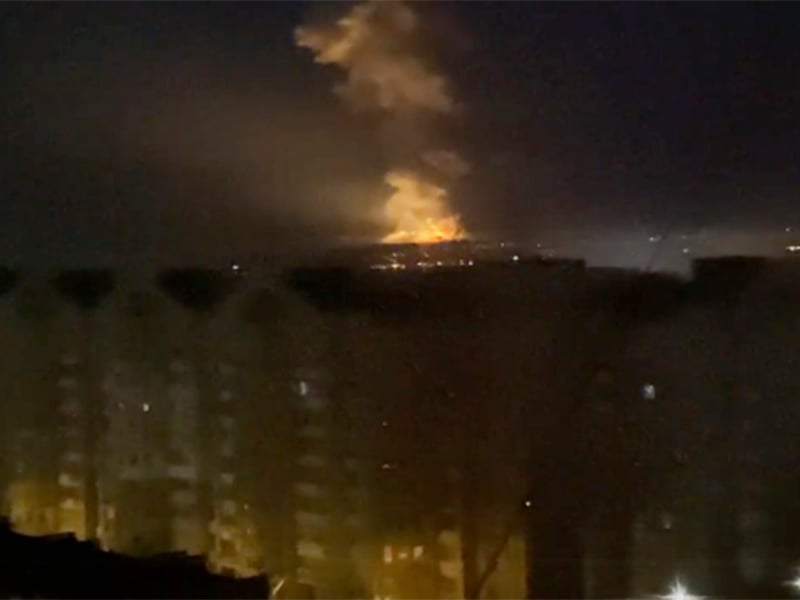
(CN) — A major war in Europe broke out Thursday when Russia launched a full-scale attack against Ukraine in the early morning hours, bombing airports and military installations while deploying troops, tanks and military aircraft.
By afternoon, there were reports of heavy casualties, military as well as civilian, and numerous missile strikes against Ukrainian cities including Kyiv, the capital. There were reports that Russian forces were advancing on Kyiv and attempting to seize its airport. Fighting also had broken out in or near the site of the devastated Chernobyl nuclear power plant, raising fears of a release of radioactive materials.
Images from social media, news reports and officials showed Russian helicopters flying over residential areas, columns of armored vehicles crossing border points, bombed airports, loud explosions, military tanks on fire, a downed Russian helicopter, Russian soldiers taken prisoner and gruesome civilian casualties. Ukraine’s government and banks were also hit by cyberattacks.
By Thursday evening, information about what was happening on the ground remains limited, with little detail about the full extent of the invasion and state of battle. Official and media reports describe Russian troops as close to Kyiv and making gains in southern and eastern Ukraine. Ukraine said about 40 soldiers had been killed, a number that is expected to rise. Russia did not release a number of casualties, but the Ukrainian military claimed it had killed 50.
The fighting seemed concentrated in the disputed eastern regions of Ukraine, but there were fears that Russian President Vladimir Putin was planning to seize as much of Ukraine as he possibly can.
Russia’s attack on Ukraine may mark what many see as a definitive rupture in world politics between the East and the West and a point of no return in a new Cold War.
Putin launched the multipronged attack after an early morning speech in which he blasted the United States as an “empire of lies” that has wreaked havoc with its military campaigns in the former Yugoslavia, Iraq and Libya. He portrayed NATO’s expansion east and attempts to get Ukraine into the military pact as a threat to Russia.
In a stark warning to the West that could hint at Russia’s status as a nuclear power, Putin threatened to attack any country that seeks to interfere with his invasion of Ukraine.
“I would now like to say something very important for those who may be tempted to interfere in these developments from the outside,” he said. “No matter who tries to stand in our way or all the more so create threats for our country and our people, they must know that Russia will respond immediately, and the consequences will be such as you have never seen in your entire history. No matter how the events unfold, we are ready.”
Ukrainian President Volodymyr Zelenskyy called on his country’s armed forces to fight, and he urged citizens to take up arms and defend their country’s independence. His government asked NATO for more help and even to send troops.
Zelenskyy called on NATO to impose a no-fly zone over Ukrainian airspace and declared that the presence of Russian forces at the Chernobyl site was a “declaration of war against the whole of Europe.”
Vadym Prystaiko, the Ukrainian ambassador to the United Kingdom, said at a news conference that Ukrainians were ready to fight to “the last one.” Citing his country’s suffering in the past, he pointed to the Holodomor famine caused by Joseph Stalin, the Nazi invasion of Ukraine and the 1986 Chernobyl disaster.
“We’re quite resilient people. We’ve been through artificial famine, we’ve been through Chernobyl, we suffered a lot after the Second World War,” Prystaiko said. “This land is sometimes called the bloodlands of Europe, so people suffered for all their existence. So they know how to fight.”
Putin’s military invasion of Ukraine was immediately condemned by the West and its allies, who vowed to impose the harshest of sanctions on Russia in a bid to cripple its economy and weaken Putin’s regime.
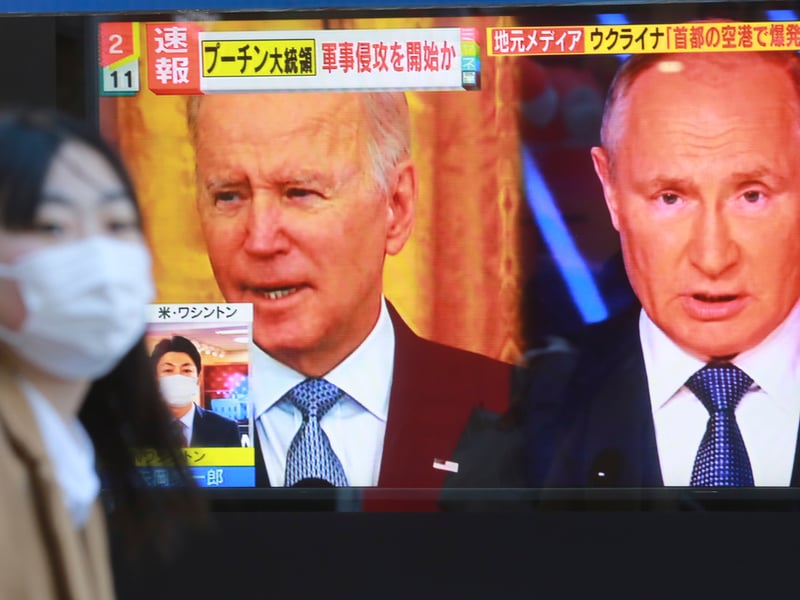
“President Putin of Russia has unleashed war in our European continent,” British Prime Minister Boris Johnson said in a speech in which he called Putin a “dictator.”
NATO has said it has no plans to send troops into Ukraine to protect the country, though the alliance has stepped up shipments of military equipment to Kyiv and helped train its army.
“We condemn this barbaric attack and the cynical arguments to justify it,” said Ursula von der Leyen, the president of the European Commission. “It is President Putin who is bringing war back to Europe and in these dark hours the European Union and its people stand by Ukraine and its people.”
Von der Leyen said the package of sanctions against Russia will be “massive and targeted” to hit strategic economic sectors, block Russia’s access to vital technologies and markets, freeze Russian assets in the EU, and forbid Russian banks from trading in Europe’s financial markets.
“We will weaken Russia’s economic base and its capacity to modernize,” von der Leyen vowed.
“We are facing an unprecedented act of aggression by the Russian leadership against a sovereign, independent country,” she said. “Russia’s target is not only Donbas, the target is not only Ukraine, the target is the stability in Europe and the whole of the international peace order and we will hold President Putin accountable for that.”
Whether this massive wave of sanctions and Western condemnation can deter Putin remains to be seen. His country has already been under harsh sanctions, and many experts believe he’s prepared to try to weather the economic punishment.
Putin’s attack comes after weeks of diplomacy that saw the U.S. and its NATO allies anger the Kremlin by not agreeing to consider withdrawing NATO troops from Russia’s borders and keeping the former Soviet republics of Ukraine and Georgia out of the anti-Russian military pact.
“He’s probably taken the biggest gamble of his political career,” said Tony Brenton, a former British ambassador to Russia, speaking about Putin’s invasion on Sky News television.
Brenton said Putin’s huge gamble comes after he apparently saw no alternative. Although Putin is at fault, Brenton said the West, too, had a big role in this disaster by not taking the Kremlin’s security concerns into consideration.
“It’s an appalling breach of international law, it’s a major shift in the way we do business in Europe and the world is made significantly worse by it and Putin is a major agent of it,” he said.
“We never really made any concessions at all to his demands, negotiations broke down and this is where we now are,” Brenton said. “So there’s a certain unwillingness by the West to recognize how seriously Putin takes this issue.”
In Putin’s calculations, he said, the damage the sanctions will do are worth enduring to ensure national security.
“The Russian government and Putin in particular don’t take sanctions seriously,” Brenton said. “Not because they dismiss the potential economic damage they can do, but because they take Russian national security much more seriously than they take Russian economic welfare.”
Brenton said Russia will continue to do business with China, India, Middle Eastern countries and many others that will not shun Russia and continue to see it as a mighty and important country.
“People talking about getting the whole world together to oppose Putin is obviously unrealistic,” Brenton said. “What is going on here in a way is a demonstration of the diminishing clout that the West holds over world affairs compared to where we were actually quite recently five or 10 years ago.”
He added: “The measure of being a serious power isn’t how moral you are, it’s how strong you are. And Russia has demonstrated, I’m afraid, significant political will and, depending on how the war goes, significant military capacity to make itself felt in the world.”
Putin is accused of trying to reconstitute the old Russian empire or Soviet Union and avenge the humiliation that he perceives has been brought upon Russia by the West since the collapse of the communist bloc. In the past, he has called the fall of the U.S.S.R. the 20th century’s greatest geopolitical disaster.
Prystaiko, the Ukrainian ambassador in London, cited Putin’s expansionist designs as the cause of this war.
“I believe he wanted to get the Soviet Union back and for this he won’t stop at anything,” Prystaiko said. “He’s trying to get the Slavic tribes” together.
In keeping with Putin’s expansionist dreams, the leader of the breakaway Luhansk region in eastern Ukraine, Leonid Pasechnik, said reuniting Russian peoples is the path forward.
“This reunification is a great thing,” he said, speaking at a news conference aired and translated by RT, the Russian broadcaster. He said Russian peoples need to unite to “bring back the glory of the country that everyone respected, everyone was afraid of.”
He said the fall of the Soviet Union was a tragedy orchestrated in part by Western powers, and that the West is undermining the old Soviet republics, such as Russia, Ukraine, Belarus and Kazakhstan, through so-called “color revolutions,” popular pro-democratic uprisings against authoritarian governments that are backed by Western nations.
“I think what happened back in 1991 was this horrible divide,” Pasechnik said. “The Soviet Union was destroyed and now our republics individually are destroyed by the West by launching these color revolutions.”
He claimed the EU has adopted the centralized and unitary model of the Soviet Union.
“They will have one economy, they will have one currency; basically they are building the prototype of what we had in the last century, but somehow they thought that what we had was wrong under democratic ideals,” he said. “They destroyed our union but now they aspire to do the same: That only shows that that collapse was artificial and Western secret services had something to do with that because a strong Russia is something no one wants.”
Pasechnik vowed that the people of the Donbas were taking back their land.
“That’s the land of our ancestors, that’s the land where our history started,” he said. “Neither the U.K. nor the U.S. have anything to do with this land, this is our land. This is where we have to live and honor our history, honor the exploits of our grandfathers, great-grandfathers who fought for this land for centuries.”
For his part, Prystaiko, the Ukrainian ambassador in London, said the invasion by Russia proves that it was a major mistake for Ukraine to agree to give up its nuclear arms after the fall of the Soviet Union and that membership in NATO is the only way to secure Ukraine’s freedom from Russia.
“I spent my professional life trying to get into” NATO, he said. “I understand that that’s the only chance for us to survive. It’s not that we want to get NATO engaged in conflict, but we wanted to have this same level of security as your people in the streets are enjoying.”
Courthouse News reporter Cain Burdeau is based in the European Union.
 Follow @cainburdeau
Subscribe to our free newsletters
Our weekly newsletter Closing Arguments offers the latest about ongoing trials, major litigation and rulings in courthouses around the U.S. and the world, while the monthly Under the Lights dishes the legal dirt from Hollywood, sports, Big Tech and the arts.