
 Search Articles


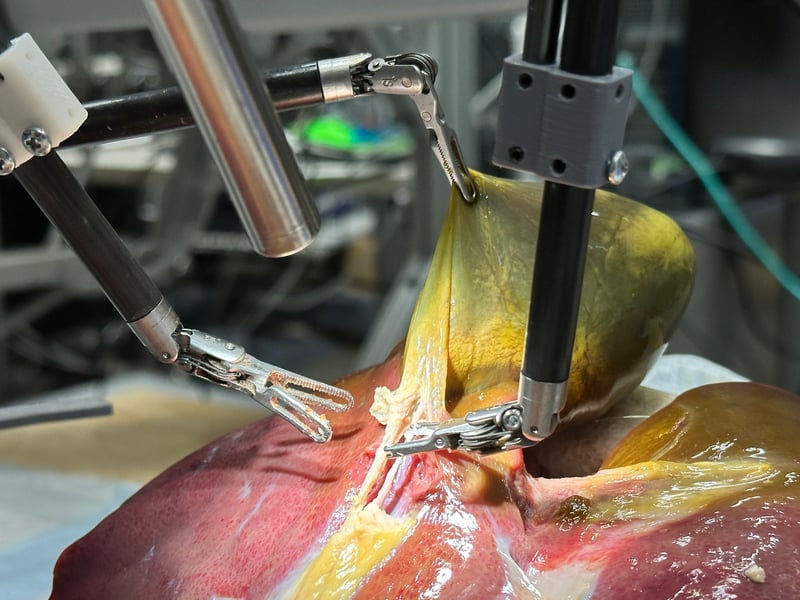
(CN) — For the very first time, a robot has performed surgery without the help of a human, successfully removing a gallbladder from a dead pig at Johns Hopkins University.
Make that eight gallbladders, all without a hitch.
“When we set out on this project, we did not think we would be able to do eight consecutive gallbladder surgeries without any human intervention,” said Axel Krieger, a Johns Hopkins engineering professor and the leader of the team of researchers who built and programmed the robot. “So it’s definitely surprising and exciting that it turned out much better than we initially anticipated.”
Gallbladder surgery was one of the first surgeries to be performed as minimally invasive. Surgeons currently use remote control instruments — laparoscopic tools — and an endoscope, or tiny camera, to remove the gallbladder while making only the smallest of incisions. Krieger and his team used the same da Vinci Surgical System tools, but instead of being controlled by remote, Krieger and his team built the system a brain that could watch training videos and listen to instructions from researchers. The robot was, effectively, trained to perform gallbladder surgeries by itself.
“Our technology now frees up the surgeon to play a supervisory role, so the robot performs the surgery, and the surgeon sits there and can read or listen to what the robot wants to perform,” said Krieger.
The technology is a bit like autonomous driving vehicles, Krieger said, which are designed to do everything while a human — hopefully — watches over, just in case.
“Surgeons are under a lot of pressure,” Krieger said. “We have an aging society, more surgeries needed. We have fewer trained surgeons, so the caseload is rising. So we want to provide technology to help surgeons do more procedures with fewer complications. That’s the goal. And so by building these technologies, we make can make surgery faster, easier, and less mentally and physically taxing for the surgeons.”
He added: “At the end of the day, if you’re the 6 p.m. patient, you still get a really good surgery. You know, that’s really the goal. We’re not trying to replace surgeons. That’s absolutely not what we are after.”
Four years ago, Krieger and his team performed the first autonomous surgery on a live animal, a pig. But that was done with extensive prep work and specially marked tissue. It was a bit like having a self-driving car navigate a carefully mapped route. Now, Krueger’s robot can navigate through the surgery all on its own, even adapting to little hiccups along the way. Most gallbladder removals are simple enough, but they can get difficult depending on different variables.
During the 30 training sessions, researchers would sometimes have to correct the robot.
“The robot sometimes would make a mistake and say, ‘Now I want to cut the left artery,’” Krieger recalls. “And then we said, ‘No, no, no, don’t cut the left artery, place the clip.’ So we improved the robot performance during training a lot.”
But in the eight-part test phase of the study, the robot needed no instructions at all.
Krieger said that in the near future, he hopes to have his robot perform surgery on live pigs. He’d also like to try programing the robot to remove tumors — a tricky procedure that involves discerning the tumor from the normal tissue.
Similar technology, meanwhile, is already in development in far more prosaic areas. Last year, a company working on a laundry-folding robot raised $400 million from, among other people, Jeff Bezos and OpenAI.
 Follow @hillelaron
Subscribe to our free newsletters
Our weekly newsletter Closing Arguments offers the latest about ongoing trials, major litigation and rulings in courthouses around the U.S. and the world, while the monthly Under the Lights dishes the legal dirt from Hollywood, sports, Big Tech and the arts.