
 Search Articles


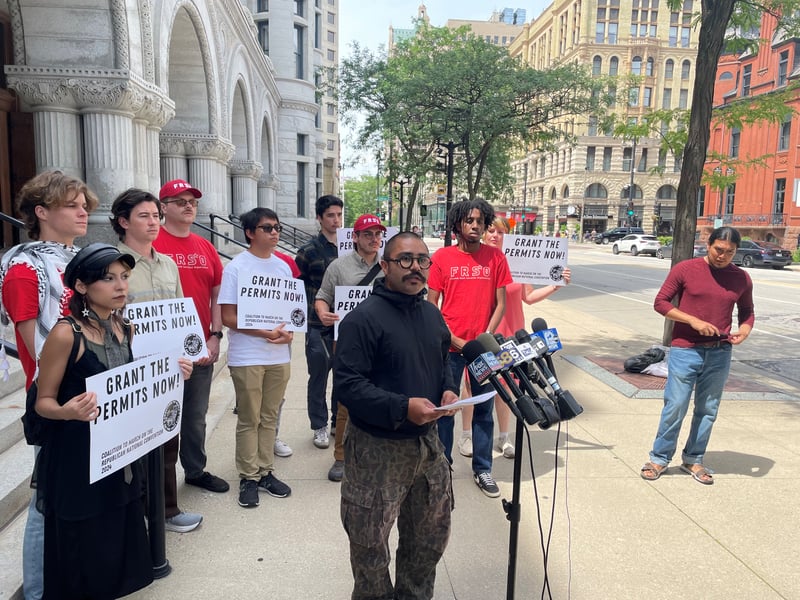
MILWAUKEE (CN) — Protesters who were denied a bid to march along their preferred route at the Republican National Convention next week blasted the court’s last-minute decision on Tuesday — and said they plan to ignore the route convention organizers designated for them.
The Coalition to March on the RNC sued the city claiming its members’ constitutional rights to free speech and assembly are being stifled by protest restrictions enacted in light of the security plan for the Republicans’ nominating convention July 15 through July 18.
U.S. District Judge Brett Ludwig delivered the protesters a blow by denying the central thrust of their injunction motion.
“The coalition members have the right to march in protest of the RNC. Their right to do so lies at the heart of the First Amendment. But the First Amendment does not allow them to protest or parade in any way they choose,” the Trump-appointed judge wrote in a 35-page ruling late Monday.
Despite the protesters’ claims of bad faith and feet-dragging by the defendants throughout the protest permit application process, Ludwig felt the record showed city officials made “extensive efforts” to balance the protesters’ constitutional rights against legitimate security concerns and government interests.
“The vast majority of the resulting security plan is a reasonable and valid time, place and manner regulation on speech,” the judge said.
The protesters, who are represented by the American Civil Liberties Union, planned to march past the Fiserv Forum, home of the Milwaukee Bucks and one of the main venues for the convention, to be within sight and sound of convention delegates and attendees, and vice versa.
The defendants said the protesters’ chosen route was unacceptable because it would cross a “hard” security zone around the convention’s main venues. The protesters instead were granted a permit to march along a route that is smaller and farther away from the Fiserv Forum.
At a press conference on the steps of the Milwaukee federal courthouse on Tuesday, Coalition to March on the RNC representative Omar Flores condemned Ludwig’s decision as siding with those who want to muffle the group’s constitutional rights.
“What we have seen happen in Milwaukee is unfortunately what happens when the RNC comes to town,” Flores said. “Mayors and local police departments from host cities will work with the Secret Service and the RNC to suppress communities’ free speech.”
Flores charged the city with tactically delaying the release of the designated protest route so the group would have less time to take the matter to court.
While the city no longer has a legal obligation to accommodate the group, he said it still has a moral obligation to do so, adding that the city’s actions have increased the likelihood of marchers coming into contact with police despite officials’ hand-wringing about safety.
In any case, the group’s march will continue — and not on the route the city and Secret Service have cordoned for them, Flores said. Reporters were given a printout with a map of the group’s new chosen route, an amended version of their original route that avoids crossing the hard security zone.
“We were never going to let this decision decide if we march or not,” Flores said. “We are going to march on the streets we have a right to march on, the same way we always have in Milwaukee. This court decision is about how the city will react to our family-friendly protest.”
While the Coalition to March on the RNC failed with regard to its preferred march route, the protesters prevailed in their challenge to a RNC-related ordinance allowing the city to deny or revoke protest permits based on applicants’ or their associates’ prior criminal convictions for violent or destructive conduct at a previous parade or public assembly.
Citing Seventh Circuit precedent from 1972 involving the denial of a permit application by the leader of the Nazi Party of America, Ludwig said the city’s interest in preventing incitements to violence does not justify unconstitutional restraints on free expression. The ordinance subsection the protesters challenged “flatly violates this rule,” he said.
Revocation of a permit under this ordinance, Ludwig said, would cause “an irreparable injury of constitutional magnitude.”
He also felt the city unconvincingly argued there may not be enough law enforcement to maintain the parade route. The parties stipulated that as many as 4,500 police officers will be brought in from outside Milwaukee to staff the convention, in addition to security measures implemented by the Milwaukee Police Department and Secret Service.
“Absent more concrete evidence to support the city’s speculation, the court cannot conclude that the city will be somehow unequipped to handle protests simply because one or more of the individuals demonstrating may have been involved in violent or destructive behavior at a prior demonstration within the last seven years,” Ludwig said.
As part of the judge’s ruling, the city and Department of Public Works commissioner Jerrel Kruschke are enjoined from denying or revoking any permit registrations under the disputed special event ordinance based on criminal convictions.
At the press conference Tuesday, Flores referred to this portion of the court’s injunction as “an extremely weak win,” but said the group would take it. That so many details are being figured out less than a week before the convention, without adequate transparency, is “abysmal,” Flores said.
The protest group’s stated goals for their march include fighting “the racist and reactionary agenda of the Republican Party,” standing with Palestine, defending women’s reproductive rights and “peace, justice and equality for all.”
In addition to the city and Kruschke, the protesters’ early June lawsuit named as defendants Milwaukee Mayor Cavalier Johnson and U.S. Secret Service Director Kimberly Cheatle.
During the convention, security perimeters will extend for blocks around convention sites in downtown Milwaukee, including the Fiserv Forum, the University of Wisconsin-Milwaukee Panther Arena and the Baird Center.
An inner security perimeter will be accessible only to those with credentials or tickets, like convention attendees or volunteers; an outer “vehicle screening perimeter” will have checkpoints for cars but will be open to all pedestrians and bicyclists, with no screening or credentials required — and in accordance with state law, the open and concealed carry of firearms will be allowed, too.
 Follow @cnsjkelly
Subscribe to our free newsletters
Our weekly newsletter Closing Arguments offers the latest about ongoing trials, major litigation and rulings in courthouses around the U.S. and the world, while the monthly Under the Lights dishes the legal dirt from Hollywood, sports, Big Tech and the arts.