
 Search Articles


(CN) — The cascade effects of climate change are undeniable, whether through weather systems, ocean ecosystems or seasonal harvests. But how rising temperatures affect insect populations is less widely understood.
Now, in a study published Wednesday in the journal Ecology Letters, researchers from Binghamton University, State University of New York, reveal a glimpse into how so-called “specialist” insect communities — that is, those that feed on specific plants that deter other insects — might respond to realistic climate change scenarios about 50 to 100 years in the future.
“These specialist insects are going to respond in very different ways that are going to have pretty important ecological ramifications for these populations and overall insect communities moving forward,” said lead author Thomas H.Q. Powell, assistant professor of biological sciences at Binghamton University.
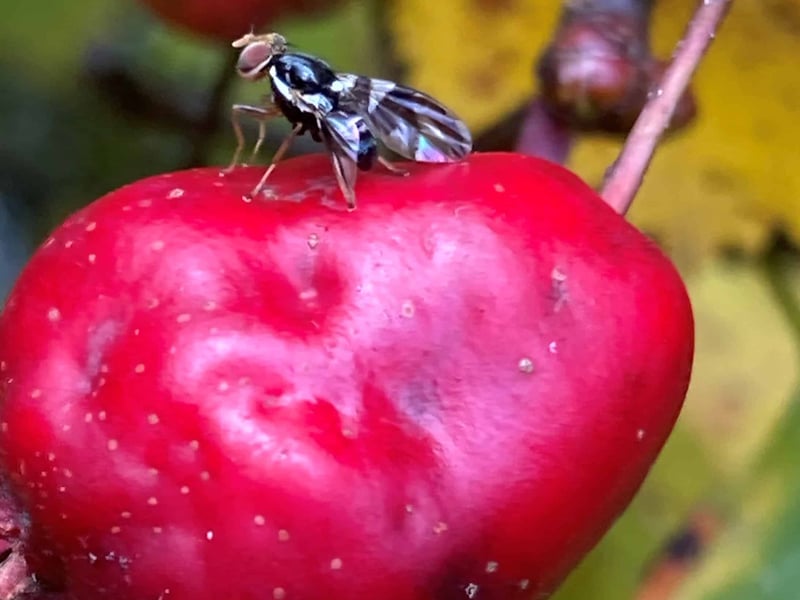
To observe how rising temperatures may affect specialist insects, Powell’s lab focused on two varieties of Rhagoletis pomonella — a species of fruit fly that traditionally infested the fruit of hawthorn trees in eastern North America.
Or at least they did until European settlers came along.
During the 1850s — about 200 years after colonial introduction — non-native apple trees in the Hudson Valley spurred an evolutionary event: A population of the Rhagoletis began solely sourcing the fruit of apple trees, which arrive three to four weeks earlier in the year than the fruit of hawthorn trees.
Though living in proximity, the two fly groups never mixed or bred together, eventually “diverging” or creating two distinct populations. But that’s not all the apple trees inspired at the time.
Since Rhagoletis or “hawthorn flies” are also part of a parasitic wasp lifecycle — meaning the fly’s eggs are hosts to wasp larvae that eat them from the inside out — an earlier reproductive cycle for the flies also resulted in new populations of parasitic wasps that would become only attracted to the environment in which they were born: apple trees.
Because climate change also impacts the viability and seasonality of plant species, Powell and other researchers thought the situation could be an interesting case study on the effects of climate change. Powell’s lab set up an experiment to compare the insects’ life cycles in conditions matching the region’s seasonal average from the last decade and into projected warmer conditions.
What researchers found was that, despite sharing the same habitat and very similar genes, the two fly populations responded very differently to temperature shifts. It affected “different points in their life cycle,” Powell said, “causing apple flies to fail to go into dormancy.”
For hawthorn flies that are active somewhat later in the season, though, an increase of three degrees is much less consequential.
“Instead of affecting their entrance to dormancy, it more affects their exit from dormancy,” Powell said.
The wasps, on the other hand, were not affected by the heat at all — a finding that may spell trouble for all flies involved. It signaled that with climate change, the “ecological interaction” between species “could really fall apart,” Powell explained.
In terms of what the findings mean for this particular wasp community, Powell said it’s difficult to tell because outside of the controlled parameters of a lab study, humans and human-induced climate change can change their environments in a variety of other ways that are not simple temperature increases, such as habitat loss and habitat fragmentation.
“In the short term, if the wasps are not able to shift their life cycle timing appropriately, there’s going to be pretty big fitness consequences for them,” Powell said. He noted that “insects are the most abundant and diverse group of animals on the planet.”
In other words: Climate change can impact ecosystems in surprising and sometimes counterintuitive ways — affecting the relationships between species or even how and when a particular species evolves.
 Follow @alannamayhampdx
Subscribe to our free newsletters
Our weekly newsletter Closing Arguments offers the latest about ongoing trials, major litigation and rulings in courthouses around the U.S. and the world, while the monthly Under the Lights dishes the legal dirt from Hollywood, sports, Big Tech and the arts.