
 Search Articles


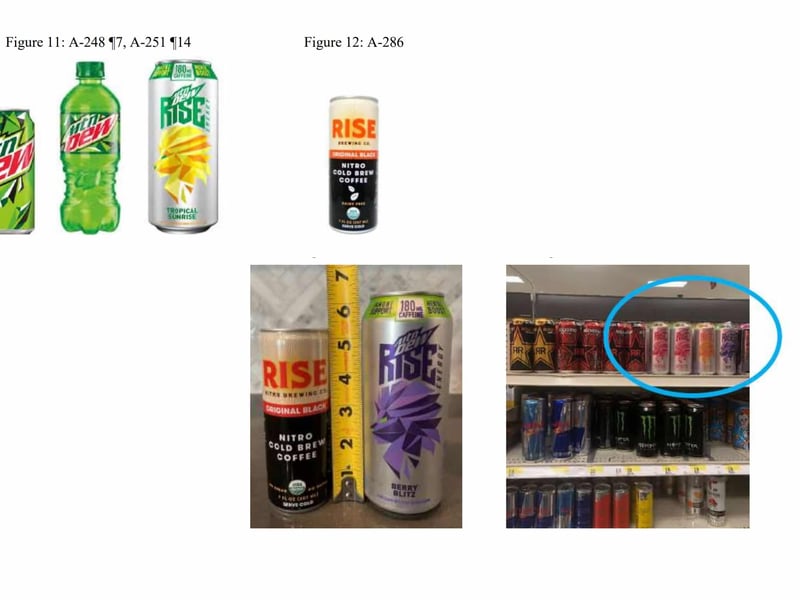
MANHATTAN (CN) — PepsiCo knowingly designed its “Mountain Dew RISE” drinks to be visually similar to Rise Brewing’s coffee beverages, the coffee wholesaler told a Second Circuit panel Thursday in an attempt to revive its claims against the global food and beverage conglomerate.
Rise Brewing, which sells its products in grocery stores nationwide and won People Magazine’s 2019 award for best canned coffee, claims Pepsi launched its competing caffeine drink bearing a similar label after several meetings to discuss a partnership between the two brands.
Though Pepsi ultimately decided not to partner with Rise, the coffee company says Pepsi used its recently gained insider knowledge of Rise’s product strategy to develop a competing product.
“Actual confusion ensued,” Christopher McArdle, an attorney with Alston Bird representing Rise, told the panel Thursday.
Rise cites several examples of customer confusion in its brief, pointing to one instance in which a customer accidentally bought Mountain Dew Rise because of its similarity to the Rise canned coffee beverage and another in which a grocery manager accidentally put the wrong order in because the products look similar.
But Pepsi says Rise failed to state specific examples of customer confusion, pointing out that the coffee company did not produce surveys stating as much.
“We had six surveys testing six ways to Sunday why there is no confusion here and they have zero, not a single survey,” Dale Cendali, an attorney with Kirkland Ellis representing Pepsi, said Wednesday.
This is the second time Rise has brought this case to the Second Circuit, which in 2022 lifted the injunction ordering Pepsi to rename its energy drink after finding that Rise’s mark is “inherently weak” because “Rise” is a common term used in coffee and energy drink marketing.
The case was then kicked back to the Southern District of New York, which agreed with the Second Circuit panel and granted Pepsi summary judgment.
But McArdle said the lower court misinterpreted the first panel’s decision and sided with Pepsi on a misguided assumption that Rise wouldn’t be able to win its case on merit.
In particular, McArdle said the court erroneously associated the word “Rise” with “coffee,” and found that the close word association makes it difficult to enforce trademark restrictions.
“There’s no fact in the record that says ‘Rise’ means anything about coffee,” McArdle said. “It says that ‘Rise’ is associated with feelings of energy and getting up in the morning, not coffee.”
But Wednesday’s panel didn’t seem to agree.
U.S. Circuit Judge Steven Menashi, a Donald Trump appointee, doubted Rise’s categorization that there is a difference between associating the mark with coffee or getting up in the morning, and said the slightly different definition is not enough to believe Rise may succeed at trial.
“You spent a lot of money, you got some awards, there are some employees in the beverage industry who associate the word ‘Rise’ with the coffee product,” Menashi said. “But I don’t think a reasonable jury could conclude that it overcomes the commonality of this kind of mark.”
But McArdle responded that Rise’s award in People Magazine, in addition to the $17.5 million the company spent in promotional material to boost its brand, is enough to establish consumers’ association of the word “Rise” with its specific coffee product.
U.S. Circuit Judge Joseph Bianco, a Trump appointee, and U.S. Circuit Judge Eunice Lee, a Joe Biden appointee, also participated in Wednesday’s panel. The judges did not indicate when they would rule.
 Follow @NikaSchoonover
Subscribe to our free newsletters
Our weekly newsletter Closing Arguments offers the latest about ongoing trials, major litigation and rulings in courthouses around the U.S. and the world, while the monthly Under the Lights dishes the legal dirt from Hollywood, sports, Big Tech and the arts.