
 Search Articles


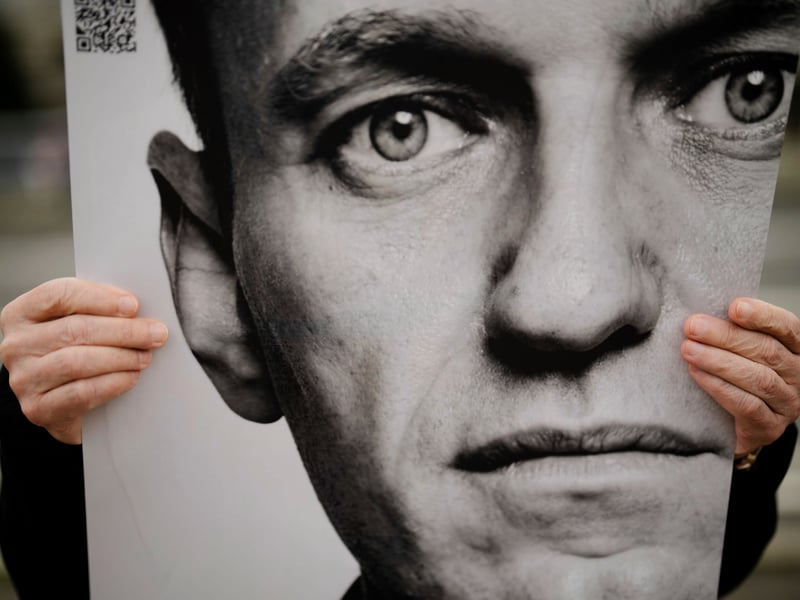
(CN) — After years of police raids, frozen assets and “extremism” labels targeting allies of the late opposition leader Alexei Navalny, European judges said Tuesday Russia crossed a red line, using the law itself to systematically erase organized political opposition.
In a ruling that lays bare the mechanics of Russia’s crackdown on dissent, the European Court of Human Rights said the moves against Navalny and his network were never about legitimate law enforcement.
Instead, they found a coordinated campaign to silence dissent, violating a raft of fundamental rights — from privacy and free speech to freedom of association and property — driven by a political purpose the human rights convention does not allow.
Judges examined a broad crackdown that ranged from raids and asset freezes to the branding of Navalny-linked groups as “foreign agents” and later as “extremist,” measures that ultimately shut the organizations down and outlawed their activities.
A judgment on motive, not just method
What mattered most to the judges was intent. The scale, timing and coordination of the measures, they said, pointed to a prohibited objective rather than genuine law enforcement.
That conclusion was backed up by how the judges assessed those measures in legal terms. Raids and seizures lacked a firm legal basis, asset freezes came with few protections, and the “foreign agent” and “extremist” labels were applied so broadly they bore little relation to proven criminal conduct.
The court was equally dismissive of Moscow’s explanations. Claims that the measures were aimed at fighting money laundering or extremism, the judges said, were not supported by evidence.
“They formed part of a concerted effort on an unprecedented scale to strike at the heart of and eliminate the organized democratic opposition centered around Mr. Navalny and therefore pursued an ulterior purpose” within the meaning of Article 18 of the European Convention on Human Rights, the court said.
Article 18 is one of the convention’s most demanding provisions. It bars governments from limiting fundamental rights for any reason other than the specific purposes the treaty allows, and it is invoked only in exceptional cases where the misuse of power is clear.
That is why the finding carries unusual weight. The judges stressed they were not dealing with technical errors or flawed procedures, but with a deliberate abuse of the law itself.
Philip Leach, a lawyer representing the applicants, said the judgment lays bare “the centrally coordinated measures taken by the Russian authorities on an unprecedented scale to dismantle and shut down Alexei Navalny’s political movement right across Russia.”
“The decision exposes the extraordinary and utterly illegal steps taken to crush any independent political opposition in Russia,” Leach added.
Sergei Golubok, a human rights lawyer with experience before the European Court of Human Rights and the International Criminal Court, said the ruling captures the broader significance of the case.
Stripped of legal language, he said, the judgment confirms the legal system itself was turned into a weapon against political opposition, a conclusion now “judicially established and authoritatively confirmed” by a unanimous chamber of the Strasbourg, France-based court.
Who was Navalny and what was FBK?
For more than a decade, Navalny stood as Russia’s most prominent opposition figure, building a following by exposing suspected corruption at the highest levels of power and mobilizing supporters through online investigations and grassroots networks.
In 2011, he founded the Anti-Corruption Foundation, known by its Russian acronym FBK, a nonprofit that published detailed reports and widely viewed videos accusing senior officials of graft. Financed largely through small private donations, the group’s work quickly drew international attention and turned Navalny into a central figure in Russia’s opposition landscape.
Navalny later expanded the movement beyond the internet. In 2017, he opened a network of regional offices across Russia, creating the backbone of what became his presidential campaign and one of the few nationwide opposition structures capable of organizing protests and political activity.
That structure was later dismantled through the use of “extremism” legislation. Once applied, the label led to the dissolution of registered organizations, criminalized any continued activity under their banners and exposed former members and supporters to prosecution. Those measures were followed by criminal cases across dozens of regions, effectively wiping out the movement’s organizational core.
Navalny died in February 2024 while serving a long prison sentence in a high-security penal colony in the Russian Arctic, after years of arrests, prosecutions and restrictions that had repeatedly drawn scrutiny from the Strasbourg court.
Judges examined the case now before them against that background. In its judgment, the court said the measures against FBK and related groups were not isolated acts, but part of what it called a “well-established pattern of reprisals” targeting Navalny and those around him.
Seen together, the impact was unmistakable. The measures, the court said, “dismantled the organizational framework of Mr. Navalny’s movement, excluded its members from political life, and sent a clear warning to anyone who might seek to engage in opposition activity.”
And the judges left little doubt about why those measures didn’t hold up. “The official reasons advanced by the authorities, namely the fight against money laundering and extremism, were not supported by any evidence of genuine criminal conduct and instead served as a pretext for dismantling independent political and civic structures,” the court said.
Russia and the Strasbourg court
Russia was expelled from the Council of Europe in 2022 after launching its full-scale invasion of Ukraine, but the move did not place its earlier conduct beyond scrutiny. The Strasbourg court retains jurisdiction over human rights violations that occurred before Russia’s withdrawal took effect.
In setting out its reasoning, the judges framed the case against a stark political backdrop. They noted that “the political system in Russia has undergone a profound transformation, marked by the progressive dismantling of independent institutions, the suppression of dissenting voices and the erosion of fundamental democratic safeguards, further aggravated by the full-scale military aggression against Ukraine in February 2022.”
Those observations echoed years of warnings from international bodies. The Parliamentary Assembly of the Council of Europe and the European Parliament have repeatedly condemned Russia’s use of “foreign agent” and “extremism” laws as tools to stifle dissent, a pattern the court said lent further weight to its findings.
Tuesday’s ruling also sits within a broader line of Strasbourg judgments charting the steady collapse of space for civil society, independent activism and opposition politics in Russia in recent years.
What comes next
The court set out non-pecuniary damages in an appendix, declined to award certain pecuniary claims for lack of substantiation, and left no doubt that the underlying violations were established.
On paper, the decision carries sweeping consequences. Lize R. Glas, associate professor of international and European law at Radboud University, said the ruling places Russia under a clear legal obligation to end the violations and prevent similar abuses from happening again.
“In this case, this would entail Russia taking a wide range of measures, including returning the applicants’ money that was seized by the authorities or obtaining a formal seizure order, and withdrawing the ‘foreign agent’ legislation,” she said.
Glas noted the judgment would also require Russia to pay between 5,000 euros and 30,000 euros to individual applicants, adding up to more than 1.7 million euros (about $1.89 million).
In reality, however, compliance is unlikely, given that Russia no longer recognizes the court’s authority.
That gap between legal force and real-world impact was hard to miss, said Kanstantsin Dzehtsiarou, professor of human rights law at the University of Liverpool.
“This is clearly a moral victory for the victims,” he said, noting that Russia has stopped engaging with the Strasbourg court and “has made no effort to participate in the proceedings,” leaving the ruling’s immediate practical impact limited despite the strength of the findings.
Even so, the judges stressed that Russia’s withdrawal does not erase responsibility for violations committed while it was still bound by the convention — a point rights groups say gives the ruling lasting significance, even if enforcement remains out of reach for now.
“It is particularly poignant that, alongside the other violations, the court also found a breach of Article 18 of the European Convention, which prohibits the use of state power for any purposes other than those for which such power was granted,” said Tanya Lokshina, senior associate director for Europe and Central Asia at Human Rights Watch.
“For the applicants and Navalny’s supporters, this ruling is very important as it finds the government responsible for numerous human rights violations,” she said, adding that the judgment creates a formal record of responsibility that could matter if Russia ever returns to a law-abiding democratic path and rejoins the Council of Europe.
Russian authorities did not respond to a request for comment.
Under the European Convention on Human Rights, the ruling will become final unless one of the parties asks for a referral to the Grand Chamber within three months, with supervision of its execution passing to the Council of Europe’s Committee of Ministers.
Courthouse News reporter Eunseo Hong is based in the Netherlands.
Subscribe to our free newsletters
Our weekly newsletter Closing Arguments offers the latest about ongoing trials, major litigation and rulings in courthouses around the U.S. and the world, while the monthly Under the Lights dishes the legal dirt from Hollywood, sports, Big Tech and the arts.