
 Search Articles


BRUSSELS (CN) — European lawmakers voted Thursday to exempt over 80% of companies from supply chain sustainability rules, handing a victory to energy giants like TotalEnergies and Siemens over food manufacturers including Nestlé and Ferrero.
The vote caps months of intense lobbying that split corporate Europe into opposing camps.
More than 150 companies including Nestlé, Ferrero, Mars, Unilever and Allianz warned in January against weakening rules they had already invested millions to comply with. But 46 German and French CEOs — led by TotalEnergies and Siemens — countered in October with a letter demanding the complete abolition of the due diligence law.
The European Parliament’s center-right European People’s Party abandoned negotiations with its traditional allies and joined forces with far-right groups to push through the cuts. Seventeen lawmakers from liberal Renew Europe and 15 from the Socialists and Democrats broke ranks to support the right-wing version.
Thursday’s vote establishes Parliament’s negotiating position for talks with EU member states, which have already adopted their stance. Negotiations begin Nov. 18, with lawmakers aiming to finalize the legislation by year’s end.
Under the approved changes, only companies with more than 1,750 employees and annual revenues exceeding 450 million euros (about $520 million) would need to file social and environmental reports. An even higher threshold applies to supply chain due diligence: Corporations must employ over 5,000 workers and generate more than 1.5 billion euros annually.
The thresholds dramatically scale back the Corporate Sustainability Reporting Directive and Corporate Sustainability Due Diligence Directive, both passed within the last three years. The reporting rules only began applying to Europe’s largest companies last year, with the first deadline arriving in January.
The amendments also scrap mandatory climate transition plans and shift liability for violations from EU-level enforcement to national courts.
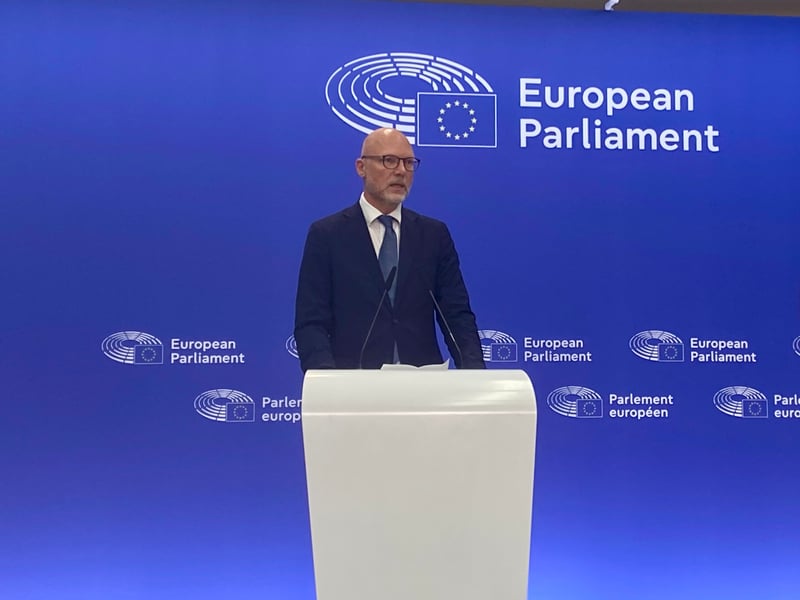
“Today’s vote shows that Europe can be both sustainable and competitive,” said Jörgen Warborn, the Swedish center-right lawmaker who steered the legislation.
Warborn framed the vote as a response to Europe’s economic struggles. “Europe has a huge growth problem,” he told reporters. “We are falling behind more or less all of the different big economies around the world.”
He claimed the package would cut costs for businesses by roughly 5 billion euros annually for businesses.
The corporate split reflects different business models and supply chain risks. Food companies like Nestlé and Ferrero source commodities from regions with significant human rights and environmental concerns. For them, due diligence offers reputational protection.
These companies warned in their January letter that policy uncertainty would undermine investments they had already made in compliance systems. The letter stated that “investment and competitiveness are founded on policy certainty and legal predictability.”
Energy and industrial giants took the opposite view. TotalEnergies CEO Patrick Pouyanné and Siemens CEO Roland Busch wrote to French President Emmanuel Macron and German Chancellor Friedrich Merz in October arguing that abolishing the rules would send “a clear and symbolic signal” about restoring competitiveness.
Their letter, dated Oct. 6, outlined a broader deregulatory agenda including a moratorium on digital rules and a freeze on new EU directives.
Several companies later distanced themselves from the letter. Deutsche Bank, German state bank KfW, Allianz and French asset manager Amundi confirmed to German media that they continue to support the due diligence directive.
“After weeks of obstruction and blackmail, the conservative EPP has broken off negotiations with the three centrist groups and decided to crack the ‘cordon sanitaire,’” Green co-president Terry Reintke said after the vote. “They chose to join forces with Orbán and Le Pen to kill environmental and human rights laws that make big companies responsible for their production process.”
She accused the center-right of dismantling legislation that “not only protected the environment or prevent child labour in the value chain, but also preserved our businesses and our workers.”
The real winners are “big corporations that we won’t ever be able to stop from relocating to increase their profits,” said her co-president, Bas Eickhout.
Far-right lawmakers celebrated the outcome. The Patriots for Europe group, which includes Marine Le Pen’s National Rally and Hungarian Prime Minister Viktor Orbán’s Fidesz party, said the “cordon sanitaire” — a firewall against far-right parties — had been broken for the first time.
It marks the first legislative file passed by what critics call the “Venezuela majority.”
The vote comes as European leaders respond to competitive pressures from Washington. President Donald Trump has promised sweeping deregulation and an “America First” industrial policy.
American companies lobbied intensively against the EU rules. A report published in October by SOMO, a Dutch research organization, found that ExxonMobil held at least 25 meetings with EU institutions on the omnibus between January 2024 and July 2025.
The Trump administration raised the due diligence directive in U.S.-EU trade negotiations earlier this year, with the July 2025 trade agreement between Washington and Brussels including commitments to modify aspects of the EU law.
The vote came after Parliament rejected an earlier version in October, prompting protests from several heads of state. Merz publicly urged lawmakers to “correct” that vote.
The simplification effort is part of the commission’s Omnibus I package, which European Commission President Ursula von der Leyen unveiled in February. The package aims to roll back portions of the sustainability directives that business groups have criticized as burdensome.
The EU executive has indicated this is the first of several simplification packages targeting environmental legislation. In October, Brussels dramatically scaled back its deforestation law, exempting close to 100% of EU producers while maintaining requirements for large U.S. exporters.
As booing erupted from the left side of the chamber, Parliament President Roberta Metsola joked that “the machines are tired” after voting equipment malfunctured during the lengthy session.
Courthouse News correspondent Yuval Molina is based in Brussels, Belgium.
Subscribe to our free newsletters
Our weekly newsletter Closing Arguments offers the latest about ongoing trials, major litigation and rulings in courthouses around the U.S. and the world, while the monthly Under the Lights dishes the legal dirt from Hollywood, sports, Big Tech and the arts.